

Is my diamond real?
The most reliable way to check at home is a dual thermal-and-electrical tester pen, which costs $60 to $150 in Australia and gives you a clear "diamond", "moissanite", or "other" reading in a few seconds. The classic fog, water, and newspaper tests work as a rough first pass but each one has gaps. None of the home methods can tell a lab-grown diamond from a natural one, because they're the same material with the same physical properties.
If you're trying to work out what's in a piece of inherited or vintage jewellery, this guide covers what each test can and can't tell you, and when to take it to a jeweller instead.
How to tell if a diamond is real at home
There are four stones you might be looking at, and the home tests separate them differently:
- Natural diamond and lab-grown diamond are chemically and physically identical (both are pure carbon in a cubic crystal structure). No home test distinguishes them.
- Moissanite is silicon carbide, a different mineral that behaves close enough to diamond on heat and hardness to fool basic tests but is detectable on electrical conductivity and through a loupe.
- Cubic zirconia (CZ), glass, and other simulants are softer, less dense, and behave very differently from diamond on most tests.
The fastest home check is a diamond tester pen. The other tests are useful when you don't have one, or as confirmation when you do.
The fog test for diamonds
Reliable for ruling out glass and cubic zirconia, useless for separating diamond from moissanite. Breathe on the stone like you'd fog a mirror and time how long the condensation takes to clear:
- Clears in 1 to 2 seconds: likely diamond or moissanite. Both conduct heat well enough to disperse the moisture almost immediately.
- Stays fogged for 3 seconds or longer: likely glass, cubic zirconia, or another simulant. These hold heat poorly and the condensation sits there.
The catch is that moissanite passes this test just as well as diamond, so a fast clear tells you "real-ish" rather than "definitely diamond". Worth doing as a thirty-second sanity check before anything else.
The water test
Unreliable, skip it. The water test (drop the stone into a glass of water and watch whether it sinks) gets shared widely as proof of authenticity, but diamond, moissanite, cubic zirconia, glass, and most other clear stones all sink. Density alone won't tell them apart at this scale, and a stone "floating" usually means there's an air bubble caught on it.
It looks scientific and tells you almost nothing.
The newspaper or dot test
Only works for loose stones, and only as a rough filter. Place the stone table-down (flat top facing down) on a printed page or a piece of paper with a clear dot drawn on it, then look through the pointed end:
- You can read the print or see the dot clearly: likely not a diamond. Real diamonds bend light so sharply that text and dots become blurred or invisible through the stone.
- The print is blurry or invisible: likely diamond or moissanite. Both have high refractive indices that scramble the image.
This won't work for a stone in a setting (the prongs block the bottom point), and moissanite passes it just like diamond, so a "blurry" result narrows things to "diamond or moissanite" without confirming which.
The diamond tester pen
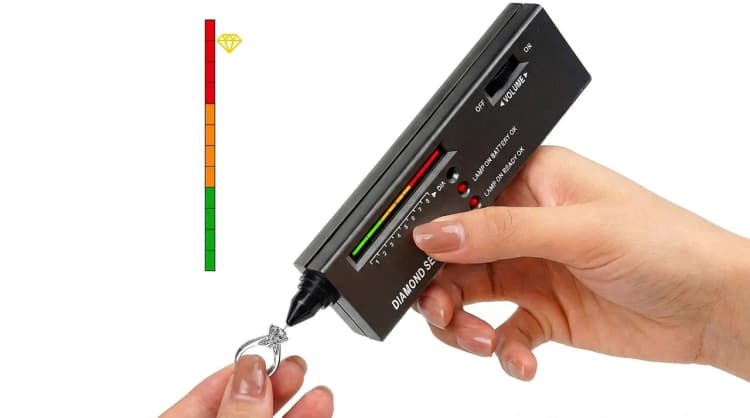
The closest thing to a definitive home test, especially if you buy a dual-mode one. A standard single-mode tester reads thermal conductivity only and will give a false positive on moissanite, which conducts heat almost as well as diamond. A dual thermal-and-electrical tester adds an electrical reading that flags moissanite separately.
How it reads on each stone type:
- Natural diamond and lab-grown diamond: "diamond"
- Moissanite: "moissanite" on a dual tester, "diamond" on a single-mode tester (which is the main reason people get caught out)
- Cubic zirconia, glass, white sapphire, white topaz: no reading or "not diamond"
A few practical notes:
- Hold the probe perpendicular to the stone and press lightly. Loose contact gives unreliable readings.
- The stone needs to be at room temperature. A stone that's been in a cold pocket or under a hot lamp can read wrong.
- A small stone (under 0.25 carat) can be hard to read because the probe tip is bigger than the facet.
- A reading taken on the metal setting instead of the stone will always come back negative.
Dual testers from brands like Presidium, GemOro, and HDE sit at the $60 to $150 mark in Australia and are sold through Amazon, eBay, and jewellery-supply retailers.
The loupe test
A 10× jeweller's loupe shows structural details the human eye misses, and it's useful if you know what to look for. A usable one costs $15 to $40.
What to look for through the loupe:
- Razor-sharp facet edges and crisp facet junctions: diamond. Diamonds are cut with extreme precision and the edges look knife-sharp at magnification.
- Doubled facet lines on the lower part of the stone: moissanite. Moissanite is doubly refractive, so looking through the crown at the pavilion facets you'll see each line appearing as two parallel lines, slightly offset.
- Slightly rounded or worn facet edges: cubic zirconia or glass. These are softer and don't hold a sharp edge through wear.
- Small natural inclusions, mineral specks, feather-like internal marks: strong indicator of a natural diamond. Lab-grown diamonds tend to have fewer or different-looking inclusions, and CZ usually has none at all.
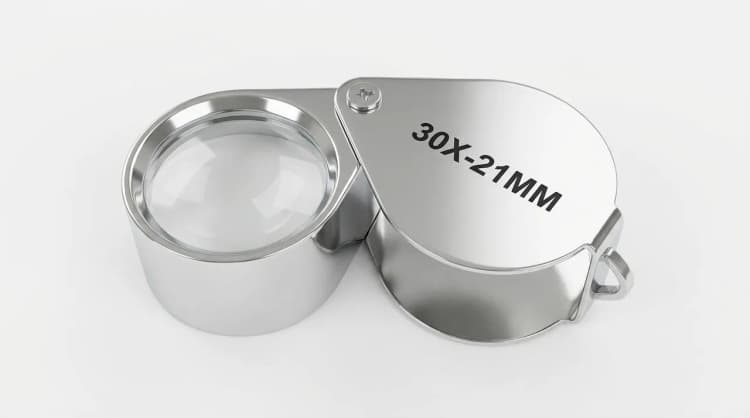
The loupe test takes practice. If you've never used one, start by looking at a stone you know is diamond (a confirmed engagement ring, for example) so you have a reference for what crisp facet edges look like.
The UV light test
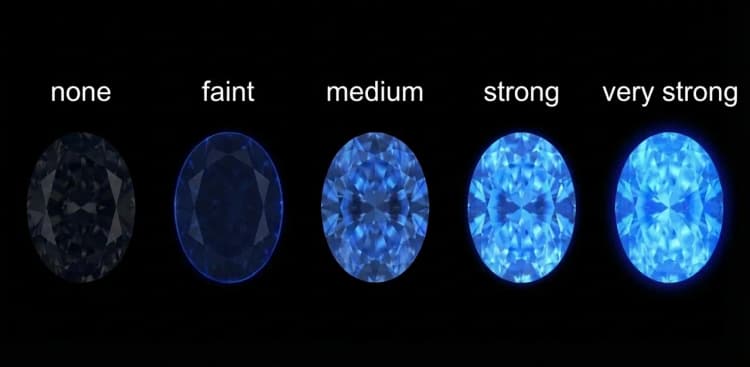
A supporting clue alongside the other tests. Shine a UV torch (the kind that costs $10 at a hardware store) onto the stone in a darkened room:
- Blue glow: suggests natural diamond. About one in three natural diamonds fluoresce blue under UV.
- Orange, yellow, or green glow: suggests lab-grown diamond or moissanite. Lab-grown stones often fluoresce orange or red, moissanite often green or yellow.
- No glow: suggests cubic zirconia, glass, or one of the two-thirds of natural diamonds that don't fluoresce at all.
A UV reading on its own can't confirm a stone type. It's useful as a tiebreaker once you've combined it with the other tests.
Are scratch and heat tests safe for diamonds?
No, skip them. Three popular tests that get shared online shouldn't be used:
- Scratch tests (scratching the stone against glass or sandpaper). Diamond, moissanite, and sapphire are all hard enough to scratch glass, so the test doesn't separate them. It can also damage the stone or the setting.
- Heat tests (heating the stone and dropping it into cold water). Sudden temperature change can fracture diamonds with inclusions, and the test doesn't reliably distinguish stone types anyway.
- Hardness tests with a file or knife. Most gemstones are harder than household metal so they all "pass", and the test risks marking the stone instead.
These have low information value and a real risk of damaging the piece you're trying to identify.
Can you tell if a diamond is lab-grown at home?
No. Lab-grown diamonds are chemically and physically identical to natural diamonds (same hardness, same refractive index, same density, same thermal and electrical conductivity), so every home test gives the same reading for both. Separating natural from lab-grown requires spectroscopy equipment that costs tens of thousands of dollars and looks for trace nitrogen patterns and growth striations.
If you need to know whether a stone is natural or lab-grown for insurance, resale, or peace of mind, the only reliable path is sending it to a gemmological lab (GIA, IGI, or HRD all run this service in Australia through partner labs) for a graded report.
What about the setting and hallmarks?
A real diamond is almost always paired with a precious metal setting, so the hallmark inside the band is supporting evidence. Common hallmarks you'll see in Australia:
- 375, 9k: 9-carat gold
- 585, 14k: 14-carat gold
- 750, 18k: 18-carat gold
- 916, 22k: 22-carat gold
- PT, PLAT, 950: platinum
- 925, STG: sterling silver
A diamond in a sterling silver or unmarked base metal setting is suspicious but not impossible, since some antique and handmade pieces are unhallmarked. A clear stone in a setting with no hallmark at all is more likely to be CZ or glass than a real diamond. Counterfeit hallmarks exist too, so a hallmark alone isn't proof either; our home gold testing guide covers the metal side in more detail.
When to take it to a jeweller
If the stakes are higher than satisfying your own curiosity, get it checked professionally. Reasons to do so:
- Inherited or vintage jewellery where you want to know what's in it before insuring it.
- A piece you're thinking of selling or having appraised. Buyers and insurance companies need a written report from a gemmologist.
- A stone that gave mixed results on the home tests (the fog test says diamond but the tester pen says moissanite, for example).
- Any time you suspect a setting has been swapped, for example taken in to be cleaned and returned with a different stone.
Most Australian jewellers will test a stone for you in a few minutes at no charge. We do this at our Melbourne workshop and can also send a stone to a lab for full grading if needed. Contact us if you'd like a piece checked. And if the answer sends you looking for a new stone, our engagement rings are set with certified lab-grown diamonds and moissanite.
For broader context on the differences between the three diamond-like stones, the difference between a natural, lab and moissanite walks through it.
Thanks for reading,
Jared & Brie
Designed by us in Melbourne, made to order
Lily Dia is a small studio, so every ring is drawn, set and finished for the person wearing it. If this article helped, the collection shows how these choices look on real rings, and you can ask us anything before you decide.
View lab-grown diamond ringsOr ask us a question first