

Why doesn't my wedding band sit flush with my engagement ring?
Because the engagement ring's setting sticks out further than the band can sit under. A halo, a low basket that drops below the band line, or side stones that flare out from the centre stone all push a straight wedding band away from the engagement ring and leave a visible gap. This is the setting shape doing its job, not a manufacturing fault.
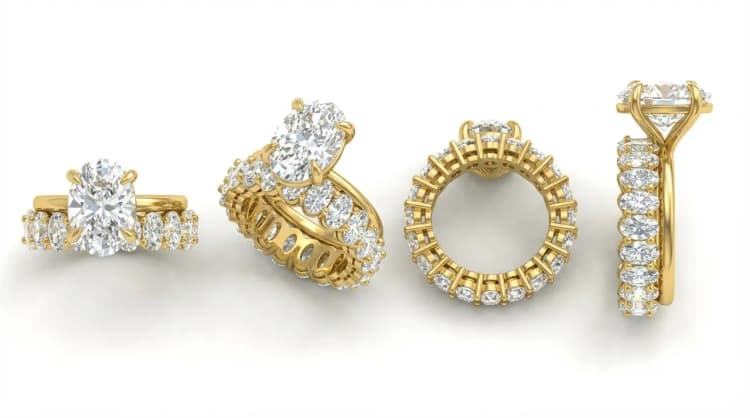
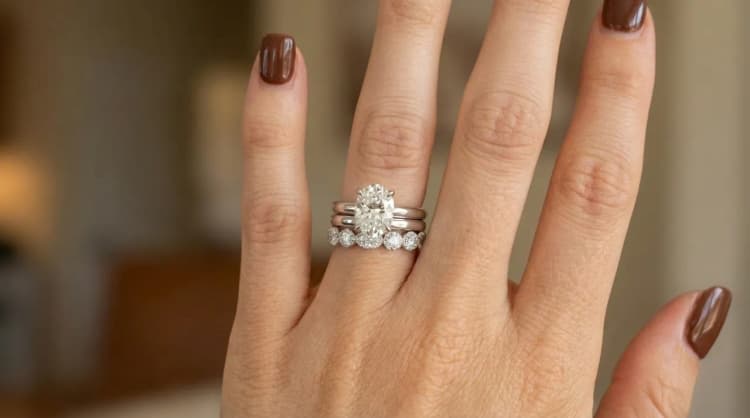
There are three real fixes: a contour (curved) wedding band that's cut to nestle around the engagement ring, soldering the two rings together so they can't shift, or modifying the engagement ring itself (raising the setting or adding a spacer). The right one depends on your ring, your budget, and whether you ever want to wear the band on its own.
What "sitting flush" actually means
A wedding band sits flush when its inside edge touches the engagement ring along the band line with no visible gap. No rocking, no light showing between them, and no pinching when your hand moves. Two straight bands of the same width sit flush by default. A straight band against a halo, basket, or low-set engagement ring almost never does.
Reasons a wedding band won't sit flush
The usual suspects, roughly in order of how often we see them:
Low-set or basket settings. The centre stone sits in a basket that drops below the band line, so the wedding band can't slide up against the engagement ring without hitting the basket. Common on solitaires, especially older or vintage-style settings.
Halos and side stones. Halo settings and three-stone rings have stones that flare out beyond the band width. A straight band hits those first and stops short.
Band-width mismatch. If the wedding band is taller (chunkier in profile) than the engagement ring's setting, the band physically can't sit underneath, and you'll see a gap no matter what shape you pick.
Deeper stone shapes. Round, princess, and square cushion cuts sit deeper in the setting than the same carat weight in oval, marquise, or emerald. Deeper stones mean the basket drops lower, which means a bigger clearance issue for the band.
East-west or compass-set stones. Stones set sideways across the band push the wedding band out at the long axis of the stone. A straight band can't follow that.
How Can I Prevent a Gap Between My Engagement Ring and Wedding Band?
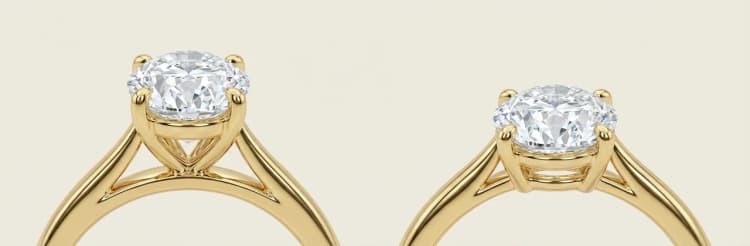
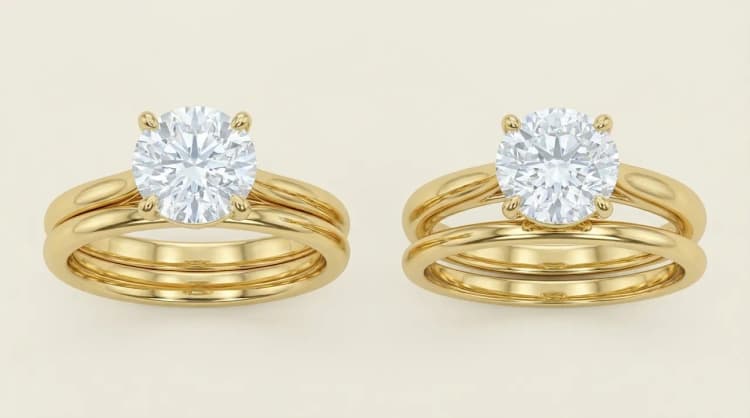
Choose a setting that leaves clearance beside the band, or pair an existing low or wide setting with a curved band made around its outline. Take the engagement ring to the jeweller and try bands against it. Photos alone will not tell you what you need to know because the gap is a three-dimensional problem and it changes when the ring is on a finger versus on a tray. Three things to look at while it is on:
- Profile match. The wedding band shouldn't be noticeably taller in profile than the engagement ring's setting. If it is, the gap is locked in.
- Curve match. If the engagement ring has a halo, a low basket, or side stones, ask to see contour or shadow bands cut to mirror that shape.
- Width balance. A wider band reads heavier; a thinner band reads more delicate. Try both. Most rings look balanced when the wedding band is 60 to 100% the width of the engagement ring's band, but it's a personal call.
If you're buying the wedding band from a different jeweller than the engagement ring, bring the engagement ring with you. They can't design around it from a photo.
Curved and contour wedding bands
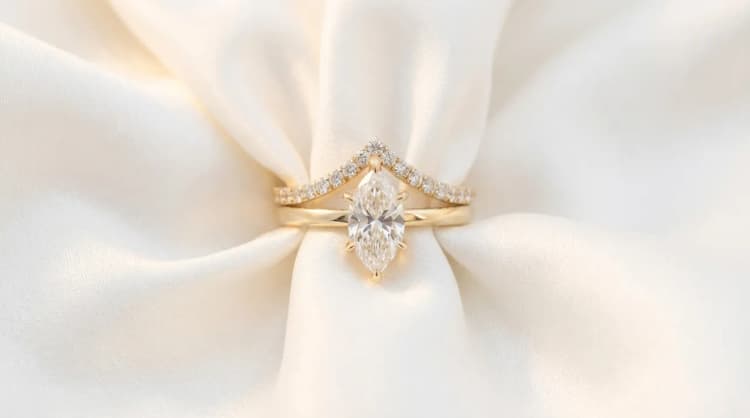
A contour, shadow or tracer band is cut with a curve, notch or step that follows the engagement ring. It is often the cleanest way to close a gap, but the curve can make the band look less conventional when worn alone. The curved wedding band guide covers the different shapes, fit checks and ordering choices in full.
Wedding bands that won't spin under a solitaire
If your wedding band keeps spinning or sliding around under the engagement ring, the issue is either the gap (no contact = nothing holding it in place) or a slight size mismatch. Two ways to fix it without soldering:
- A contour band that nests against the basket. Even a shallow notch gives the engagement ring something to seat into and stops the rotation.
- A spacer ring. A thin plain band sits between the two and fills the gap. It also lets you keep both rings as separate pieces.
If neither of those works and the spinning is driving you mad, soldering them together is the permanent fix (more on that below).
Should I just embrace the gap?
For some rings, yes. A small symmetrical gap against a low-set solitaire is something a lot of people actively prefer because it lets each ring read as its own piece, and it lets you wear the wedding band on its own without it looking weird.
A gap that's worth keeping:
- Small (under a couple of millimetres), even on both sides
- Doesn't catch on clothing, hair, or gloves
- Doesn't cause the rings to spin constantly
- Doesn't pinch when you make a fist
A gap that should get fixed:
- Wide enough to catch fabric or hair
- Uneven, so one side touches and the other doesn't
- Lets the rings rotate around each other every time you move
- Lets the metal edges grind together and wear
If the gap is annoying you in the first week, it'll annoy you for fifty years. Fix it now.
Soldering, spacers, and raising the setting
Three modifications worth knowing about:
Ring soldering joins the wedding band to the engagement ring permanently using a small amount of filler metal at the contact points. Done well, the join is invisible. The result is one solid stack that doesn't spin, doesn't gap, and doesn't wear the rings against each other. The downsides are that you can't wear the bands separately afterwards, and any future resize has to be done as a pair.
Adding a spacer ring keeps the rings as separate pieces but closes the gap. A spacer is a thin plain band (usually 1 to 1.5mm wide) that sits between the engagement ring and wedding band. Reversible, cheaper than custom work, and useful if you're not sure you want to commit to a permanent join.
Raising the engagement ring setting lifts the centre stone higher off the band so a standard straight wedding band can slide flush against the engagement ring underneath the basket. Not always possible (some settings can't be raised without rebuilding) but it's the fix that lets you keep using off-the-shelf straight bands. For related resizing constraints, see our engagement ring resizing guide.
How much do these modifications cost in Australia?
Rough Australian pricing in 2026:
- Ring soldering: $120 to $300 depending on metal and design complexity
- Spacer ring (plain solid gold): $200 to $500
- Raising an engagement ring setting: $300 to $700
- Custom contour wedding band: $1200 to $2800
- Off-the-shelf contour band: from around $700
- Simple band resize: $75 to $150
- Setting modification with prong adjustments: $200 to $500
Most jewellers turn modifications around in 5 to 10 business days. Anything involving stone resetting (raising the setting, adding stones to a spacer) takes longer, usually two to three weeks.
When to get a jeweller to look at it
Don't wait for any of these:
- The two rings are rubbing hard enough to leave visible scratches on each other
- The wedding band is pinching skin between the rings when you make a fist
- A prong on the engagement ring is moving or looking worn down from contact with the band
- A stone in either ring is shifting in its setting
- The engagement ring's basket or shoulders look bent from the wedding band pressing against them
Small problems become expensive problems when you wear through prongs or wear off the underside of a setting. A free inspection at the jeweller catches all of these in five minutes.
Common questions
Can a wedding band be made flush with any engagement ring?
Almost always, yes, but it might need to be custom. Off-the-shelf bands work flush with simpler engagement ring designs. Halos, three-stone rings, and low baskets usually need a contour band cut to the shape.
Will soldering my rings together affect resale?
The rings can be separated again, but the join leaves a small mark that needs polishing out. Resale is unlikely to be the dominant factor anyway, since most engagement rings hold limited resale value.
Should the wedding band go above or below the engagement ring on my finger?
Tradition has the wedding band closer to the heart (below the engagement ring, i.e. nearer the base of the finger). In practice most people wear them whichever way they sit best, and that's fine. If you are weighing up one ring versus two, see our can I use my engagement ring as my wedding ring guide.
Is a flush fit worth paying for if my engagement ring is a simple solitaire?
For a low-set solitaire, often not. A spacer or a small adjustment to the engagement ring usually solves the visible gap for under $500 and you keep the option to wear the band on its own. Custom contour bands make more sense for halos and three-stone rings.
If you're starting from scratch and want a set that sits flush by design, our engagement ring collection shows how each setting profile pairs with a band, in lab-grown diamond or moissanite, and we make matched wedding bands to fit any of them.
Thanks for reading,
Jared & Brie
Designed by us in Melbourne, made to order
Lily Dia is a small studio, so every ring is drawn, set and finished for the person wearing it. If this article helped, the collection shows how these choices look on real rings, and you can ask us anything before you decide.
View lab-grown diamond ringsOr ask us a question first