
What does diamond carat weight actually measure?
Carat is a unit of weight, not size. One carat equals exactly 200 milligrams (0.2 grams, or one-fifth of a gram). The word comes from carob seeds, which ancient gem traders used as counterweights because they were unusually uniform in weight (around 200mg each, which is where the modern carat measurement is anchored).
The metric carat was standardised internationally in 1907 and is the same everywhere in the world today. Every diamond is weighed on precision scales accurate to one ten-thousandth of a carat. Carat weight is the easiest of the 4Cs to measure objectively (the others are cut, colour, and clarity), which is why it usually gets the most attention when people start shopping.
Each carat divides into 100 points. A 0.75-carat diamond is sometimes called a "seventy-five pointer". Diamonds over a carat are usually described in carats and decimals: 1.50 carats, 2.08 carats.
How much does 1 carat weigh in grams?
0.2 grams. That is by definition, since one carat is exactly 200 milligrams. For context, a paperclip weighs about 1 gram (so 5 carats), an Australian 5 cent coin weighs about 2.8 grams (14 carats), and a sheet of A4 paper weighs about 5 grams (25 carats).
A 1 carat diamond is genuinely tiny in absolute weight, which is why diamonds use the carat unit instead of grams in the first place. Working in 0.005 gram increments (the level of precision used in diamond grading) is far easier as 0.025 carats than as five-thousandths of a gram.
Does carat weight tell you how big the diamond looks?
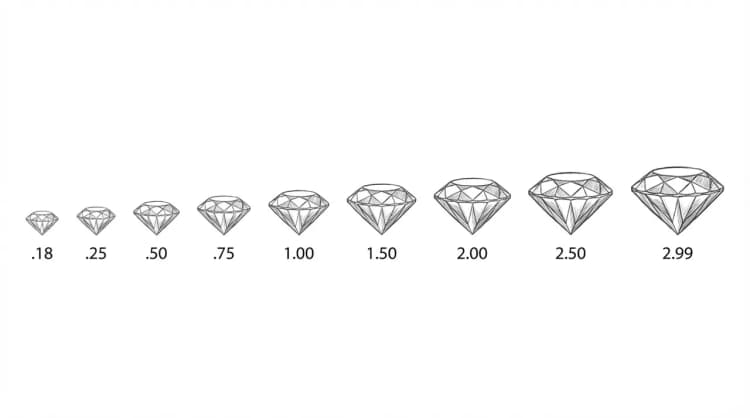
Not directly. Carat is weight, and the visible size of a diamond depends on two other things: the density of the gemstone and how it has been cut. Two diamonds of the same carat weight can look quite different in size from above.
A few examples to make this concrete:
- A well-cut 1 carat round measures about 6.5mm across. A 1 carat oval (cut at a 1.4 ratio) stretches to about 8.0mm long.
- A poorly cut 1.2 carat round with extra weight hidden in the pavilion can look visually identical to a well-cut 1.0 carat round from above. You paid for the weight; you did not get the size.
- A 1 carat ruby looks smaller than a 1 carat diamond because ruby is denser, so the same weight occupies less space.
This is why the millimetre measurements of a stone matter more than the carat number when you are picking a diamond for the visual look. Always ask for the mm dimensions, not just the carat weight.
How big is a 1 carat diamond in mm?
Roughly, for a well-cut stone at each shape:
- Round brilliant: 6.4 to 6.5mm across
- Oval (1.40 ratio): 8.0 to 8.5mm long x 5.7 to 6.0mm wide
- Cushion (1.00 ratio): 5.5 to 6.0mm x 5.5 to 6.0mm
- Princess: 5.5mm x 5.5mm
- Emerald cut (1.40 ratio): 7.0mm long x 5.0mm wide
- Asscher (1.00 ratio): 5.5mm x 5.5mm
- Pear (1.50 ratio): 8.5mm long x 5.5mm wide
- Marquise (2.00 ratio): 10.0mm long x 5.0mm wide
The elongated shapes (oval, pear, marquise, emerald) all look larger than a round of the same carat weight, because they spread the same weight across more visible surface area. For a more detailed breakdown at the 2 carat mark, see our is a 2 carat diamond considered big guide.
How does carat weight affect diamond price?
Exponentially, not linearly. The price-per-carat curve scales up sharply as the stone gets larger because larger rough diamonds are rarer than small ones. Some rough numbers for lab-grown round brilliants at G colour, VS2 clarity, excellent cut, in AUD as of 2026:
- 0.5 carat: $400 to $600 loose
- 1.0 carat: $800 to $1,500 loose
- 1.5 carat: $1,800 to $2,800 loose
- 2.0 carat: $3,000 to $4,500 loose
- 2.5 carat: $4,500 to $6,500 loose
- 3.0 carat: $6,500 to $9,500 loose
A 2 carat stone costs roughly four to five times what a 1 carat stone costs at the same quality, not twice. For mined diamonds, the curve is even steeper, with a 2 carat mined diamond costing roughly six to eight times a 1 carat mined diamond.
What are "magic sizes" in diamond carat weight?
Magic sizes are the round-number carat weights where prices jump dramatically because buyer demand concentrates there: 0.50, 0.75, 1.00, 1.50, and 2.00 carats. A stone that crosses one of these thresholds costs noticeably more than the stone just below it, even when the visual difference is invisible.
The classic example: a 0.97 carat diamond and a 1.03 carat diamond. The mm difference between them is less than 0.1mm (genuinely undetectable to the naked eye), but the 1.03 crosses the 1.00 carat threshold and the price jumps 15 to 25% over the 0.97 stone of identical other-grade.
Shopping a quarter under the magic size is one of the easiest ways to save money on a diamond without losing visible quality. Specifically:
- Look at 0.90 to 0.95 carat instead of 1.00 carat: save 10 to 20%
- Look at 1.40 to 1.45 carat instead of 1.50 carat: save 8 to 15%
- Look at 1.90 to 1.95 carat instead of 2.00 carat: save 5 to 10%
The face-up size barely changes. The price drops measurably. Most reputable jewellers will help you search for these "under-magic-size" stones if you ask.
What is CTW (carat total weight) and why does it matter?
CTW (or TW, or CTTW) is the combined weight of every diamond in a piece, not the weight of the centre stone alone. A ring described as "1.50 CTW" might have a 1.00 carat centre stone plus 0.50 carats spread across small accent stones on the band or in a halo.
This abbreviation matters because CTW can be misleading when shopping. "2 carats total weight" sounds impressive, but if that is forty tiny stones at 0.05 carats each, the visual impact is completely different from a single 2 carat stone. The centre stone is what reads as "the diamond" on the ring; accents add sparkle around it.
Always ask for the centre stone weight specifically when you are evaluating a multi-stone ring. The reputable way to describe a ring is with both numbers: "1.00 carat centre stone, 1.50 CTW total".
Is carat the most important of the 4Cs?
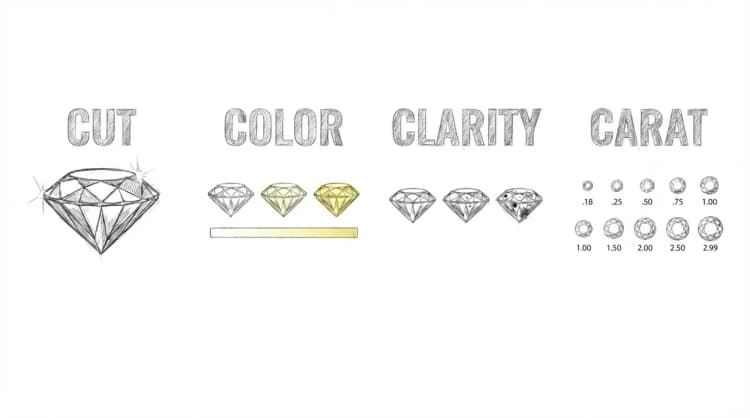
No. Cut is more important than carat for how a diamond actually looks. A poorly cut 2 carat diamond can look duller than a beautifully cut 1 carat stone because cut controls how light enters, bounces around, and returns from the stone as sparkle. Carat just controls how much stone there is.
A practical priority order for shopping within a fixed budget:
- Cut grade: excellent or ideal, never compromise here
- Colour: G or better for white-metal settings, H or I for warm metals
- Clarity: VS2 for most stones, VS1 for step cuts or stones above 2 carats
- Carat: as much as your budget allows after the first three are nailed
The classic mistake is buying too much carat and not enough cut, ending up with a large stone that looks flat. The fix is to pick a slightly smaller stone (especially just under a magic size) with an excellent cut.
What is the average engagement ring carat weight in Australia?
The Australian average sits around 1.0 to 1.2 carats. The most common centre stone size we see on Lily Dia engagement rings is between 1.0 and 1.5 carats, with a fast-growing share of buyers in the 1.5 to 2.0 carat range. The shift towards bigger stones over the last five years is driven almost entirely by lab-grown diamonds making the upgrade affordable.
A rough breakdown of where modern Australian engagement ring carat weights land:
- Under 0.5 carat: about 5 to 10%
- 0.5 to 1 carat: about 25%
- 1 to 1.5 carats: about 30%
- 1.5 to 2 carats: about 20%, fastest-growing band
- 2 to 3 carats: about 10 to 15%
- Over 3 carats: about 5%
Worldwide the averages are similar, with the global average just under 1 carat. The "right" size is the size that suits your hand, your taste, and your budget. Bigger is not better and smaller is not worse.
Carat vs karat, what is the difference?
Carat measures the weight of a diamond or gemstone. Karat or carat for gold measures the purity of the alloy. The spellings differ by one letter in American usage and the measurements are unrelated.
Pure gold is 24 karat (24K). 18K gold is 75% gold (18 parts out of 24). 14K gold is 58% gold. 9K gold is 37.5% gold. The remaining parts in each are harder alloy metals like copper, silver, palladium, or nickel that give gold structural strength for jewellery.
So a "1 carat, 18 karat" ring describes the weight of the diamond and the purity of the gold band: two separate numbers about two separate parts of the ring.
View our collection of lab-grown diamond engagement rings for stones in every practical carat weight.
Thanks for reading,
Jared and Brie
Designed by us in Melbourne, made to order
Lily Dia is a small studio, so every ring is drawn, set and finished for the person wearing it. If this article helped, the collection shows how these choices look on real rings, and you can ask us anything before you decide.
View lab-grown diamond ringsOr ask us a question first