
1. Ovals Are the Easiest Way to Make a Ring Look Bigger
Of all the diamond shapes, ovals give you the most visual size for your carat weight. The elongated shape spreads across more of your finger, which makes the stone appear larger than its carat weight suggests.
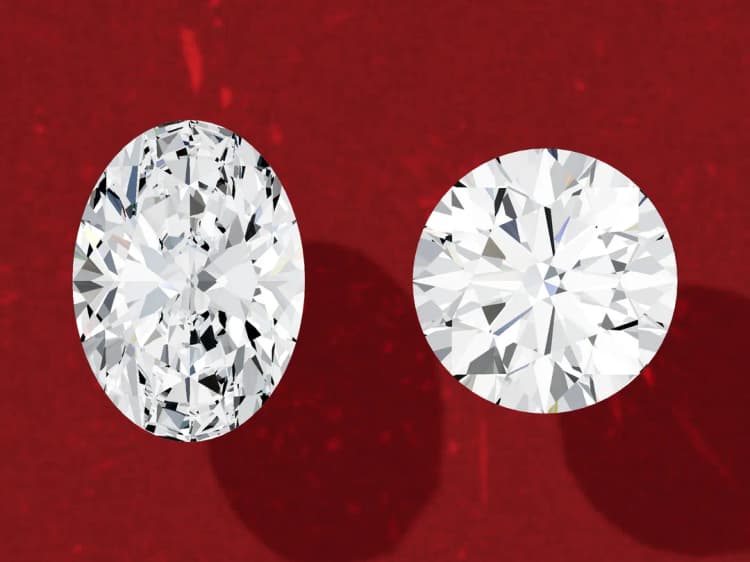
One of the standout benefits of an oval cut diamond is its flattering effect on the hand. It can make fingers appear longer and more slender, which is why ovals work so well for longer, slimmer fingers.
This means you can buy a smaller stone and still achieve the look of something much bigger. If you're working within a budget, an oval is one of the smartest choices you can make purely on visual impact per dollar spent, which is a big part of why our oval engagement rings are among the most popular designs we make.
2. A Certificate Won't Tell You If the Cut Is Good
This is the part most people learn about after they have bought the stone.
Unlike round diamonds, oval diamonds are not graded for cut quality on a GIA or IGI certificate. The report covers colour, clarity, carat weight, polish, and symmetry. It does not cover whether the stone actually returns light beautifully or whether the proportions produce a flat, watery look.
The reason this matters most is the bowtie effect. Almost every oval diamond has one: a dark shadow across the centre of the stone, roughly bowtie-shaped, caused by how light moves through the elongated pavilion. A faint bowtie is normal and adds contrast. A strong, hard-edged bowtie sits across the stone like a black band and will be visible every time you look at the ring.
The only way to assess a specific oval is on a 360-degree video or in person. A reputable jeweller will provide both. If a retailer will not show you video of the actual stone you are buying, do not buy from them. We covered the bowtie in depth in our bow tie effect in diamonds guide.
3. When Balancing the Budget, Sacrifice Clarity Before Colour
With ovals, the priority order matters.
Ovals hide inclusions well. The brilliant facet pattern scatters light across the stone, which means small flaws become very hard to see with the naked eye. Inclusions near the rounded ends are particularly easy to hide under the prongs of the setting. A VS2 or even SI1 oval can be reliably eye-clean and is the most common compromise for buyers stretching the budget.
Colour is the harder thing to compromise on. The rounded ends of an oval tend to hold body colour more visibly than a round stone would. If you are setting in white gold or platinum, the cool metal emphasises any warmth in the stone, so G or better is the sensible floor. In yellow gold or rose gold, you can comfortably drop to H or I.
The practical takeaway: if you need to compromise somewhere, go lower on clarity before you go lower on colour.
4. The Ratio Determines the Whole Look of the Stone
The length-to-width ratio is the number you divide the stone's length by its width. It tells you how elongated the oval is, and it has a bigger impact on the finished ring than most people expect.
A ratio between 1.30 and 1.40 offers a gently elongated look that flatters most fingers. Ratios between 1.41 and 1.50 produce longer, more dramatic ovals often chosen for their slimming effect on the finger.
As a rough guide: a 1.30 ratio is softer and wider, closer to a round in appearance. A 1.40 is the classic balanced oval that most people picture. A 1.50 is longer and more slender, with a noticeably dramatic look on the finger. There is no correct answer here. It comes down entirely to your personal preference and the shape of your hand.
The best approach is to look at several stones across the ratio range before deciding. What looks proportional on one hand can look very different on another.
Bonus: The Moval
If you want something more elongated than a standard oval, ask your jeweller about a moval. It sits between an oval and a marquise, with flatter, more pointed ends that create a dramatically elongated outline. Movals are uncommon and rarely advertised, but they are a beautiful option for someone who wants the long, modern look without committing to the sharp corners of a true marquise.
If you want to talk through ratios or look at specific stones, send us a message. We can send you video of real stones across the ratio range, or walk you through them on a video call.
View our full collection of lab-grown diamond engagement rings that are sure to get you excited!
Thanks for reading, Jared and Brie
Designed with you, made to order
Our jewellers in Melbourne and Auckland make every ring to order for the person wearing it. If this article helped, the collection shows how these choices look on real rings, and you can ask us anything before you decide.
Or ask us a question first