Diamond Certification Guide

By Jared James · Last updated 21 May 2026
Quick answer
A diamond grading report identifies the stone, confirms whether it is natural or lab-grown, and records the 4Cs along with the measurements, polish, symmetry and fluorescence. Use it to compare diamonds, then verify the report number and look at the actual stone, because the document can tell you a lot but never quite captures how beautiful a diamond is.
What is diamond certification?
Diamond certification is the shorthand buyers use for an independent grading report. A laboratory examines the diamond and writes down its measurable features, the weight, the dimensions, the colour, the clarity and the origin.
The report lets you compare stones without leaning on a seller's description alone, and it matters most for a centre stone, because small shifts in colour, clarity, carat weight and origin can move the price quite a bit.
A report still needs context, though. Read it alongside the 4Cs of diamonds, and then judge the diamond itself through images, video or an in-person viewing wherever you can.
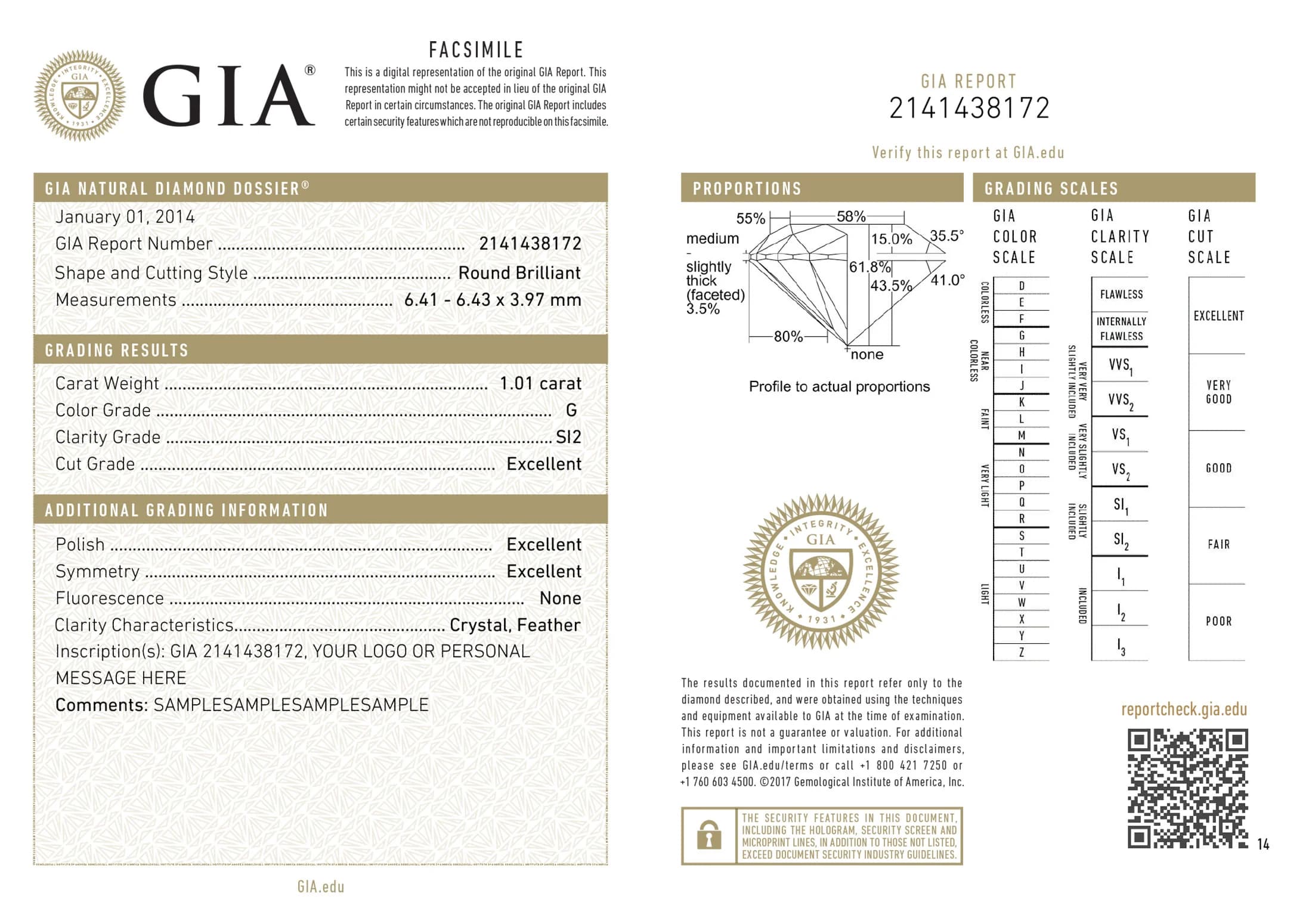
What is on a diamond grading report?
Report number
A unique identifier you can verify through the grading laboratory.
Shape and measurements
The outline, cutting style and millimetre dimensions, which help you understand face-up size.
Carat weight
The diamond weight, usually recorded to the hundredth of a carat.
Colour and clarity
The D to Z colour grade and clarity grade, assessed under grading conditions.
Cut, polish and symmetry
Cut grade appears on round brilliant reports. Polish and symmetry describe finish and alignment.
Fluorescence
The diamond's response to ultraviolet light, recorded as none, faint, medium, strong or very strong.
Origin
The report should identify whether the diamond is natural or laboratory-grown.
GIA vs IGI: which is better for diamonds?
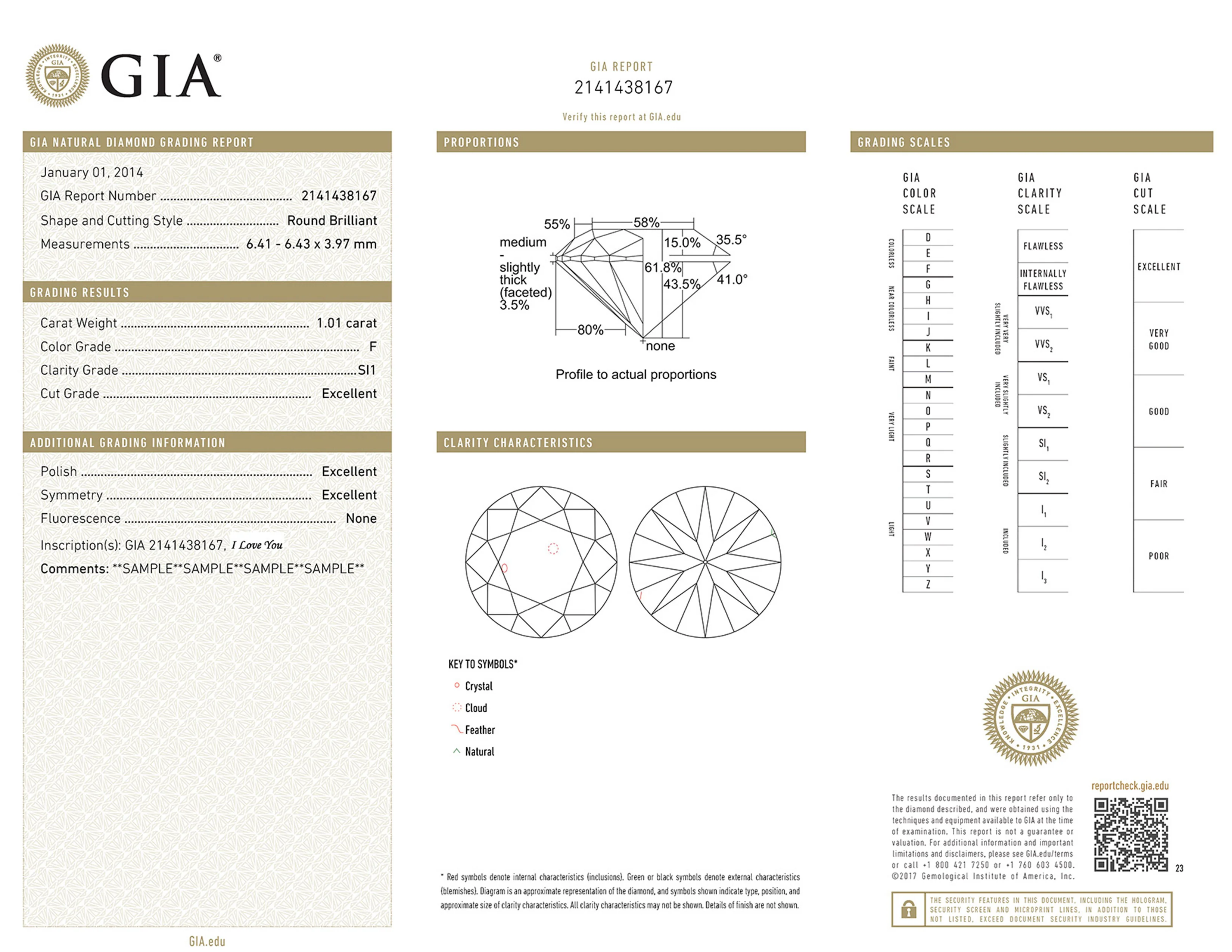
GIA and IGI are two of the most recognised diamond grading laboratories. Both grade natural and lab-grown diamonds, and a report from either should make the stone's origin clear. IGI sets out its report types in its own diamond reports overview.
One recent change is worth knowing. From October 2025, GIA stopped grading lab-grown diamonds on the 4Cs, and a GIA lab-grown report now gives a simpler Premium or Standard rating instead. GIA still grades natural diamonds on the full 4Cs, and IGI still grades lab-grown diamonds that way too, so for a 4Cs breakdown of a lab-grown stone you will usually be looking at an IGI report.
Try not to choose a stone on the laboratory name alone. Compare the actual grade, the proportions, the images and the price, and ask whether the report number has been verified.
| Factor | GIA | IGI |
|---|---|---|
| Best known for | A long-standing laboratory widely used for natural diamond grading. | A widely used laboratory, especially common in lab-grown diamond grading. |
| Reports cover | Shape, measurements, carat, colour, clarity, polish, symmetry, fluorescence and origin. | Shape, measurements, carat, colour, clarity, polish, symmetry, fluorescence and origin. |
| Lab-grown diamonds | Since October 2025, lab-grown reports drop the 4Cs for a Premium or Standard rating. | Lab-grown reports identify the origin and still grade the stone through the 4Cs. |
| How to use it | Verify the report number and compare the grade with images or video of the exact stone. | Verify the report number and compare the grade with images or video of the exact stone. |
How to verify a diamond certificate
- Find the report number on the document.
- Enter the number through the grading laboratory's report lookup tool, such as GIA Report Check or IGI Report Verification.
- Check that the shape, carat weight, measurements and grades match the stone.
- Confirm the inscription if the diamond has one, because many stones are laser inscribed on the girdle.
- Compare the report with photos, video or in-person inspection before choosing.
Lab-grown diamond certification
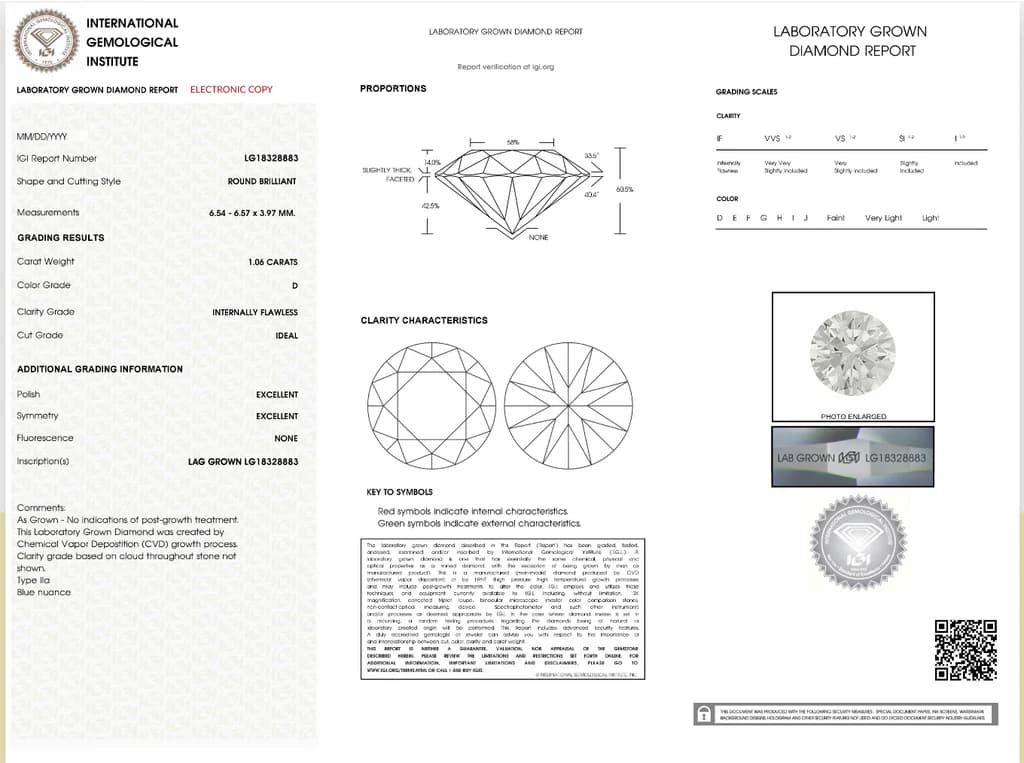
Lab-grown diamond reports come in two styles now. Laboratories such as IGI grade a lab-grown diamond on the same 4Cs as a natural diamond, and the report states that the stone is laboratory-grown. GIA took a different path in October 2025, and its lab-grown reports no longer use the 4Cs at all.
A GIA lab-grown report now describes the stone as Premium or Standard rather than listing individual colour, clarity and cut grades. GIA made the change because lab-grown production has become so consistent that nearly every stone landed in the same narrow band of colour and clarity, which left the fine 4Cs distinctions doing very little. Any GIA lab-grown report issued before the change is still valid, so you will see both styles in the market for a while yet.
Whichever style you are handed, the report still confirms the stone as lab-grown and gives you a basis for comparison. Our insights piece on how GIA changed lab-grown grading covers what it means for buyers in more detail.
If the origin question is still on your mind, read are lab-grown diamonds real?
Ready to compare
Compare certified lab-grown diamonds
Browse lab-grown diamond engagement rings and use the grading report beside shape, colour, clarity and setting style.
View lab-grown ringsFrequently asked questions
- What is a diamond certificate?
- A diamond certificate, more accurately called a grading report, is an independent laboratory document that records a diamond's measurements, 4Cs, origin and identifying details.
- What is a GIA certified diamond?
- A GIA certified diamond is one graded by the Gemological Institute of America and sold with its GIA report. GIA grades a diamond rather than certifying it, so the report records the 4Cs, measurements and origin, and the report number can be checked on GIA's website.
- Is GIA or IGI better for lab-grown diamonds?
- Both GIA and IGI grade lab-grown diamonds and identify their origin. IGI reports are especially common in the lab-grown market, while GIA is also widely recognised. The practical step is to verify the report and compare the actual stone.
- Can a diamond certificate be faked?
- A document can be copied or misrepresented, which is why you should verify the report number with the laboratory and check that the details match the exact stone being sold.
- Do all engagement ring diamonds need certification?
- For a centre stone, yes. Certification gives you independent information about quality and origin. Very small accent diamonds are often sold without individual reports.
- Does a certificate guarantee a beautiful diamond?
- No. A report gives technical information, but it does not replace looking at cut quality, light performance, shape balance and how the diamond appears in the setting.
Need help reading a report
Send us the certificate
If you are comparing two diamonds, send the grading reports and we can help you read the differences in plain language.
Contact the studio