
What is a comfort fit ring?
Last updated 17 October 2026
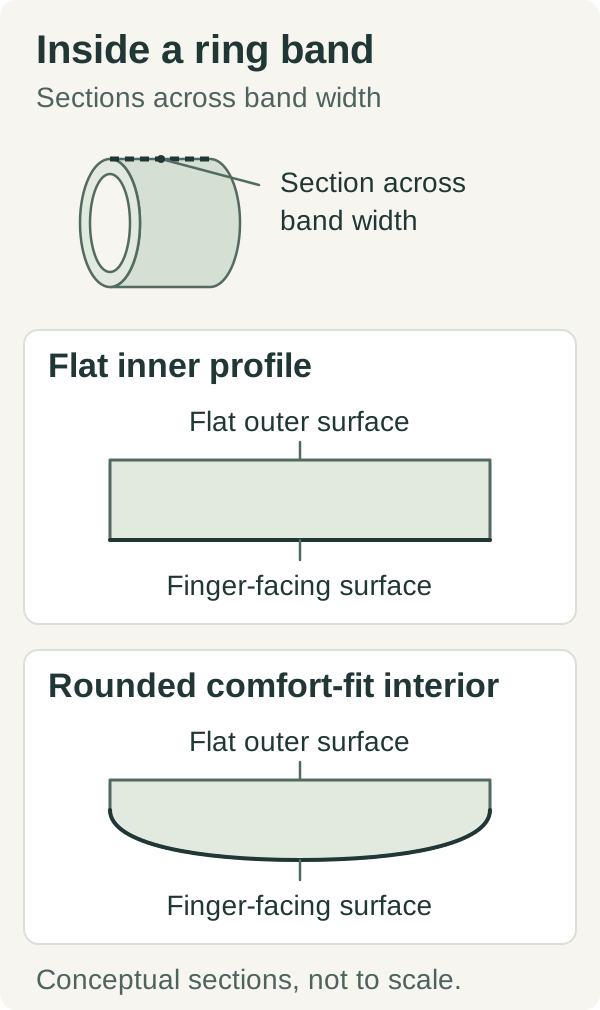
Comfort fit describes a ring band with a rounded inner profile. Viewed in cross-section across the band’s width, the surface facing the finger curves rather than remaining flat. The outer surface can be flat or domed independently, so a flat band can also be comfort fit. How the ring feels depends on its width, dimensions, sizing and the wearer as well as that inner shape.
The inside and outside describe different shapes
Comfort fit names the finger-facing profile. Flat and domed usually describe the outside of the band. A section drawing can show both surfaces at once. When comparing designs, keep the outer shape and width consistent so you can see which feature is changing.
Fit the width you plan to wear
A narrow sizing ring may not represent a much wider band or a stack. Tell the jeweller which width and inner profile you want, and bring the other rings you expect to wear beside it. A marked size is only part of the fitting decision.
Frequently asked questions
- Do comfort fit rings run larger?
- Not by a fixed amount. A rounded interior can feel different from a flat interior, but there is no universal half-size conversion. Ask to be measured with a sizer suited to the intended width and inner profile, and try the actual band where possible. Follow the maker’s sizing guidance rather than automatically ordering a different size.
- Is a comfort fit ring worth it for a wedding band?
- Try both inner profiles in a similar width. Some wearers prefer a rounded interior, while others are comfortable with a standard fit. The band should pass over the knuckle and sit comfortably where it will be worn. Check it together with any other rings you plan to wear on that finger.
- Can any ring style be made with a comfort fit?
- A comfort-fit interior can be used with several outer shapes, including a flat exterior. Whether it suits a particular design depends on the band’s dimensions, construction and any stone settings. Ask the jeweller to confirm the intended profile; converting an existing ring requires a separate assessment.