Engagement Ring Arrived Damaged or Wrong Size?

By Jared James · Last updated 25 May 2026
Quick answer
If your engagement ring turned up damaged, the wrong size, or with a loose stone, Australian Consumer Law puts you in a stronger position than most sellers will admit. Here's what to document, what to say, and what each fix usually costs.
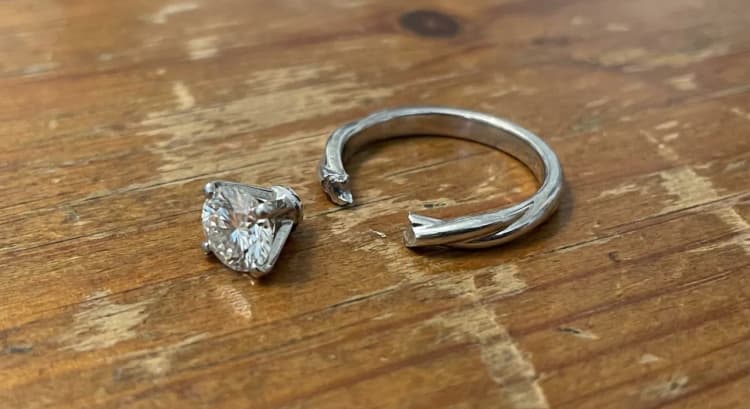
What to do if your engagement ring arrived damaged
If the ring is damaged or isn't what you ordered, you're covered. Under Australian Consumer Law, when a product has a major failure (a damaged engagement ring almost always counts) the seller has to refund, replace, or repair it, and you choose which one. "Store policy", "all sales final" and "exchanges only" don't override that.
Before you contact them, do two things. Photograph everything: the ring from multiple angles, the prongs and stone close up, the box, the packaging, the courier label, and a screenshot of the original order confirmation showing size, metal and stone spec. And take the ring off. Don't wear it again until it's sorted. A bent prong or a tilted stone gets worse every hour you wear it, and that weakens both the ring and your case.
Then email the seller (not phone, you want a written trail). Tell them what arrived versus what you ordered, attach the photos, and say which remedy you want. Quote ACL by name and give them a reasonable timeframe (a week is fair) to respond in writing. The next section covers wording.
What to do if your engagement ring is the wrong size
There are two situations and they're treated differently.
The seller sent the wrong size. You ordered a J, the box has a P stamped inside, and the ring slides off. That's the seller's mistake, the product doesn't match the order, and you're entitled to a refund or a free correction under ACL. Email them with the order details and a clear photo of the size stamp.
You picked the wrong size. You ordered a J, they sent a J, and a J doesn't fit. That's a resize, not a faulty product, and it's at your cost. Most Australian jewellers will resize a solitaire or basic band for $75 to $200, depending on metal and how many sizes you're going up or down. Rings with stones set all the way around the band (eternity, pavé halo, full-set diamond bands) are harder to resize and sometimes can't be done without rebuilding the ring. For more detail on what's possible, see our resize an engagement ring guide.
A grey area worth flagging: sizing tools vary. A plastic mandrel from one shop reads differently from the metal one at another, and wider bands fit tighter than narrow ones at the same nominal size. If you sized yourself with a paper strip at home and it's a size off, a lot of jewellers will absorb the first resize as a goodwill gesture, especially if you ask politely. Worth asking before you assume you're paying.
What if the ring you got back from a resize isn't yours?
This is the worst version of the problem, and it does happen. You send the ring in for resizing, it comes back, and something is off: a different stone, a different setting, or just enough difference to feel wrong.
Email the jeweller immediately with the original photos you took before sending it in. (If you didn't take any, that's the lesson for next time. Always photograph a ring before it leaves your hand for any kind of service.) Ask them to compare what they returned against your original and explain the difference in writing. If they push back, escalate to your state consumer affairs body (Consumer Affairs Victoria, NSW Fair Trading, etc.) and they'll usually get a response.
Mix-ups happen most often at jewellers who outsource resizing to a third-party workshop without tagging or photographing the ring on intake. If you're picking a jeweller for a resize, ask whether they photograph rings on intake. The good ones do.
What to do if the stone is loose or rattling
A stone should never move in its setting. If yours rattles, shifts when you press it, or tilts to one side, take the ring off and don't put it back on until it's been repaired.
What to look for:
- A faint clicking or rattling sound when you tap the ring gently against your fingernail
- Visible movement when you press the stone with a fingertip
- Prongs that look bent outward, flattened, or worn down to a stub
- The stone sitting noticeably crooked compared to the band
If you bought the ring recently and it arrived this way, that's a manufacturing fault and the seller is on the hook to fix or replace it under ACL. If it's developed over years of wear, that's normal prong wear and a re-tipping job at a jeweller usually runs $80 to $200 depending on how many prongs need attention. Most repairs are turned around in three to ten days in Australia.
Your rights under Australian Consumer Law
The short version: when something you bought has a major problem, you choose the remedy, not the seller. Refund, replacement, or repair. "Store policy" doesn't override this and a seller who says "we only do exchanges" is wrong.
A major problem with an engagement ring includes anything that means you wouldn't have bought it if you'd seen it first: a visibly damaged stone, bent prongs, an incorrect size or metal, a loose stone, a clearly defective setting. The product is also expected to match the description and any photos in the listing, so if the stone in the photos was eye-clean and the one that arrived has a visible inclusion, that's a description mismatch.
How to make the request stick:
- Send it in writing, not by phone. Email or the seller's messaging system.
- Quote ACL by name. Something like: "I'm requesting a refund under the consumer guarantees in the Australian Consumer Law. The ring arrived [describe issue], which is a major failure."
- Attach the photos and the order confirmation.
- Ask for a written response within a reasonable timeframe (a week is fair).
- If they refuse or stall, escalate to your state body (Consumer Affairs Victoria, NSW Fair Trading, Office of Fair Trading QLD, etc.) or the ACCC.
You don't need to be aggressive. The law is clear, the seller knows it, and a calm written request that names the act usually moves the conversation forward by itself.
How much does it cost to resize an engagement ring in Australia?
Rough Australian bands as of 2026:
- Plain gold or silver solitaire band: around $75 to $150 for one or two sizes up or down
- Solitaire with claw setting: around $100 to $200
- Stone-set band (pavé, channel, partial halo): around $150 to $400 depending on how many stones need to be reset
- Eternity or full-set band: often a full rebuild rather than a true resize, $400 and up
Most jewellers turn resizes around in 5 to 10 business days. Express service (2 to 3 days) usually adds $50 to $100. Wider bands and harder metals (palladium, platinum) cost a bit more than narrow yellow gold.
Some rings can't be resized at all without rebuilding them:
- Titanium and tungsten are too hard to cut and resolder cleanly
- Full eternity bands need to be remade rather than resized
- Tension-set rings rely on a specific band width and tension, and most jewellers won't touch them
If your ring falls into one of those categories, talk to the original maker before you take it anywhere else.
Should I insure an engagement ring?
If the ring is worth more than a few thousand dollars and you wear it every day, yes. Standard home and contents insurance covers some jewellery, but the per-item limit is usually around $1,500 to $2,500 and it often excludes loss away from home. Specialist engagement ring insurance covers loss, theft, and accidental damage worldwide.
What to look for in a policy:
- Agreed-value cover (the insurer pays the documented value rather than depreciating it)
- Worldwide cover, including loss and theft, not just damage
- Repair clause that lets you use your preferred jeweller rather than the insurer's panel
- A reasonable claim excess (often $200 to $500)
Australian providers worth comparing: Mastercare, Jewel Cover, Q Report. We're not affiliated with any of them. Get a written valuation from your jeweller first, since that's what the policy will be based on.
If you do need to claim, photos of the ring on your hand from before the loss or damage make the process much smoother. A few candid shots are usually enough.
Common questions
Can the seller refuse a refund because the ring was a special order?
No, not for a fault. Custom and made-to-order items still have to meet consumer guarantees. The seller can refuse a change-of-mind return on a custom piece, but a fault, a wrong size on their end, or a description mismatch are all covered by ACL.
The seller says I voided the warranty by trying it on. Is that legal?
No. Trying on a ring you bought to see if it fits or is what you ordered is not a way to void consumer guarantees. The guarantees can't be excluded by store policy.
What if the damage happened in the post?
The seller is responsible for getting the product to you in one piece. Australia Post or whichever courier is the seller's problem to chase, not yours. Tell them it arrived damaged and let them sort the courier claim out.
How long do I have to raise this?
There's no fixed deadline under ACL, but raise it within a few days of receiving the ring. Sooner is always better, because the seller can argue that any later damage happened after delivery.
If you're picking a new ring after a bad experience, our engagement ring collection is photographed in detail and ships with the exact specs you order. If something does go wrong, the same rules above apply, and we'd rather hear from you fast than hear nothing.
Thanks for reading,
Jared & Brie
Next step
Take the next step
Browse the engagement ring collection, or explore the custom design guide if you want something built around your preferences.
Browse engagement ringsNeed a second opinion
Talk to the studio
If you are weighing up a ring or comparing options, send the details through and we can help you think it through.
Contact the studio