

What is the best ring shape for long skinny fingers?
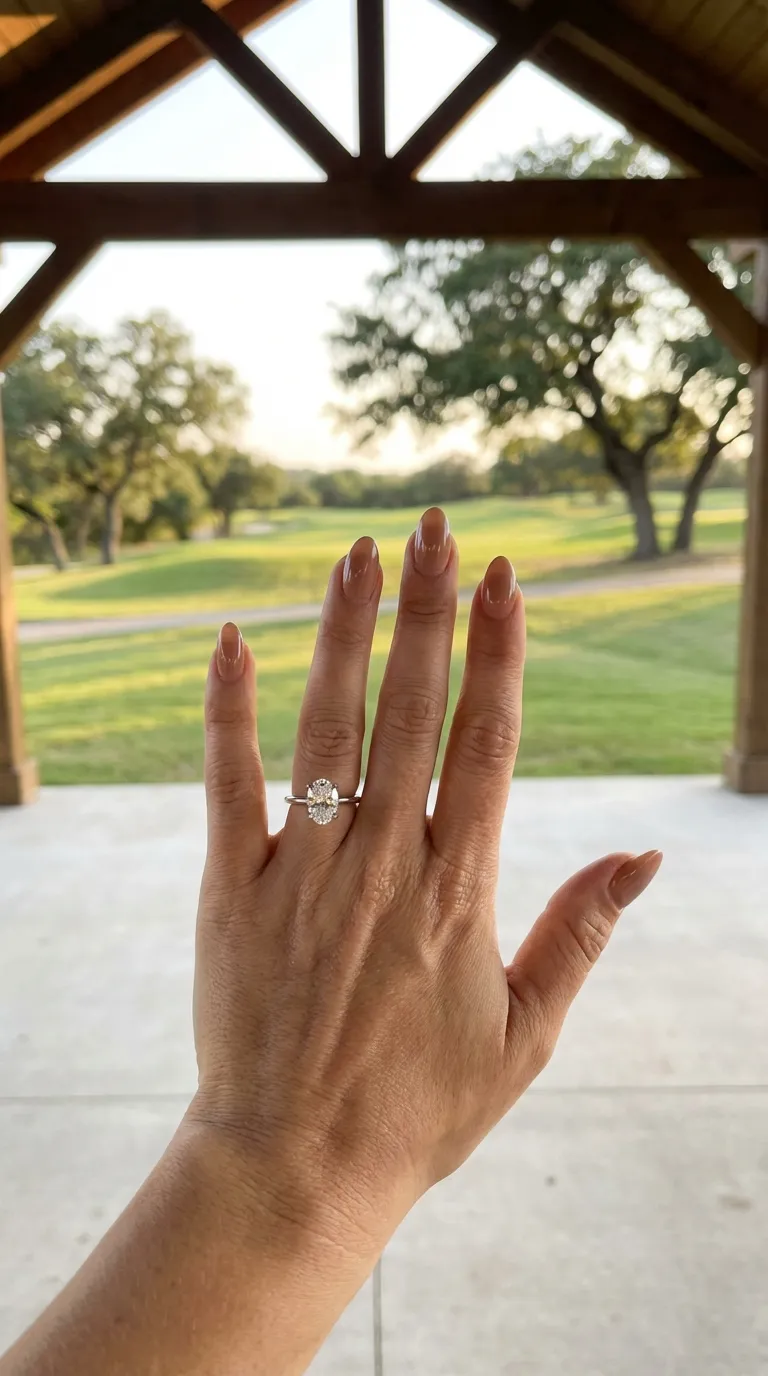
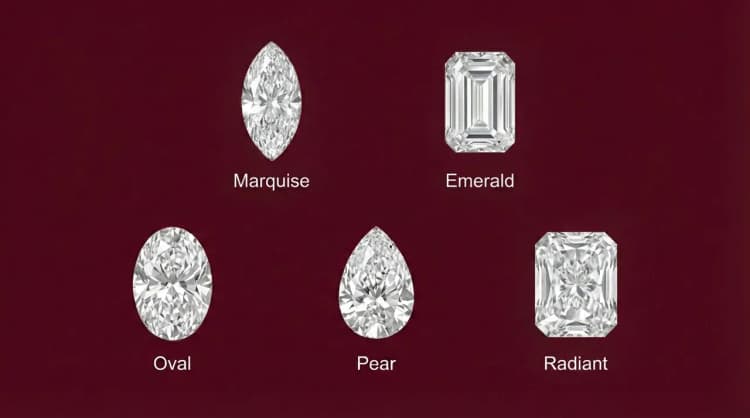
Oval, pear, marquise, emerald, elongated radiant, and elongated cushion all flatter long, slim fingers because they follow the direction of the finger rather than interrupting it. The eye travels along a continuous line from knuckle to fingertip, which reads as graceful rather than stretched.
Of those, the rough order of popularity:
- Oval. The most common pick for long fingers. Carries the elongation of a marquise with softer, more approachable lines.
- Pear. Pointed tip and rounded body. Flattering and dramatic without being as bold as a marquise.
- Emerald. Step-cut, architectural, clean rectangular outline. Beautiful on a long finger because the rectangle reinforces the line.
- Marquise. The boldest of the elongated shapes. Two pointed tips create a strong directional sweep that long fingers can carry without looking overwhelmed.
- Elongated radiant or elongated cushion. Rectangular versions of normally-square shapes. Same elongation effect with more sparkle than an emerald.
Length-to-width ratios in the 1.4 to 1.6 range give you the most flattering elongation without the stone looking stretched. All of these shapes are available across our custom engagement rings, so you can compare an oval against a pear in the same setting before you commit.
What is the best diamond cut for long fingers?
For maximum flattery, an elongated cut at a length-to-width ratio of 1.40 to 1.55. That is the sweet spot where the stone reads as confidently elongated without crossing into "stretched". An oval at 1.45 is the classic.
If you want a round or square stone instead, the cut matters less than the carat. Round and square shapes are orientation-neutral, which means they neither elongate nor shorten the finger. They sit balanced. The trade-off is that smaller stones (under 0.8 carat) can look lost on a longer finger, so round and square shapes generally need to be at 1 carat and above to feel proportionate.
Do bulky rings look good on slender fingers?
Yes, slender fingers carry bulky rings surprisingly well, often better than wider hands do. The contrast between the slim finger and the substantial ring reads as intentional, and the finger has plenty of bare space on either side of the band to let the ring breathe visually.
What "bulky" looks good includes:
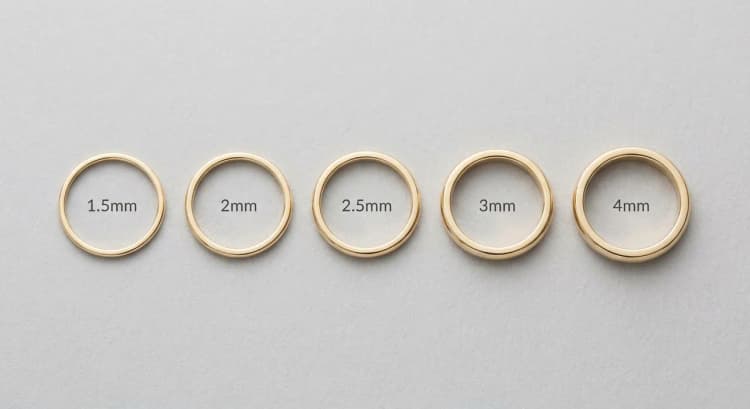
- Wide bands (2.5mm to 4mm). A 3mm band on a slim finger reads as confident and modern, not heavy, and every ring in our thick band collection opens at 3mm.
- Cathedral or basket settings that lift the stone above the band. The vertical height balances the slim horizontal of the finger.
- Large centre stones (1.5 to 3 carats). Slim fingers exaggerate carat weight, so a 2 carat reads visually closer to 2.5 than it would on a wider hand.
- Pave or three-stone settings. Extra metal and accent diamonds add visual width without looking crowded.
- Bezel settings on a chunky band. The architectural look suits slender hands particularly well.
What does not work, even on a slim finger: very narrow bands (under 1.6mm) paired with very small stones (under 0.5 carat). The whole ring disappears on the length of the finger, and reads as underwhelming rather than delicate. If you want a small stone, give it a wider band or a halo. If you want a thin band, give it a more substantial stone.
Are wide engagement rings good for slender fingers?
Yes. A 2.5mm to 3mm band sits beautifully on a slim finger and balances the length of the hand. Wider bands (3.5mm and above) start to read as more substantial or statement-style, which can still work but become a design choice rather than the default.
A rough framework:
- Slim finger, delicate-style ring: 1.8mm to 2mm band, smaller centre stone (0.5 to 1 carat)
- Slim finger, classic-style ring: 2mm to 2.5mm band, 1 to 1.5 carat centre stone
- Slim finger, statement-style ring: 2.5mm to 3.5mm band, 1.5+ carat centre stone
The other thing to consider is the wedding band that will eventually sit alongside the engagement ring. Slim fingers carry stacks beautifully because there is room for them, but matching the band widths within 0.3mm keeps the stack proportional. A 2mm engagement ring next to a 2mm wedding band gives a clean, deliberate stack.
Are round diamonds good for long skinny fingers?
Yes, at 1 carat and above. A round brilliant is orientation-neutral, so it neither elongates nor shortens the finger. On a long finger, a smaller round (under 0.8 carat) can look lost in the surrounding bare metal of the band, especially if the band itself is thin. At 1 carat and above, the stone has enough visual presence to anchor the ring.
A round on a slim finger benefits from one of these design choices:
- A slightly thicker band (2mm to 2.5mm) to add visual weight under the stone
- A halo of accent diamonds around the centre stone to widen the visual footprint
- A six-prong setting (the original Tiffany style) rather than four, which adds a touch more metal at the head
- A bezel rim around the stone, which both protects it and adds visual mass
A round at 1.5 carat on a slim finger in a 2mm pave band is one of the most flattering combinations possible for long fingers.
What about square cuts on long fingers?
Princess, asscher, and standard cushion are all orientation-neutral square shapes. They flatter long fingers at 1 carat and above for the same reason rounds do: enough visual mass to anchor the ring without competing with the length of the finger.
Of the squares:
- Princess cut reads modern and architectural, with sharp 90-degree corners
- Asscher cut reads vintage and Art Deco, with deeply cropped corners and a hall-of-mirrors look
- Cushion cut reads classic and soft, with rounded corners and brilliant facets
All three look beautiful on slim fingers when sized appropriately. Under 1 carat, consider adding a halo or going to a wider band so the stone has presence.
What is an east-west setting and does it work on slim fingers?
An east-west setting rotates an elongated stone (most commonly an oval, emerald, or marquise) 90 degrees so it sits across the finger rather than along it. Instead of the long axis pointing towards your knuckle, it runs from one side of the finger to the other.
On long, slim fingers an east-west setting works especially well. The horizontal orientation balances the vertical length of the finger and reads as confidently modern. Slim fingers also have the visual real estate to carry the horizontal sweep without it looking crowded.
If you love an elongated stone but feel like a standard north-south orientation accentuates your finger length too much, east-west is the elegant alternative that nobody talks about enough.
What should I avoid on long skinny fingers?
Three combinations to be cautious of:
- Very small stones with very thin bands. A 0.3 carat round on a 1.5mm band reads as delicate to the point of disappearing on a long finger. Either size up the stone or thicken the band.
- Overly tall settings without a substantial band. A high cathedral setting on a 1.6mm band looks top-heavy on a slim finger. Match the band weight to the setting height.
- Single tiny accent stones without context. Multi-stone bands and pave look beautiful. A solo 0.05 carat accent on either side of a small centre stone can look meek rather than detailed.
The general principle is proportion. Long fingers can carry a lot of ring without looking overwhelmed, so the danger is more often picking something too delicate and ending up with a ring that gets lost on the hand.
The simple framework
Two paths work on long, slim fingers. The first is to lean into the length with an elongated stone (oval, pear, marquise, emerald, elongated cushion) in a setting that complements the natural line of the finger. The second is to balance the length with width through a thicker band, a larger or rounder stone, or an east-west setting that runs the stone horizontally across the finger.
Both are flattering, neither is more correct, and the right choice comes down to the look you want.
We walk through this with side-by-side examples on TikTok; you can watch the long-finger ring breakdown.
View our collection of lab-grown diamond engagement rings to see how each shape sits on a long finger.
Thanks for reading,
Jared and Brie
Designed by us in Melbourne, made to order
Lily Dia is a small studio, so every ring is drawn, set and finished for the person wearing it. If this article helped, the collection shows how these choices look on real rings, and you can ask us anything before you decide.
View lab-grown diamond ringsOr ask us a question first