


What does engagement ring band width mean?
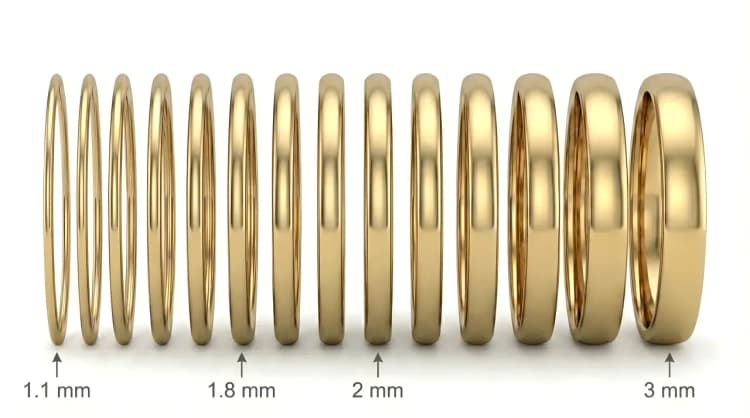
Band width is the measurement of the metal band when you look at it from above, across the top of your finger, in millimetres. It is not the height of the setting (that is called profile), and it is not the thickness of the metal (which is a separate measurement). Just the width of the band you can see across the top of your finger.
Most engagement rings sold worldwide land between 1.6mm and 3mm. Anything under 1.6mm reads as a stacking band or a delicate eternity ring rather than a solo engagement ring. Anything over 3mm starts to read as a chunky statement piece or a men's-style band.
What is the best band width for an engagement ring?
For most people, 2mm is the right answer. It looks elegant on the finger, holds up well to daily wear in 14k or 18k gold, and stacks cleanly with most wedding bands. Roughly two thirds of the solitaires we sell sit at 2mm.
If you want a more delicate look, drop to 1.8mm. If you want something with more presence, push up to 2.5mm. If you want a band that is part of the visual statement of the ring rather than a frame for the stone, 3mm. None of these are wrong; they look meaningfully different on the finger. Our own made-to-order engagement rings come in 1.8mm, 2mm, 2.5mm and 3mm as standard. The step from 1.8mm to 2mm adds $100 on our rings, and each wider step adds $200, which is a fair proxy for what extra width costs in solid gold.
A rough decision frame:
- Smaller hands or shorter fingers: 1.8mm to 2mm. Anything wider can crowd the finger.
- Average hands: 2mm to 2.5mm. The widest range that suits everything.
- Longer or wider fingers: 2.5mm to 3mm. A thinner band can disappear visually.
- Stacking with a wider wedding band: match within 0.3mm of the wedding band.
For the full matrix crossing Australian ring size, finger length, hand breadth and stone size, with a printable width strip you can check on your own hand, see band width by hand size. And if a band has to clear a prominent knuckle, the inner profile matters as much as the width; that trade-off is covered in what is a comfort fit ring.
1.8mm vs 2mm band, which is right for an engagement ring?
The 0.2mm gap looks small on paper and is visibly different on the finger. The 1.8mm reads as delicate and barely-there and is the smallest width we recommend for a solo engagement ring in solid gold; the 2mm reads as classic and balanced, holds pave or milgrain detail with room to spare, and is more forgiving of daily knocks. Choose 1.8mm for maximum focus on the stone on a smaller hand; choose 2mm if you want the band to look intentional, plan a stack, or wear the ring through hands-on work. Anything finer than 1.8mm is a durability decision more than a style one, and the full comparison of the thin widths, including the safe floor for each metal, lives in is a 1.5mm ring band too thin, with the quick 1.8mm verdict at is a 1.8mm band too thin.
2mm vs 2.5mm band, what is the difference?
The 2mm sits as the standard delicate-but-durable engagement ring width. The 2.5mm starts to read as structured and intentional, with the band visibly contributing to the overall shape of the ring rather than disappearing behind the stone: it holds pave with more breathing room, balances centre stones above 1.5 carats, and stacks with a 2mm or 2.5mm wedding band without either ring overwhelming the other. If you are choosing between them at the design stage, the 2.5mm is almost always the right call when a wedding band will share the finger, and the 2mm when the stone should be the whole story.
2mm vs 3mm wedding band, what works better with an engagement ring?
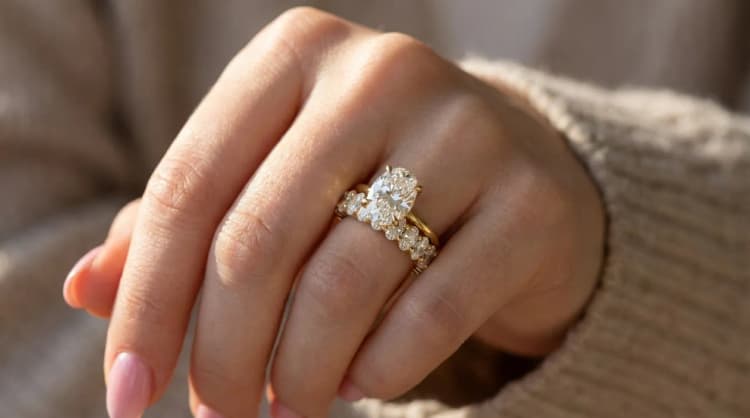
A 3mm wedding band reads as substantial and traditional, often the choice if the engagement ring also has a wider band or a large stone. A 2mm wedding band reads as understated and matches a 2mm engagement ring almost exactly, which gives a neat, balanced stack with no visual mismatch.
A few practical pairings that work well:
- 2mm engagement, 2mm wedding band: the cleanest, most matched look
- 2mm engagement, 2.5mm wedding band: wedding band reads slightly heavier, common with eternity bands
- 2.5mm engagement, 2.5mm or 3mm wedding band: balanced for a more substantial overall look
- 3mm engagement (solid band), 3mm wedding band: a heavier, more architectural set, often in yellow gold
If your engagement ring has a wider 3mm band already, a 3mm wedding band is the natural partner. If your engagement ring is at 1.8mm or 2mm, a 3mm wedding band is heavier than the engagement ring and the stack ends up looking back-heavy.
2.5mm vs 3mm wedding band
The 2.5mm is the most common adult wedding band width worldwide, and the 3mm is the step up into genuinely substantial. For a band beside a typical 2mm engagement ring, 2.5mm is the cleaner pairing; 3mm becomes right when the engagement ring band is already 2.5mm or wider, or when the wedding band will stand alone. The full comparison, including how each width feels, resizes and balances a centre stone, is in 2.5mm vs 3mm ring band.
Is a 2mm engagement ring band too thin?
No, 2mm is the most common engagement ring band width in the world and holds up well to daily wear in solid 14k or 18k gold or platinum. With a yearly check and reasonable care, a 2mm band will last decades without thinning to a point where it needs re-shanking.
Where 2mm becomes a question:
- Very hands-on daily wear (trades, manual work, lifting weights without gloves). A 2mm band will need re-shanking sooner than a 2.5mm in these conditions, and a slightly heavier band is worth considering.
- Very large centre stones (over 2 carats). A heavier stone benefits from a heavier base, both structurally and visually.
- A high-profile cathedral or basket setting. The taller the setting, the more force the stone puts on the band when the ring takes a knock, and the heavier the band should be to balance.
For a 1-carat solitaire on average hands, 2mm is perfect.
Is 1.6mm too thin for an engagement ring?
1.6mm is on the thin edge of practical for a solo engagement ring. In platinum it holds up reasonably well because the metal is dense and resistant to bending. In 14k or 18k gold a 1.6mm band will bend with normal wear and probably need re-shanking inside the first decade. In 9k gold it is too thin for daily wear.
The look at 1.6mm is genuinely lovely (very delicate, almost wire-like), but it is fragile compared with 1.8mm or 2mm. If you want that delicate look and you wear the ring constantly, 1.6mm in platinum is the safest version. Otherwise step up to 1.8mm. If you're considering anything finer, our 1.5mm band guide explains where the durability risk starts to bite.
How does a 2mm band look on the finger?
Slim but visible. On most hands, 2mm reads as a clean, balanced engagement ring width that does not crowd the finger or get lost on it. The metal is wide enough that you notice it as a band rather than as a wire, but narrow enough that it stays elegant rather than chunky.
A useful physical reference: an Australian 5c coin is roughly 19mm in diameter, so a 2mm band is about a tenth of that width. A US nickel is about 2mm thick edge-on. The width of an HB pencil is around 7mm to 8mm, so a 2mm band is just under a third of that.
Try on rings of different widths before committing. The photo never tells you what a width actually looks like on your specific hand.
How does band width affect durability?
Thicker bands bend less. That is straightforward physics, more metal means more resistance to deformation. A 1.6mm band in 14k gold will bend if you grab a heavy bag with the ring still on. A 2.5mm band in the same metal will not.
Real-world durability also depends on the metal and on the profile thickness (the depth of metal under your finger, which does most of the structural work). Assuming a solid band of standard profile depth:
- 9k gold: harder than 14k but more brittle, 2mm minimum for daily wear
- 14k gold: balanced, 1.8mm is the safe floor, 2mm is the comfortable choice
- 18k gold: slightly softer than 14k because of the higher gold content, 1.8mm floor and 2mm recommended
- Platinum: dense and tough, 1.8mm holds up well, 1.6mm is workable
- White gold: rhodium plating wears off over time, plan for re-plating every few years on top of band-width considerations
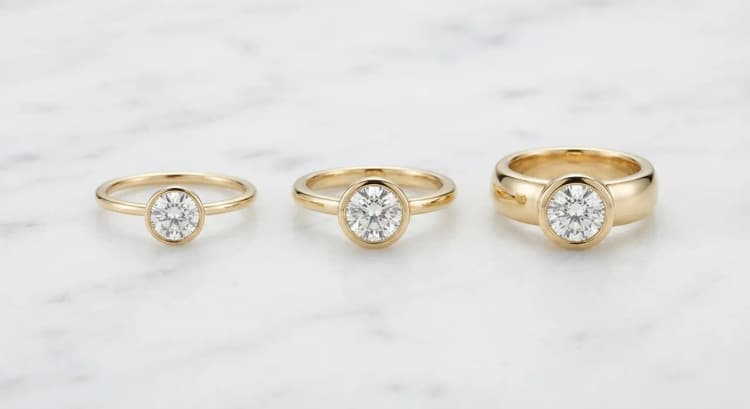
The setting style also matters. A flush, low-profile setting (bezel, low solitaire) puts less stress on the band than a tall cathedral with a 2-carat stone perched on top.
Should the engagement ring band match the wedding band width?
It does not have to match exactly, but the closer the better. A 0.3mm difference or less reads as a deliberate, balanced stack. A 0.5mm or more difference starts to look mismatched, with one ring visibly outweighing the other.
The exception is when one ring is intended to dominate. A 1.5mm pave eternity band intentionally paired with a heavier 2.5mm solitaire is a real design choice, not a mistake. But it has to be deliberate, and the proportions have to balance some other way (different metal, different stone arrangement) to work.
The simplest rule: pick the engagement ring band width first, then pick a wedding band within 0.3mm of it. That covers almost every case.
We walk through some of this in more detail on our TikTok; you can watch the band width breakdown.
Compare widths on real rings in our thin band engagement rings, which open at 1.8mm, and thick band engagement rings, which open at 3mm, or view our collection of lab-grown diamond engagement rings.
Thanks for reading,
Jared and Brie
Designed by us in Melbourne, made to order
Lily Dia is a small studio, so every ring is drawn, set and finished for the person wearing it. If this article helped, the collection shows how these choices look on real rings, and you can ask us anything before you decide.
View lab-grown diamond ringsOr ask us a question first