


Is a 1.5mm band too thin for an engagement ring?
Yes, for daily wear in gold. A 1.5mm band in 9k, 14k, or 18k gold does not have enough metal to hold its shape through years of normal wear, and will slowly bend out of round as your hand grips steering wheels, carries bags, and presses against bench tops. Once it bends, it does not spring back. The bend puts strain on the setting, which can loosen prongs and put the stone at risk over time.
In platinum the answer changes slightly. Platinum is denser and stiffer than gold, and a 1.5mm platinum band will hold its shape noticeably better than the same width in gold. It still sits on the thin edge of practical for daily wear, but it is workable in a way that 1.5mm gold is not.
If you are designing a custom engagement ring and want a delicate look, 1.8mm in gold or 1.6mm in platinum is the safe floor.
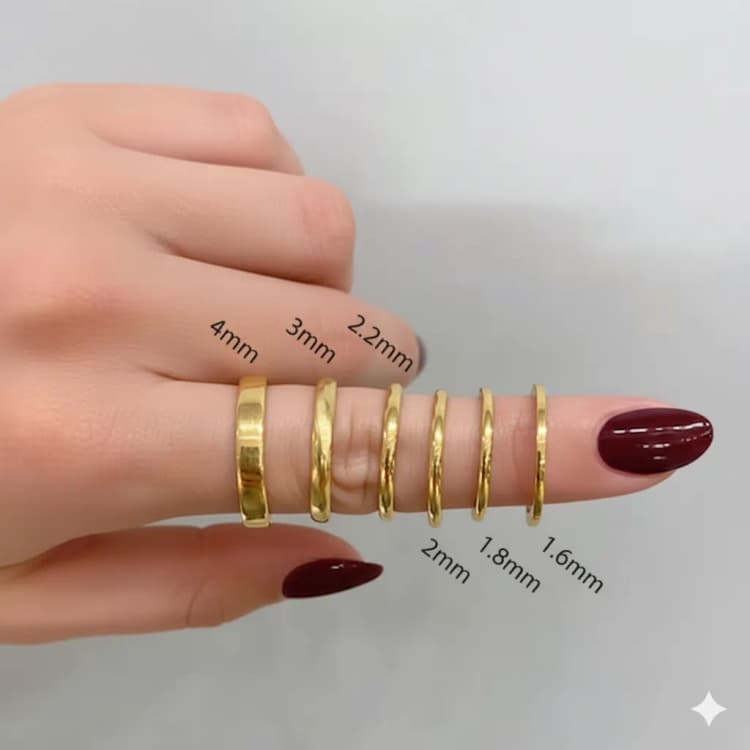
1.5mm vs 2mm band, what is the difference?
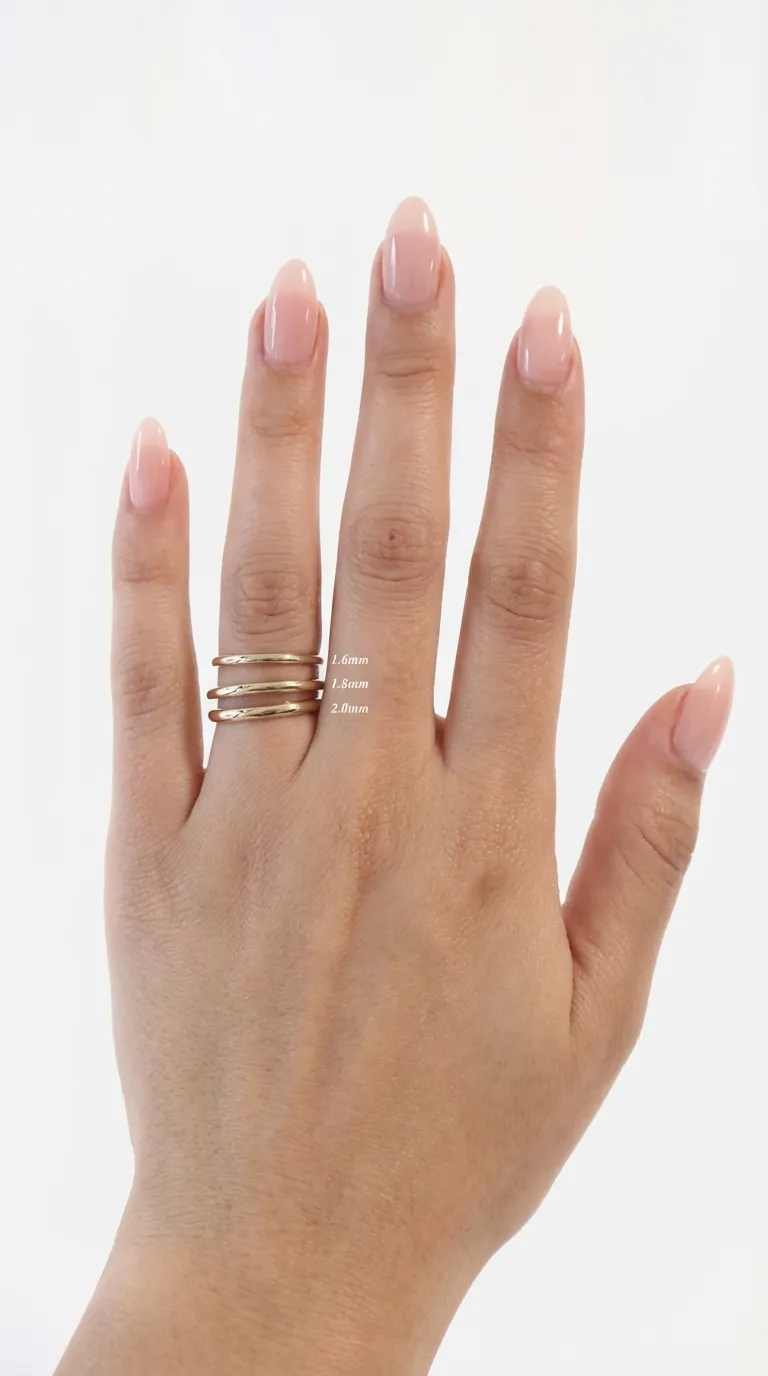
Visually, a little; structurally, a category. The 1.5mm reads as ultra-delicate, almost wire-like on the finger, and the 2mm reads as classic and slim rather than thin. On the hand the gap is noticeable but subtle. Under load the story changes: at the same profile thickness, a 2mm band carries a third more metal across the finger than a 1.5mm one, and in practice makers also deepen the profile as they widen the band, so a real 2mm band resists bending far better than the width numbers alone suggest.
One definition matters before the comparison table, because two bands with the same width can behave very differently:
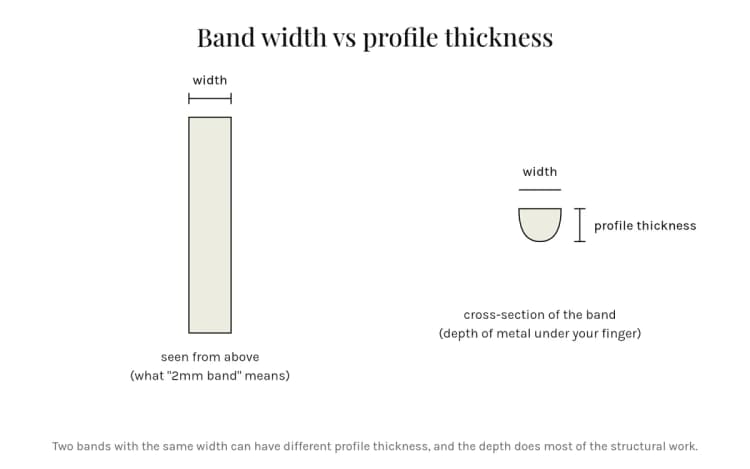
Width is what you see from above; profile thickness is the depth of metal between your finger and the world, and it does most of the structural work. Every durability claim on this page assumes a solid band with a standard profile depth in proportion to its width. A 2mm band with a skimpy 1mm profile behaves like a thinner ring than it looks.
How the two widths compare for a daily-wear engagement ring, by metal:
| Metal | 1.5mm band | 2mm band |
|---|---|---|
| 14k gold | Bends with normal wear; expect re-shanking | Comfortable daily wear for decades with annual checks |
| 18k gold | Bends slightly sooner again; the higher gold content is softer | Comfortable daily wear; our recommended floor in 18k |
| Platinum | Workable with careful wear and yearly checks | Effectively indestructible in normal life |
If you love the delicate look of 1.5mm but want the durability of 2mm, two reasonable middle paths:
- 1.8mm. Still delicate, much more durable than 1.5mm.
- A knife-edge profile at 2mm. The band tapers to a thin top edge but keeps the structural width underneath, so it looks like a thinner band from the side but performs like a 2mm band.
Why does a 1.5mm gold band bend?
Gold is one of the softer metals used in jewellery. Pure 24k gold is roughly 2.5 on the Mohs hardness scale (about as hard as a fingernail). Alloying gold with other metals is what makes 14k or 18k usable for jewellery: 14k is 58% gold, 18k is 75% gold, and the rest is harder metals like copper, silver, palladium, or nickel that give the alloy structural strength.
Even with those alloys, gold has limits. A band under 1.8mm wide does not have enough cross-sectional metal to resist the cumulative force of daily wear. Things like:
- Gripping a steering wheel
- Carrying heavy shopping bags by the handles
- Pressing your hand against a bench top while leaning
- Sleeping with your hand curled
- Squeezing through a tight grip while opening jars
None of these are dramatic events. They add up over months and years, and on hands that get used, a 1.5mm gold band typically starts to sit visibly out of round within the first few years. Once bent, the only real fix is re-shanking, which runs to a few hundred dollars and is always quoted on the specific ring, metal and size.
What is the minimum width for an engagement ring band?
For daily wear, assuming a solid band with a standard profile depth, the practical minimums by metal:
- 9k gold: 2mm minimum (the alloy is harder than 14k, but it is also more brittle)
- 14k gold: 1.8mm minimum, 2mm comfortable
- 18k gold: 1.8mm minimum, 2mm recommended (the higher gold content is slightly softer than 14k)
- Platinum: 1.6mm minimum, 1.8mm comfortable
If you want a wider safety margin (active hands, manual work, trades, gym), step up by 0.2 to 0.4mm from these floors. A jeweller can make a 1.5mm band in any of these metals, but be aware that the band will need maintenance and likely re-shanking earlier than a thicker band would.
Is a 1.6mm band too thin for an engagement ring?
In gold, yes, just barely. A 1.6mm band in 14k or 18k will still bend with daily wear, just slightly less aggressively than a 1.5mm one. In platinum, 1.6mm is workable for a daily-wear engagement ring and holds up well to normal use.
The honest answer is that the 0.1mm difference between 1.5mm and 1.6mm is too small to notice visually but too small to matter structurally either. Both are on the thin end of practical. If you want a delicate look that will hold up, jump to 1.8mm in gold or stick at 1.6mm in platinum.
1.5mm vs 1.8mm band, which holds up better?
1.8mm holds up meaningfully better. At the same profile thickness, a 1.8mm band carries 20% more metal across the finger than a 1.5mm band, and because makers typically deepen the profile as they widen the band, the finished 1.8mm ring usually resists bending well beyond that 20%. The width you see understates the strength you gain.
In practice, assuming a solid band of standard profile depth:
- 1.5mm in 14k or 18k gold: noticeable bending within the first few years of daily wear, and re-shanking becomes a question of when rather than if
- 1.8mm in 14k or 18k gold: holds shape well with normal wear; re-shanking is rare and usually only after many years
- 2mm in 14k or 18k gold: comfortable durability for most daily wear, lasts indefinitely with annual checks
The 0.3mm gap from 1.5mm to 1.8mm sounds tiny on paper. On the finger, the visual difference is small. The structural difference is large.
Can I get a pave band at 1.5mm?
No. Pave bands need a minimum of 2mm.
Pave setting works by drilling tiny holes in the band, dropping in small accent diamonds, and folding small beads of metal over the edges of each stone to hold it in place. On a band under 2mm, there is not enough metal between the stones and the inner edge of the band, which means:
- The stones sit too close to the inside of the band, where they get hit by finger pressure
- The beads of metal holding each stone are smaller and easier to wear away
- A pave stone can pop out as the band wears thin, and once one goes, others usually follow
A pave engagement ring band at 2mm or wider is fine for daily wear. At 1.5mm, expect stones to start popping out within a few years.
What is the thinnest engagement ring band that will last?
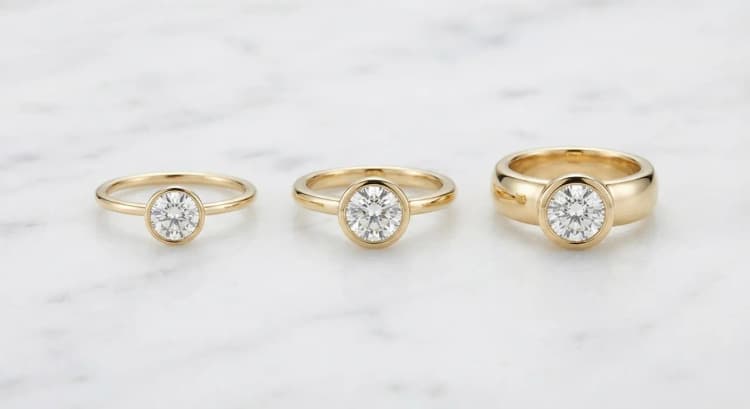
In platinum, 1.6mm is the thinnest practical width for a daily-wear engagement ring with reasonable longevity. In gold, 1.8mm is the equivalent floor. Below those numbers, the band will need re-shanking sooner than most people expect and the setting at the top of the ring will move around more under daily impact.
If a very delicate look is the priority and the wearer is willing to commit to extra maintenance (yearly check, re-shanking inside a decade), a 1.5mm platinum band is workable. A 1.5mm gold band is not.
What if I already have a 1.5mm gold band?
First, learn the warning signs so a bend never gets to a lost stone. Check the ring monthly against a flat surface or a circle drawn around its own outline: an oval silhouette, a visible flat spot at the bottom of the band, a new clicking or spinning of the centre stone, or a prong that catches on fabric where it never used to are all signs the band has moved and taken the setting with it. A jeweller checking a bent thin band looks at exactly those things, roundness, prong tension and cracks at the thinnest point of the shank, and the check takes minutes.
From there, two practical paths:
- Wear it and accept that it needs maintenance. Get the band inspected once a year, budget for a re-shank at some point in its life, and follow basic engagement ring care habits (off for the gym, off for heavy lifting, off for any task with strong grip).
- Repair or rebuild. A jeweller can re-round a mildly bent band and check the setting, or re-shank the ring, replacing the band with a 1.8mm or 2mm one while keeping the existing setting and stone. Re-rounding is a small job; a full re-shank runs to a few hundred dollars and is quoted on the specific ring. Repair suits a band that bent once; a remake of the shank is the honest answer for a band that keeps bending, because the metal work-hardens and cracks with each cycle. We covered the rebuild process in can I make my engagement ring thicker.
If the ring is brand new and you have not yet started wearing it, re-shanking is the cleaner long-term call. If the ring is older and you love it as it is, careful wear plus a re-shank when it needs one is also reasonable.
The summary
1.5mm in gold is too thin for an engagement ring meant to be worn daily. 1.8mm is the safe floor in gold, 1.6mm is workable in platinum, 2mm is the comfortable choice across all metals, and 2mm or wider is the minimum for any pave detail. For a fuller breakdown of every band width and how each one reads on the finger, see our engagement ring band width guide.
Browse our thin band engagement rings, which all open on a 1.8mm band, the safe floor in gold, and let you choose a wider band before you order.
Thanks for reading,
Jared and Brie
Designed by us in Melbourne, made to order
Lily Dia is a small studio, so every ring is drawn, set and finished for the person wearing it. If this article helped, the collection shows how these choices look on real rings, and you can ask us anything before you decide.
View thin band engagement ringsOr ask us a question first