Are Lab-Grown Diamonds Real Diamonds?

By Jared James · Last updated 21 May 2026
Quick answer
Yes. A lab-grown diamond is a real diamond, made from carbon in the same crystal structure as a mined diamond. It has the same hardness and the same diamond sparkle when cut well. The difference is origin, not the material.
Why lab-grown diamonds are real diamonds
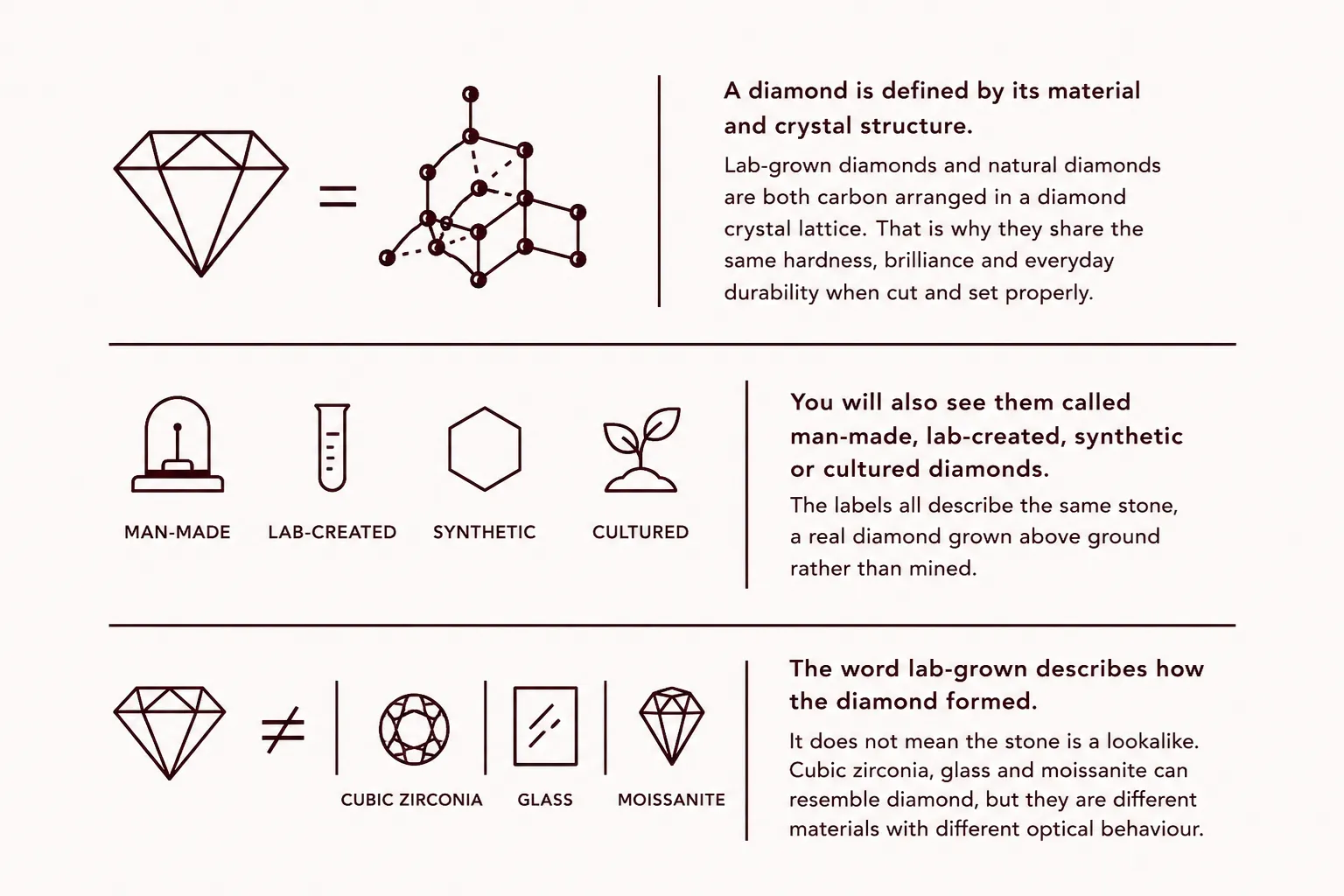
A diamond is defined by its material and crystal structure. Lab-grown diamonds and natural diamonds are both carbon arranged in a diamond crystal lattice. That is why they share the same hardness, brilliance and everyday durability when cut and set properly. Science reporting describes lab-grown and mined diamonds as chemically and physically identical.
You will also see them called man-made, lab-created, synthetic or cultured diamonds. The labels all describe the same stone, a real diamond grown above ground rather than mined.
The word lab-grown describes how the diamond formed. It does not mean the stone is a lookalike. Cubic zirconia, glass and moissanite can resemble diamond, but they are different materials with different optical behaviour.
Lab-grown diamond, natural diamond and moissanite compared
| Factor | Lab-grown diamond | Natural diamond | Moissanite |
|---|---|---|---|
| Material | Carbon in a diamond crystal structure. | Carbon in a diamond crystal structure. | Silicon carbide, a different gemstone material. |
| Hardness | 10 on the Mohs scale. | 10 on the Mohs scale. | 9.25 on the Mohs scale. |
| Appearance | Diamond brilliance and fire when cut well. | Diamond brilliance and fire when cut well. | More rainbow fire, with a different sparkle pattern. |
| Origin | Grown above ground using HPHT or CVD technology. | Formed underground and recovered through mining. | Usually grown in a laboratory for jewellery. |
| Report | Graded on the 4Cs by IGI; GIA now uses a Premium or Standard rating instead. | Graded through the 4Cs, with natural origin stated. | Often sold with quality information rather than a diamond grading report. |
Watch: natural, lab-grown and moissanite
A short video walkthrough of how natural diamonds, lab-grown diamonds and moissanite differ in material, sparkle and origin.
How are lab-grown diamonds made?
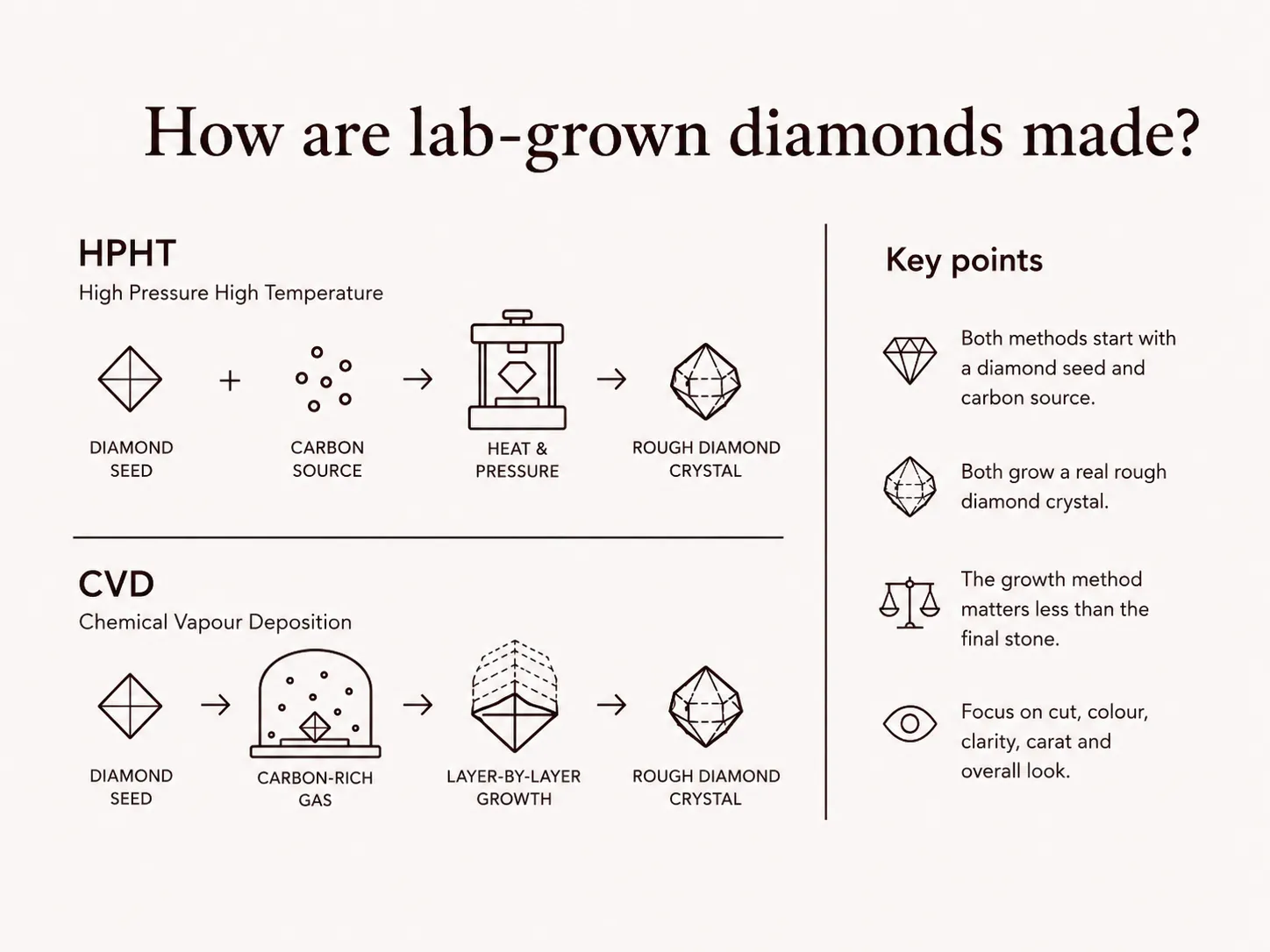
Lab-grown diamonds are made using HPHT, High Pressure High Temperature, or CVD, Chemical Vapour Deposition. Both methods start with a diamond seed and a carbon source, then grow a rough diamond crystal that is cut and polished.
The method may be listed on the grading report. For most buyers, the method matters less than the final stone: its cut, colour, clarity, carat weight, transparency and how it looks in the ring.
For a fuller explanation, read the lab-grown diamond guide.
Can you tell a lab-grown diamond from a natural one?
No, not by looking at the diamond in a ring. A lab-grown diamond and a natural diamond of the same cut, colour, clarity and carat weight look the same to the eye.
A standard diamond tester will not separate them either. It reads a lab-grown diamond as diamond, because that is what the stone is. Those pen-style testers exist to catch simulants like cubic zirconia, not to flag a real diamond as fake.
Laboratories use specialised equipment to identify growth features and trace elements that reveal origin. The grading report should also state whether the stone is natural or laboratory-grown, which is why certification matters.
Are lab-grown diamonds graded like natural diamonds?
Mostly. Laboratories such as IGI grade lab-grown diamonds by the same 4Cs, the cut, colour, clarity and carat weight, and the report identifies laboratory-grown origin, so you can compare quality and origin separately. GIA is the exception: from October 2025 its lab-grown reports use a simpler Premium or Standard rating instead of the 4Cs.
Start with the 4Cs guide, then read the diamond certification guide if you are reading a specific report.
Are lab-grown diamonds good for engagement rings?
Yes, if you want a diamond and prefer to put more of the budget into size, cut quality or the setting. They have the hardness needed for daily wear and are graded in a way that makes comparison straightforward.
They suit buyers less if natural origin, rarity or later resale value is the main priority. For that question, read are lab-grown diamonds worth it?
Ready to compare
See real lab-grown diamonds in ring settings
Browse lab-grown diamond engagement rings and compare shape, size, colour and clarity with the origin clearly stated.
View lab-grown ringsFrequently asked questions
- Are lab-grown diamonds real diamonds?
- Yes. Lab-grown diamonds are real diamonds. They are carbon in a diamond crystal structure, with the same hardness and diamond sparkle as mined diamonds of the same cut quality.
- Can you tell a lab-grown diamond from a natural diamond by looking?
- No. You cannot identify origin by eye. Specialist laboratory equipment can detect growth origin, and the grading report should also state whether the diamond is laboratory-grown.
- Are lab-grown diamonds fake?
- No. Lab-grown diamonds are not fake diamonds. They are different from simulants such as cubic zirconia and moissanite, which are different materials.
- Are man-made diamonds real diamonds?
- Yes. Man-made, lab-created and synthetic are all other names for lab-grown diamonds. They are real diamonds, the same carbon crystal as a mined diamond.
- Do lab-grown diamonds test as diamonds?
- Yes. Standard diamond testers identify lab-grown diamonds as diamonds because they share the thermal and physical properties of diamond.
- Are lab-grown diamonds graded like natural diamonds?
- Mostly. Laboratories such as IGI grade lab-grown diamonds for cut, colour, clarity and carat weight, the same as natural diamonds, and the report identifies laboratory-grown origin. GIA changed its approach in October 2025 and now rates lab-grown diamonds as Premium or Standard instead of using the 4Cs.
Still unsure
Ask us to compare the options
Send us the diamond report or ring brief and we will help you compare origin, grading and setting choices.
Contact the studio