What Are Lab-Grown Diamonds?

By Jared James · Last updated 28 October 2026
Quick answer
A lab-grown diamond is a diamond grown from carbon above ground, with the same crystal, hardness and sparkle as a mined one. It is grown by HPHT or CVD over days to weeks, then cut, polished and graded like any diamond, and its report states that it was laboratory grown, how, and whether it was treated after growth. A 1 carat lab-grown diamond costs from $1,084 with us.
What is a lab-grown diamond?
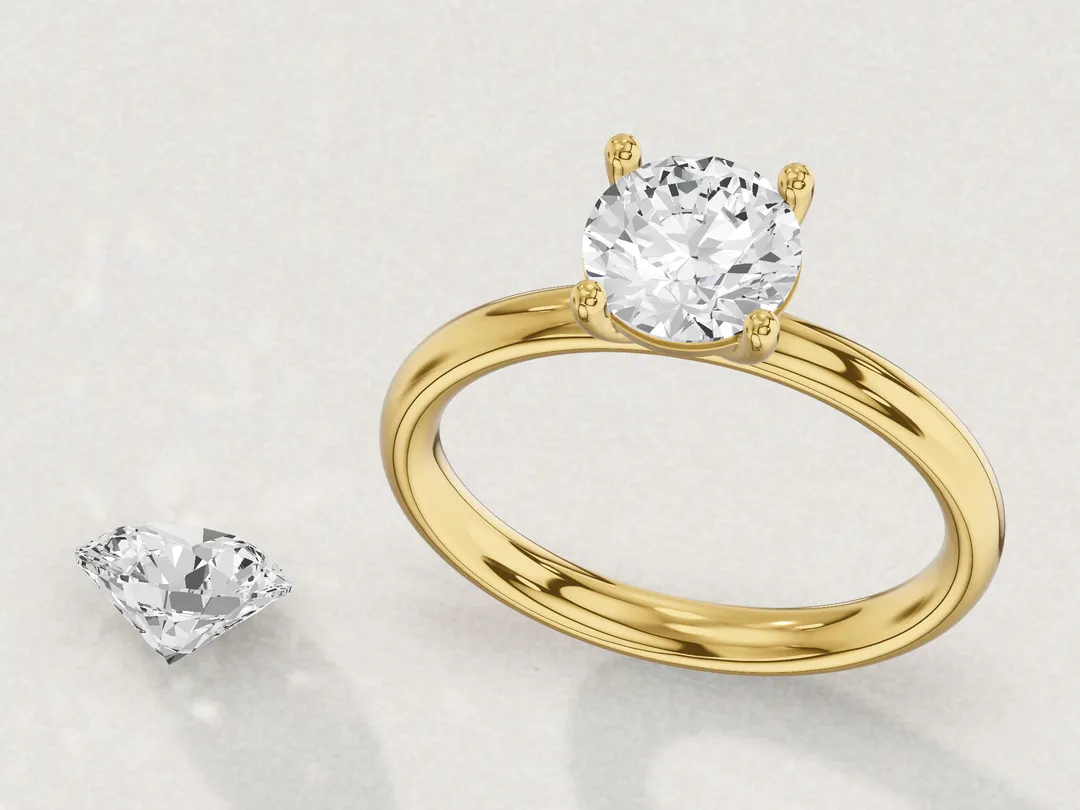
A diamond grown from carbon above ground, with the same crystal, hardness and sparkle as a mined one. It starts as a small diamond seed, grows into a rough diamond crystal, and then goes through the same cutting, polishing and grading as a mined diamond.
You will also see them called lab-created, man-made, synthetic or engineered diamonds. All of those names mean a diamond grown in a lab rather than mined.
Cubic zirconia, glass and moissanite are something else. They are diamond simulants, or diamond alternatives, made from different materials, whereas a lab-grown diamond is the same material as a mined diamond, so it behaves like a diamond once it is in a ring. If you are weighing up an alternative too, the moissanite vs diamond guide compares material, sparkle and price.
How are lab-grown diamonds made?
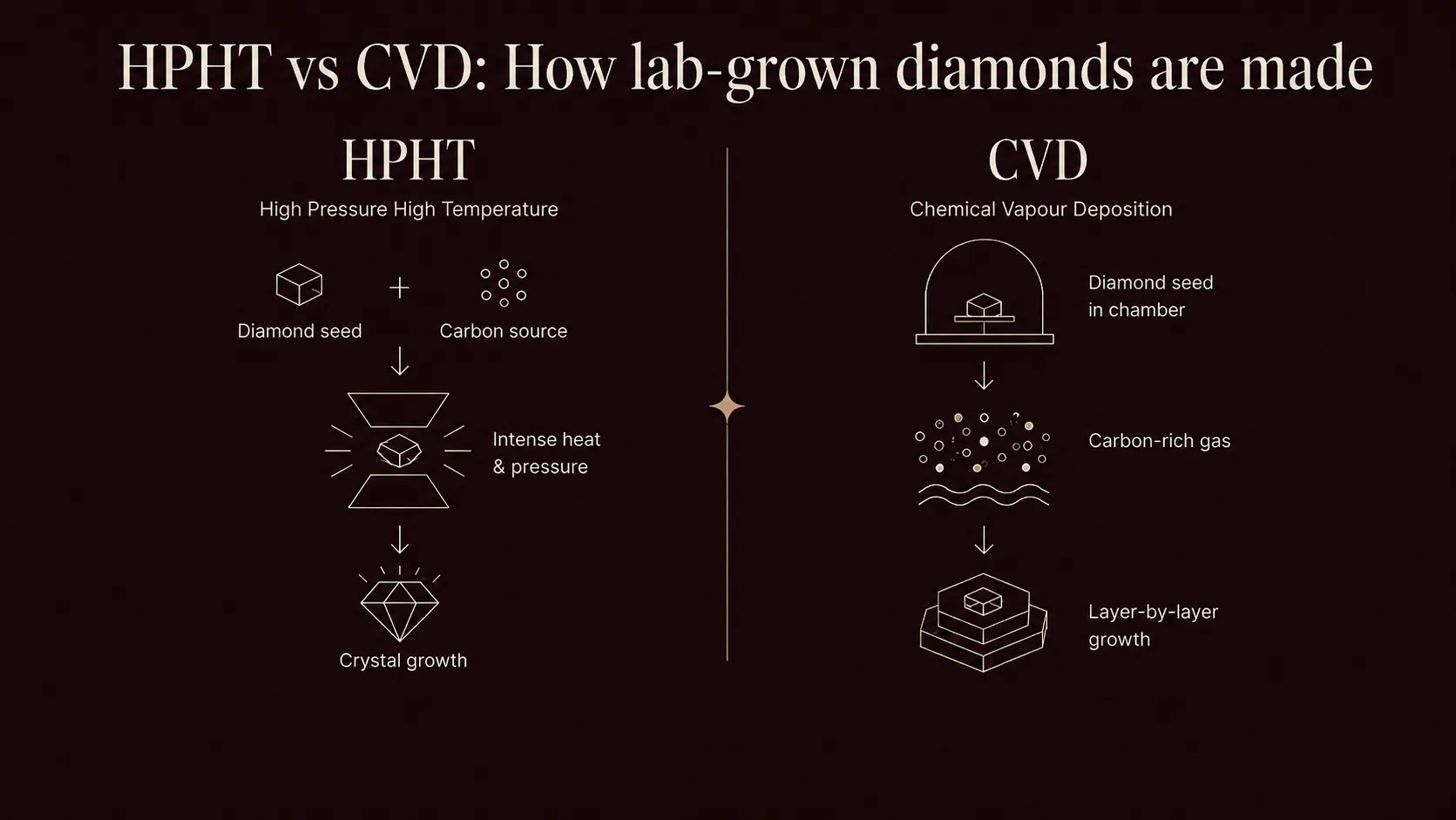
Two ways. HPHT recreates the heat and pressure deep in the earth inside a press, and CVD builds a diamond up from carbon-rich gas in a vacuum chamber, layer by layer. Both start from a diamond seed, and both produce a rough crystal that is cut, polished and graded like a mined diamond. These steps follow GIA’s account of the two growth processes.
HPHT, high pressure high temperature
- A small diamond seed goes into a press with a carbon source and a metal flux such as iron, nickel or cobalt.
- The growth cell is heated to 1,300 to 1,600°C under more than 870,000 pounds per square inch, about 60,000 times the air pressure at sea level.
- The carbon dissolves in the molten metal and crystallises on the seed over several days to weeks.
- The crystal is cooled, taken out, then cut and polished.
CVD, chemical vapour deposition
- Thin, flat diamond seed plates go into a vacuum chamber filled with hydrogen and a carbon gas such as methane.
- The chamber is heated to about 900 to 1,200°C, and a microwave beam turns the gas into a plasma.
- Carbon from the plasma settles on the seed plates in thin layers. A run takes three or four weeks, often stopped and restarted so the crystals can be cleaned.
- CVD crystals often come out brown. GIA says most colourless CVD diamonds on the market were probably brown first, then heat treated after growth to remove the colour, before cutting and polishing.
That is why a lab-grown report states the growth method and any treatment after growth. Neither changes what the diamond is, and the report tells you which applies to your stone.
What does a lab-grown diamond's IGI report show?
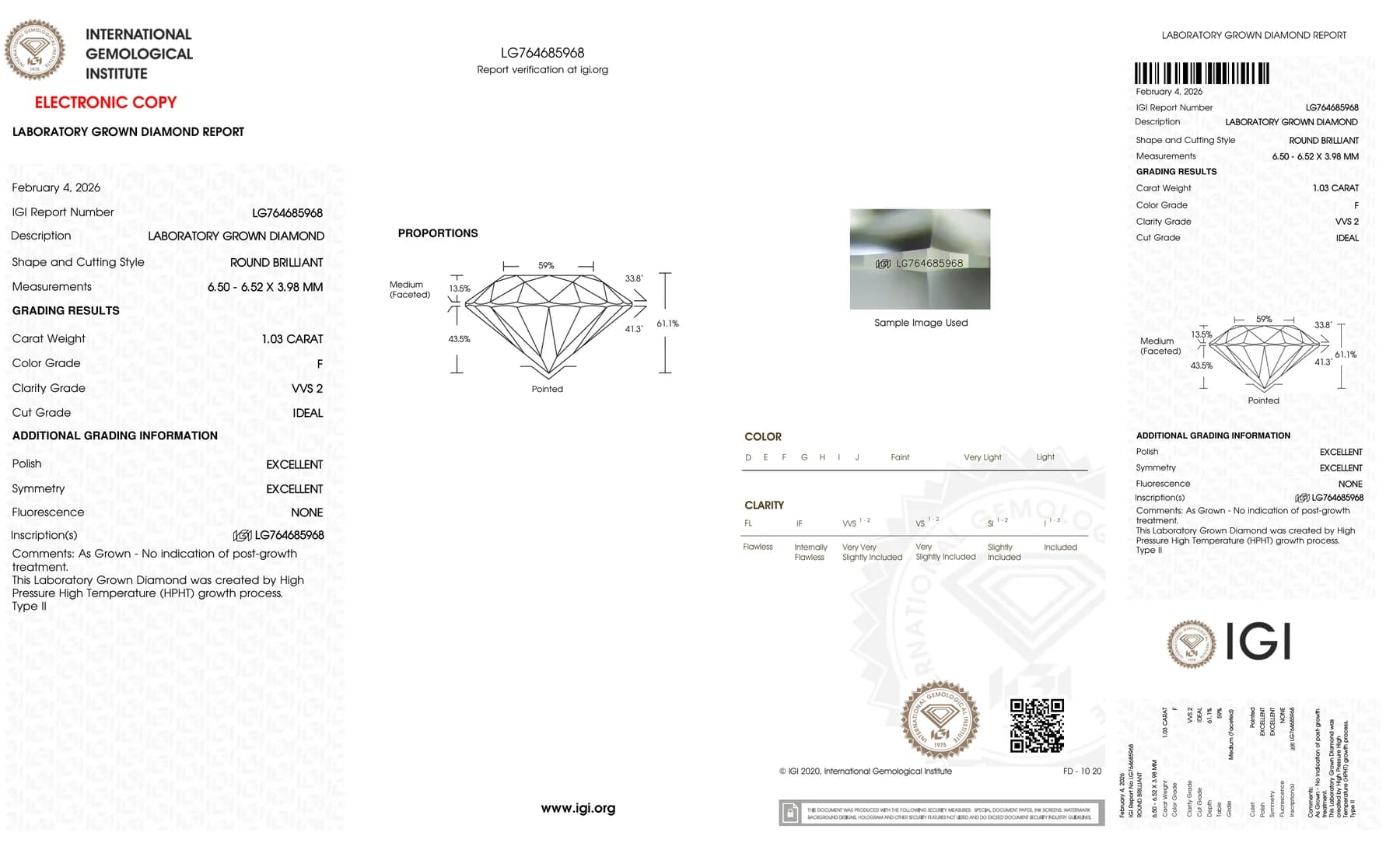
Its 4Cs and measurements, that it is laboratory grown, how it was grown, and whether it was treated after growth. This is the IGI report for a 1.03 carat round we listed earlier this year.
| On the report | What it tells you |
|---|---|
| Report numberLG764685968 | LG marks an IGI lab-grown report. Enter the number on IGI’s verification page and the same record comes up. |
| DescriptionLaboratory grown diamond | The origin, stated in words, at the top of the report. |
| Shape and measurementsRound brilliant, 6.50 to 6.52 × 3.98 mm | The smallest and largest diameter, then the depth. These tell you the size face up, which carat weight alone does not. |
| Carat weight1.03 carat | The weight, to two decimal places. |
| Colour and clarityF, VVS2 | F is colourless; VVS2 means minute inclusions that are very hard to find at 10× magnification. |
| Cut, polish and symmetryIdeal, Excellent, Excellent | Ideal is IGI’s top cut grade for a round brilliant. |
| FluorescenceNone | No glow under ultraviolet light. |
| InscriptionIGI LG764685968 | The report number is laser-inscribed on the girdle, so the stone can be matched to its report. |
| CommentsAs Grown, no indication of post-growth treatment; HPHT growth process; Type II | How it was grown, and that it was not treated after growth. A treated stone’s report says so here. Type II means the diamond has little or no nitrogen in it. |
Every lab-grown diamond we sell comes with its IGI report. Check the comments line on each one, because that is where treatment after growth is stated, and check the number on IGI’s verification page.
GIA also grades lab-grown diamonds. Since 1 October 2025 its quality assessment classes qualifying colourless to near-colourless stones of 0.15ct or more as Premium or Standard, rather than giving 4Cs grades, and it inscribes "Laboratory-Grown" and its number on the girdle. GIA-graded diamonds are available from us on request. The diamond certification guide compares the two laboratories.
Reporting information checked 28 October 2026. See GIA’s current laboratory-grown services, its October 2025 change and IGI’s laboratory-grown report.
Watch: 8 checks before you buy
A quick video walkthrough of the eight checks to make on a lab-grown diamond certificate before you buy.
How much does a lab-grown diamond cost?
From $1,084 at 1 carat with us, and most 1 carat stones cost around $1,320. These are the loose IGI lab-grown diamonds we sell, across every shape.
| Carat weight | From | Median |
|---|---|---|
| 1.00 to 1.09 carats | $1,084 | $1,322 |
| 2.00 to 2.09 carats | $2,206 | $2,599 |
| 3.00 to 3.09 carats | $2,499 | $4,091 |
You can see every one of these stones, with its IGI report and a 360-degree video, on our ring builder. Set in one of our complete 18k gold rings, a lab-grown diamond engagement ring starts at $2,950 at 1 carat, $4,250 at 2 carats and $6,900 at 3 carats, with the diamond included.
Carat weight moves the price most. Shape plays a part too: a round loses more of the rough crystal in cutting, so it usually costs more than a fancy shape of the same weight. Prices change as stones come and go, so treat these as a guide.
A natural diamond of the same grade costs about 7 times as much at 1 carat. Our lab-grown vs natural diamonds guide has the prices side by side, and are lab-grown diamonds worth it? weighs the spend against resale.
Are lab-grown diamonds real, and how do they compare with natural?
Yes, they are diamond: carbon in a diamond crystal, 10 on the Mohs scale, with the same sparkle as a mined diamond cut to the same standard. What differs is origin, price and resale, and lab-grown vs natural diamonds compares them, with our prices for each.
Are lab-grown diamonds good for an engagement ring?
Yes. At 10 on the Mohs scale a lab-grown diamond suits everyday wear, and the lower price leaves room in the budget for a larger stone, a better cut or a more detailed setting.
They suit you less if natural rarity or later resale is what you care about most, and that is a question of origin and market rather than quality.
How do you care for a lab-grown diamond?
The same way as a mined one. Clean it with warm water, a mild soap and a soft brush, then dry it with a lint-free cloth, and have the claws checked if the ring starts to catch or the stone feels loose. Our engagement ring cleaning guide goes step by step.
Are lab-grown diamonds more ethical?
They avoid mining, but growing a diamond takes a lot of energy, so the answer depends on the producer. The ethical diamonds guide compares the two and explains how we source our stones.
Frequently asked questions
- How are lab-grown diamonds made?
- By HPHT or CVD. HPHT crystallises carbon onto a diamond seed in a press at 1,300 to 1,600°C and very high pressure. CVD grows carbon onto flat diamond seed plates from a gas plasma in a vacuum chamber. The rough crystal is then cut, polished and graded like a mined diamond.
- How long does it take to grow a lab diamond?
- Several days to weeks by HPHT, and three or four weeks for a CVD run, according to GIA. Cutting, polishing and grading come after that.
- What does CVD or HPHT on a report mean?
- It is the method the diamond was grown by: chemical vapour deposition or high pressure, high temperature. Neither makes a better diamond in itself, so compare the 4Cs. The same comments line says whether the stone was treated after growth, which is common for CVD diamonds.
- Is moissanite a lab-grown diamond?
- No. Moissanite is a different material, silicon carbide rather than carbon, so it is a diamond alternative rather than a diamond. A lab-grown diamond is the same material as a mined diamond, and the two stones sparkle in noticeably different ways.
- Do lab-grown diamonds get cloudy over time?
- No. Lab-grown diamonds do not become cloudy because of their origin. Like any diamond, they can look dull when soap, lotion or everyday wear leaves residue on the stone, so regular cleaning helps keep the sparkle clear.
- Are lab-grown diamonds good for engagement rings?
- Yes, if you want a real diamond and prefer to put more of the budget into size, cut quality or the setting. They may suit you less if natural rarity or later resale value matters most.