How to Propose Without Getting the Wrong Ring
Don't gamble on taste. Here's how a placeholder ring lets you nail the proposal and still get the ring exactly right.
Read ArticleClarity measures the presence of inclusions and blemishes in a diamond. Inclusions are internal flaws. Blemishes are surface imperfections. Both occur naturally when diamonds form.
Gemologists grade clarity under 10x magnification. They assess size, number, position, and visibility of flaws. Most clarity features cannot be seen without magnification.
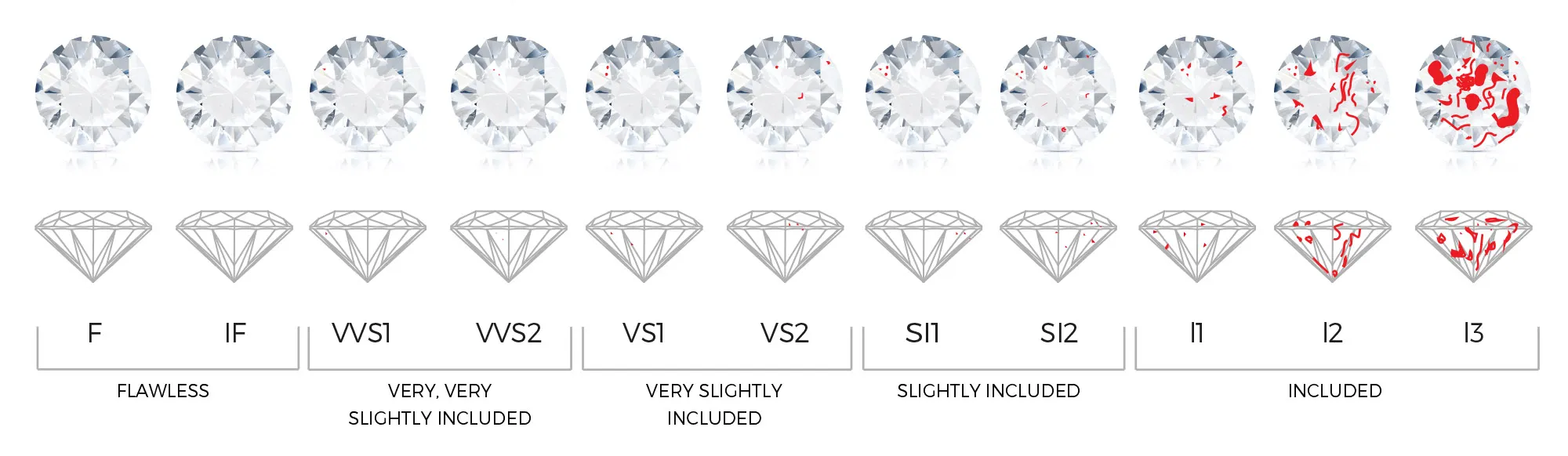
GIA created the standard scale. Eleven grades from flawless to included. Each grade represents a range of clarity characteristics.
No inclusions or blemishes under 10x magnification. Less than 1% of all diamonds earn this grade. Extremely rare. Commands highest prices.
No inclusions visible under 10x magnification. May have minor surface blemishes. Still extremely rare and valuable.
Inclusions so slight that skilled graders struggle to see them under 10x magnification. VVS1 has fewer or smaller inclusions than VVS2. Invisible to naked eye.
Minor inclusions visible with effort under 10x magnification. VS1 shows fewer inclusions than VS2. Both grades appear clean to naked eye. Popular choice for engagement rings.
Inclusions noticeable under 10x magnification. Some SI1 diamonds appear eye-clean. SI2 often shows visible inclusions to naked eye. Best value if you find an eye-clean stone.
Inclusions obvious under 10x magnification and visible to naked eye. May affect transparency and brilliance. I3 has the most visible inclusions. Not recommended for engagement rings.
Eye-clean means no inclusions visible to the naked eye from normal viewing distance. This matters more than the grade itself. A lower grade that appears clean offers better value than a higher grade you cannot distinguish.
VS2 diamonds are eye-clean about 85-90% of the time. SI1 diamonds are eye-clean roughly 50% of the time. The percentage drops with SI2. Each stone must be evaluated individually.
Diamond shape affects visibility. Round brilliants hide inclusions better than emerald or asscher cuts. Step-cut diamonds show inclusions more clearly due to their large, open facets.
Five factors determine the clarity grade. Understanding these helps you evaluate diamonds.
Larger inclusions lower the grade more than smaller ones. Tiny pinpoints matter less than large crystals or feathers.
More inclusions mean lower clarity. A diamond with many small inclusions grades lower than one with a single tiny inclusion.
Inclusions near the center or table show more than those near edges. Inclusions under the table face up. Those near the girdle hide better.
Type of inclusion matters. Clouds affect transparency more than pinpoints. Dark crystals show more than white feathers. Some inclusions threaten durability.
Relief describes how much an inclusion contrasts with the surrounding diamond. High-relief inclusions appear darker or more obvious. Low-relief inclusions blend better.
VS2 to SI1 offers the best value for most engagement rings. These grades appear eye-clean but cost significantly less than VVS or IF grades. You save money without sacrificing appearance.
For diamonds over 1.5 carats, consider VS2 or better. Larger stones show inclusions more easily. The extra clarity investment makes sense at bigger sizes.
Round brilliants under 1 carat can sometimes work at SI2. The cutting style hides inclusions well. Other shapes need higher clarity to appear clean.
Choose the lowest clarity grade that still looks clean to your naked eye. No point paying for clarity you cannot see. A lower grade that appears flawless offers better value.
GIA and IGI certificates plot inclusion locations. Study the diagram. Ask about specific inclusions. Large crystals near the table show more than edge feathers.
Clarity grades alone do not tell the full story. Two SI1 diamonds can look completely different. One might be eye-clean while the other shows obvious inclusions. Always view before buying.
Step cuts like emerald and asscher need higher clarity. Their large facets act like windows into the stone. Brilliant cuts hide inclusions better through their multifaceted pattern.
Some inclusions threaten diamond durability. Large feathers near the girdle can propagate if hit. Knots reaching the surface create weak points. Ask if inclusions pose structural risks.
Lab-grown diamonds follow the same clarity grading scale. GIA and IGI grade them identically to mined diamonds. The same standards apply.
Lab diamonds can achieve higher clarity grades more consistently. The controlled growth environment produces fewer inclusions. Finding VS1 or VVS lab diamonds costs less than equivalent mined stones.
Some lab diamonds show metallic inclusions from the growth process. These do not affect the grade if small enough. CVD and HPHT methods create different inclusion types.
VS2 to SI1 works for most engagement rings. These grades appear eye-clean but cost less than higher grades. For diamonds over 1.5 carats, consider VS2 or better.
Inclusions do not grow or spread. They remain stable. Exception: feathers near edges can extend if the diamond suffers impact. Normal wear will not change clarity.
Rarely. You cannot see the difference between FL and VS2 with your naked eye. The price premium for flawless grades makes no practical sense unless you want the absolute best on paper.
Not necessarily. SI1 and even some SI2 diamonds appear perfectly clear. Cloudiness comes from specific inclusion types like dense clouds, not the grade itself. Always view the actual diamond.
Clarity significantly impacts diamond prices. Moving from SI1 to VVS2 can double the cost. Moving from VS2 to IF can triple it. This makes clarity the best place to save money.
Don't gamble on taste. Here's how a placeholder ring lets you nail the proposal and still get the ring exactly right.
Read ArticleNeither tight nor loose is right. Here's how to find the perfect ring fit and avoid sizing mistakes.
Read ArticleThe 3 month salary rule wasn't tradition. It was a De Beers ad campaign from the 1930s. Here's where it came from and what to spend instead.
Read ArticleWe can help you find the right clarity grade for your budget and preferences. Honest advice on eye-clean diamonds, stone shape, and setting direction.
Browse our collection of lab-grown diamond engagement rings, or compare solitaire styles if you want to see how clarity shows in a cleaner, single-stone setting.