

What band width suits your hand size?
As a starting point: Australian ring sizes up to about J usually carry 1.8mm to 2mm best, the K to N middle of the range suits 2mm to 2.5mm, and sizes from O upward carry 2.5mm to 3mm comfortably. The logic is proportion rather than rule: band width reads relative to the finger under it, so the same 2.5mm band that looks structured on a size Q finger looks heavy on a size H.
Ring size is only the first input, though. Finger length, hand breadth, the centre stone and the wedding band you plan to add all move the answer, which is what the matrix below is for. And a caution before any decision gets made from this page: screens do not show real sizes. Print the strip comparison further down, check it with a ruler, and look at the widths on your own finger.
The band width matrix
Start from your AU ring size row, then let the columns adjust it. Sizes reference our Australian ring size chart.
| AU ring size | Starting width | With a 1.5ct+ centre stone | With a wedding band planned |
|---|---|---|---|
| F to J (smaller) | 1.8mm to 2mm | 2mm; the stone needs the base even when the finger is fine | 2mm, matched with a 1.8mm to 2mm band |
| K to N (average) | 2mm to 2.5mm | 2mm to 2.5mm | 2mm to 2.5mm, wedding band within 0.3mm |
| O to Q (larger) | 2.5mm to 2.8mm | 2.5mm | 2.5mm, matched or with a 3mm band |
| R and up (broad) | 2.5mm to 3mm | 2.5mm to 3mm | 3mm pairs, or 2.5mm with a 3mm band |
Then adjust for the shape of the hand rather than its size:
- Long fingers carry width easily and can lose a thin band visually. Add 0.2mm to the starting width if your fingers are noticeably long for your ring size, and consider elongated stones that use the length. More in engagement rings for long, skinny fingers.
- Short fingers do the opposite: width eats visible finger length. Stay at the bottom of your row and keep the stack to two slim bands rather than one wide one.
- Broad palms with slim fingers read best from the finger, not the palm. Size the width to the finger and let the stone carry the presence.
- Prominent knuckles change fit more than looks. The band has to clear the knuckle, so the fitted size runs looser at the base; a comfort fit profile helps it over, and a wider band makes the squeeze harder, not easier.
None of this is about gender, and we set no rule by it; a broad hand carries 3mm well and a fine hand carries 1.8mm well, whoever the hand belongs to.
Print the strips and check on your finger
The strip sheet below draws 1.8mm, 2mm, 2.2mm, 2.5mm and 3mm at one shared scale with a 50mm scale bar. Print it, measure the bar with a ruler, and once it reads 50mm the strips are true to size: cut one out, wrap it over your finger and look at it in a mirror at arm's length, which is how everyone else sees your hand.
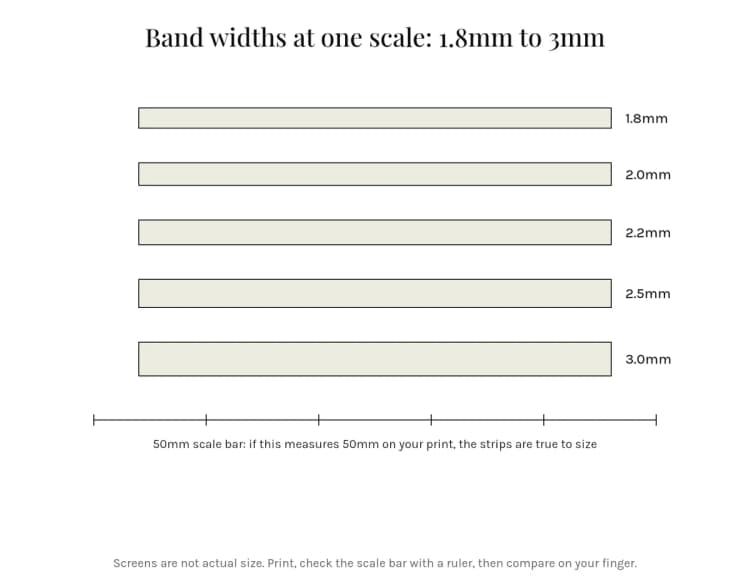
Screen images are never actual size, whatever the pixel maths promises, so do not skip the ruler step. The printable ring sizer uses the same check-ruler trick if you also need to confirm the finger size itself.
How do stone size and the wedding band change the answer?
The centre stone sets a floor under the band width. A heavier stone needs a heavier base structurally, and it also needs one visually: a 2ct stone on a 1.8mm band reads top-heavy, like a table with thin legs. From about 1.5 carats we recommend at least 2mm, and from 2.5 carats at least 2.5mm, assuming a solid shank of standard profile depth. Our 2 carat size guide shows the stone-to-band proportions on real hands.
The wedding band works the other way, as a ceiling on the pair. The two rings will live side by side for decades, and stacks look most deliberate when the widths sit within about 0.3mm of each other, so if you know you want a fine 1.8mm wedding band, resist a 2.8mm engagement ring now. Decide the pair, then buy the first half of it. The trade-offs between the two widest options live in 2.5mm vs 3mm.
The short version
Start from your ring size band: 1.8mm to 2mm for smaller sizes, 2mm to 2.5mm for average, 2.5mm to 3mm for larger. Nudge up for long fingers and big stones, down for short fingers and planned slim stacks, and always confirm on paper rather than on a screen. Then browse our thin band engagement rings, which open at 1.8mm, or thick band engagement rings, which open at 3mm, start from the lab-grown diamond collection if the stone is settled, or ask us to mock up the same design at two widths so you can compare on your own hand.
Thanks for reading,
Jared and Brie
Designed by us in Melbourne, made to order
Lily Dia is a small studio, so every ring is drawn, set and finished for the person wearing it. If this article helped, the collection shows how these choices look on real rings, and you can ask us anything before you decide.
View lab-grown diamond ringsOr ask us a question first