Four vs Six Prong Engagement Ring Setting

By Jared James · Last updated 25 May 2026
Quick answer
Six prongs are slightly more secure; four prongs let in more light and read more modern. For most stones under 2 carats either is safe with annual checks. Here's how to choose based on stone size, shape, and how you actually live.
Are 4-prong engagement ring settings safe?
Yes, for almost everyone. A well-made 4-prong setting on a stone under 2 carats holds the diamond securely for decades, and the small extra margin from a sixth prong doesn't change the maths in any way most people would notice in daily life. The real safety variable is whether the prongs are checked once a year and re-tipped before they wear too thin, not whether there are four of them or six.
Where 6 prongs do start to matter: stones above 2 carats, very active hands, or any setting where the prongs are deliberately delicate (claw-style, knife-edge prongs). For everything else, both are safe.
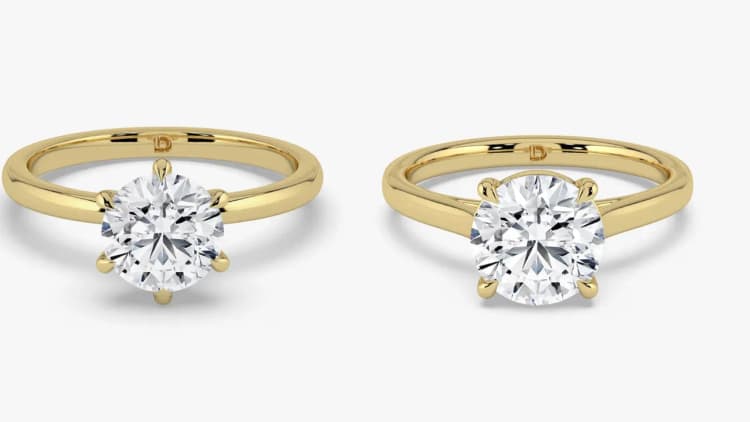
How many prongs should an engagement ring have?
Four or six, in almost all cases. Three-prong settings exist (mostly for pear, heart, or marquise cuts where one tip needs holding) and eight-prong settings are used for very large stones or some vintage designs, but the standard for a modern solitaire is four or six.
A quick rule of thumb:
- Under 1 carat: Four prongs. Six prongs swallow up too much of a small stone visually.
- 1 to 2 carats: Either works. Pick on looks, not security.
- 2 to 3 carats: Six prongs are worth the small visual trade-off for the extra hold.
- 3 carats and up: Six prongs by default, sometimes eight for very heavy stones.
The other thing that matters: prong shape. A chunky rounded prong on a 1-carat stone is more secure than a delicate claw prong on the same stone, regardless of count.
4 prong vs 6 prong: when each makes sense
4-prong settings show more of the stone. Less metal covering the crown means more light enters from the sides and more of the diamond's outline is visible from above, which makes the stone look slightly larger and reads as more modern. The classic 4-prong positions are 2/4/8/10 o'clock (a slight square frame, good for princess, asscher, cushion, and radiant cuts) or 12/3/6/9 (compass orientation, popular for rounds). Cleaning is easier because there are fewer corners for dirt to collect in.
6-prong settings are the original Tiffany solitaire design (1886). The six points hold a round stone in a more symmetrical pattern, which is why a round brilliant under a 6-prong reads as "perfectly round" while the same stone under 4 prongs reads with a faint hint of square. More metal across the crown means slightly more security but slightly less of the stone visible. Six prongs are also the safer pick for any stone over 2 carats because they distribute the holding force across more points.
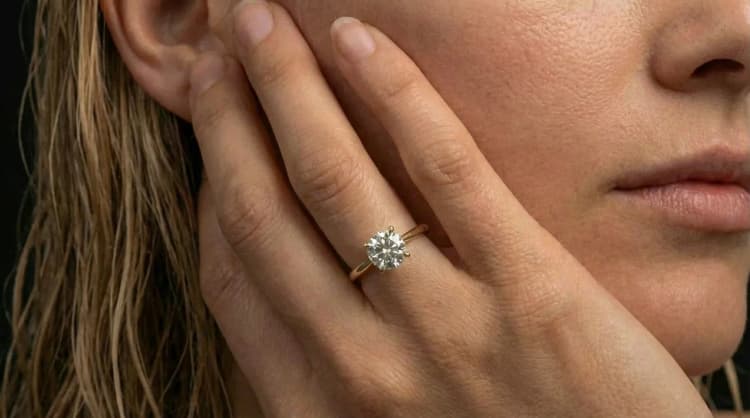
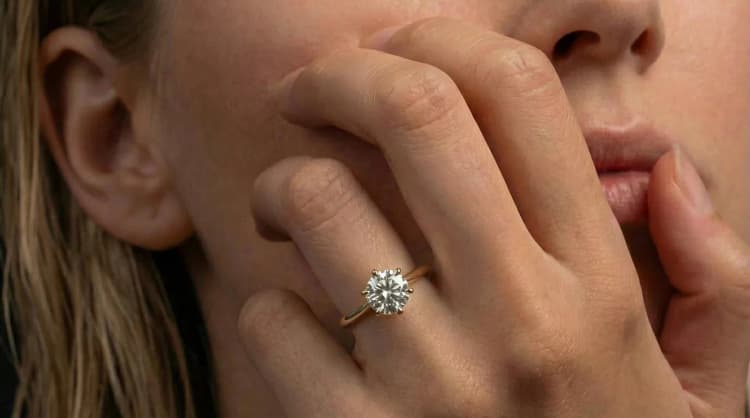
4 prong vs 6 prong on a round diamond
This is the most common version of the question, because most engagement rings are round brilliants. The honest answer is that both work and most of it comes down to taste.
- A round under a 4-prong looks slightly larger, has more visible light return, and reads modern or a bit minimalist. You can also tilt the look square (2/4/8/10) or compass (12/3/6/9).
- A round under a 6-prong looks more perfectly circular, reads classic Tiffany, and gives you a tiny security buffer. It does cover marginally more of the stone.
On a 1ct round you wouldn't notice the security difference in fifty years of normal wear. On a 3ct round, the 6-prong is the more sensible call.
4 prong vs 6 prong on an oval
Ovals are different because the long axis of the stone needs holding too. A 4-prong oval has prongs at the north, south, east and west of the stone (roughly), which leaves the tips of the long axis lightly held. A 6-prong oval adds prongs at the two long-axis tips, which is where ovals are most likely to chip or shift.
For ovals over 1.5 carats, six prongs are the default for good reason. The tip of the long axis on an oval is the most vulnerable point on the stone, and a sixth and seventh contact point there does real work. For smaller ovals (under 1 carat) a 4-prong is still safe, but four prongs on an oval is more of an aesthetic statement than a structural choice.
How prongs change how the stone looks
Three real visual effects:
- Apparent size. Four prongs cover less of the stone, so the diamond reads about 5 to 10% larger than the same stone under six prongs. Most people don't consciously notice the difference, but it's there.
- Apparent shape. A round under 4 prongs (especially 2/4/8/10) reads with a faint square outline. Under 6 prongs it reads as more perfectly round. A square cut (princess, asscher) almost always uses four prongs because the prongs sit on the corners and emphasise the squareness.
- Light return. More metal on the crown of the stone blocks light at those points. Four prongs let light enter from more directions, which translates to slightly more sparkle. The effect is small but visible side by side.
When to get the prongs checked
Don't wait for any of these, regardless of how many prongs your ring has:
- The stone moves when you press it with a fingernail
- A faint clicking or rattling when you tap the ring against your fingernail
- A prong that looks bent outward, flattened on the top, or worn down to a thin spike
- A prong tip that's clearly shorter than the others
- The stone sitting visibly crooked compared to the band
The cause is almost always worn prongs from years of contact with door frames, gym equipment, and bench tops. Catching it early means re-tipping a prong; ignoring it means losing the stone.
Most jewellers will inspect prongs for free in store. Get it done once a year if you wear the ring daily, every six months if you're hard on your hands.
How much do prong repairs cost in Australia?
Rough 2026 AUD bands:
- Re-tipping one prong: $30 to $80, depending on metal and how much the prong needs rebuilt
- Re-tipping all prongs together: $120 to $300
- Rebuilding a fully worn-down prong: $80 to $200 per prong
- Replacing the whole basket (head): $400 to $900
If you're getting one prong re-tipped, ask the jeweller to do the others at the same time. Prongs wear roughly evenly, and addressing them as a set adds a small amount to the bill versus a return trip in eighteen months. Expect to retip every five to ten years on a daily-wear ring.
What about moissanite?
The stone material doesn't change the prong choice. Moissanite is 9.25 on the Mohs scale, harder than ruby or sapphire, and any setting that holds a diamond holds a moissanite of the same size. The 4-prong vs 6-prong calculation is identical: under 1 carat go four, over 2 carats go six, in between it's taste.
The one moissanite-specific thing worth knowing is that the lower-grade stuff (G colour and below) often comes set in plated metal or alloy claws that wear faster than solid gold. If you're buying moissanite, solid 9k, 14k, or 18k gold prongs are the difference between a setting that lasts ten years and one that fails in two.
Common questions
Will a 4-prong setting let my diamond fall out?
Not if the prongs are checked and maintained. The failure mode is worn prongs, not the count. A well-made 4-prong setting on a stone under 2 carats with an annual check is as safe as a 6-prong setting that gets neglected for ten years.
Is a 6-prong setting worth the extra cost?
A 6-prong setting usually costs slightly more than a 4-prong because it uses a little more metal and takes a little more bench work. The difference is typically $50 to $150 on a solid gold ring. For a stone over 2 carats it's worth it for the security alone. Under 2 carats it's a taste decision.
Do prongs make the stone look smaller?
Six prongs cover slightly more of the stone than four prongs, so the same diamond appears marginally smaller under six. The difference is small enough that most people don't notice it without comparing side by side.
Can I change from 4 prongs to 6 prongs (or back) later?
Yes, but it's a setting modification, not a quick tweak. Most jewellers can rebuild the basket with a different prong count for $300 to $700, depending on metal and stone size. The stone has to be removed, the new basket made, and the stone reset. Worth doing if your circumstances change, but not worth doing on a whim.
For more on prong safety specifically, see our are 4 prongs enough for an engagement ring guide. To see how different prong counts look in person, our engagement ring collection has both 4-prong and 6-prong settings across the same stone shapes.
Thanks for reading,
Jared & Brie
Next step
Compare styles or design something tailored
See how different engagement ring styles compare, or explore the custom design process to build something to your brief.
Browse engagement ringsNeed a second opinion
Talk to the studio
If you are weighing up a ring or comparing options, send the details through and we can help you think it through.
Contact the studio