Moissanite vs Diamond Stud Earrings

By Jared James · Last updated 25 May 2026
Quick answer
A D VVS1 moissanite stud pair in solid gold sits around $850 to $1480 AUD. An equivalent natural diamond pair starts around $8,000 and climbs from there. The diamonds look slightly whiter, the moissanite throws more rainbow flash, and in normal indoor light very few people can pick them apart by eye.
What's the difference between moissanite and diamond stud earrings?
Two things really matter on the lobe: price and the way they sparkle. A D VVS1 moissanite stud pair in solid gold sits around $850 to $1480 AUD for a 1ct total pair. An equivalent natural diamond pair starts around $8,000 AUD and climbs from there. The diamonds look slightly whiter, the moissanite throws more visible rainbow flash, and in normal indoor light very few people can pick them apart by eye.
Everything else (hardness, ethics, recognition, resale) is worth knowing about, but it matters less than people expect once you remember that earrings sit protected on your earlobes and never really take a hit. And if you're still deciding whether studs are even the right style, our types of earrings guide compares studs against hoops, huggies, drops and the rest.
Moissanite vs diamond stud earrings side by side
| D VVS1 Moissanite | Natural Diamond | |
|---|---|---|
| Sparkle pattern | More fire (rainbow flashes), refractive index 2.65 to 2.69 | Whiter brilliance, refractive index 2.42 |
| Price (1ct total pair) | $850 to $1480 AUD | $8,000 to $25,000+ AUD |
| Hardness | 9.25 Mohs | 10 Mohs |
| Spotted by eye | Almost never in normal light | Universally recognised |
| Origin | Lab-grown | Mined (or lab-grown if specified) |
| Resale value | Close to zero | Retains some value |
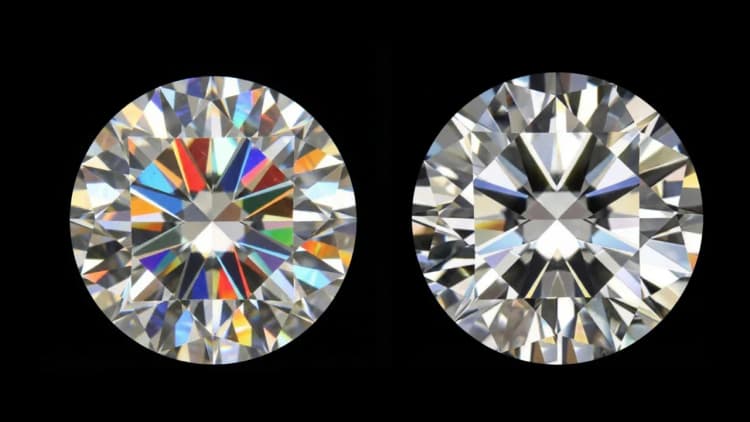
Which looks more real, moissanite or diamond studs?
By eye, both look real, and a high-quality moissanite reads as a diamond to almost everyone. D VVS1 moissanite is colourless to the naked eye and the cut on a well-made stud is symmetrical and bright, which is what people are actually picking up on when they look at someone's earrings.
The difference, when you can see it, is in the sparkle pattern. Moissanite has a higher refractive index than diamond (2.65 to 2.69 vs 2.42), which translates to more visible fire, those rainbow flashes that look like little prisms in bright light. Diamond's brilliance reads as cooler and whiter. Side by side under a downlight, the two stones look distinctly different. In normal indoor light, almost no one notices.
A jeweller without a tester usually can't tell either. A moissanite tester (a small handheld unit that measures thermal and electrical conductivity) tells the two stones apart in a few seconds, but you need the tester. Our at-home diamond testing guide covers what those testers can and cannot identify.
Moissanite vs diamond stud earrings price
Australian pricing for quality moissanite stud pairs in solid gold settings sits in roughly these bands:
- 0.5ct pair (4 to 4.5mm round): around $500 to $900
- 1ct pair (5mm round): around $850 to $1480
- 2ct pair (6mm round): around $1200 to $2200
- 3ct+ pair (7mm and up): around $1800 to $3500
Natural diamond studs in the same sizes and equivalent D VVS1 quality run roughly five to ten times higher. A 1ct natural diamond pair lands between $8,000 and $15,000 in solid gold, depending on the cut grade and the jeweller's margin. Lab-grown diamond studs sit in the middle, usually two to three times the moissanite price for the same size.
The price gap comes from the stone, not the setting. The same gold post and back is doing the same job regardless of what's set on top.
Lab-grown diamond vs moissanite earrings
Both are made in a lab, and both look like a natural diamond by eye. The differences come down to material and price.
Lab-grown diamond is chemically identical to natural diamond: carbon, 10 on the Mohs scale, the same refractive index, the same crystal structure. It's a diamond, grown in a controlled environment instead of pulled out of the ground. Moissanite is silicon carbide, a different mineral that happens to look very similar to diamond when cut well.
In studs, the practical difference is price and fire. A lab-grown 1ct stud pair in D VVS1 quality runs roughly $2,500 to $4,500 AUD in solid gold. The same pair in moissanite is $850 to $1480. A lab-grown diamond reads visually as a natural diamond (cooler, whiter sparkle), and moissanite throws more rainbow flash.
If you want the look and feel of a diamond and the lower price of a lab-grown stone, lab-grown is the pick. If you want maximum sparkle for the smallest spend and you don't mind the fire pattern, moissanite is the pick.
Are moissanite stud earrings as durable as diamonds?
For earrings, yes, comfortably. Moissanite scores 9.25 on the Mohs hardness scale, which is harder than ruby or sapphire and well past the threshold where surface scratching becomes a concern. Diamond is 10, the hardest natural material, but it's not ten times harder than moissanite (the Mohs scale isn't linear). It's a small step at the top of the chart.
The thing to remember with earrings is where they sit. A ring takes constant hits on door frames, gym equipment, kitchen benches and the underside of car steering wheels. Earrings sit on your earlobes and never really touch anything. The hardness question that comes up with engagement rings basically doesn't apply.
Both stones handle salt water, sweat, chlorine, sleep and ultrasonic cleaning without issue. The setting metal matters more than the stone, and solid 9k, 14k or 18k gold handles all of the above. Plated metals wear through at the post and back of the setting first, so avoid those regardless of which stone you pick.
When are diamond studs worth the extra over moissanite?
Three cases where diamond actually makes sense:
- You want the resale or heirloom angle. Natural diamond holds some value over time and reads as the traditional choice when it gets passed on. Moissanite has close to zero secondhand market.
- You strongly prefer the whiter sparkle. If you've held a diamond and a moissanite under bright light and the diamond's cooler brilliance is the look you want, pay for it. This is a real difference for some people.
- The recognition matters. If "real diamond" is what you want to say when someone asks about your earrings, that's a legitimate reason. Moissanite is a real gemstone in its own right, but it isn't diamond.
If none of the above land, moissanite gives you the same visual impact at roughly 10 to 15% of the price, and you can size up two carats without thinking about the bill.
Common questions
Will people know they're not diamonds?
Almost no one will pick it by eye. Jewellers without a tester usually can't either. A moissanite tester tells the two stones apart in seconds, but you need the tester.
Do moissanite earrings hold their value?
No, the secondhand market is close to zero. Lab-grown diamond studs have the same problem. Natural diamond studs hold some value, though resale is usually well below retail. Buy any of them to wear, not as an investment.
Will moissanite get cloudy or change colour over time?
No. Moissanite is stable and keeps the same colour and clarity for life. D VVS1 stays D VVS1. The setting can get dull from soap and skin oil, but that comes off in warm water with a soft toothbrush.
Can I mix moissanite and diamond earrings?
Yes. Wear whichever pair suits the day. Most people who own both end up reaching for the moissanite for everyday and saving the diamond for occasions, but there's no rule.
Are moissanite earrings just fake diamonds?
No. Moissanite is silicon carbide, a different mineral from diamond. It happens to look very similar when cut well, but it isn't an imitation. It has distinct chemical and optical properties, including more fire and a slightly lower hardness. We unpack the perception question separately in does moissanite look fake.
For a deeper read on whether they're worth buying in the first place, see our are moissanite earrings worth it guide. For the lab-grown angle, see the difference between a natural, lab and moissanite stone. Or browse our moissanite stud collection to see what's available in different shapes and sizes.
Thanks for reading,
Jared & Brie
From the studio
Designed by us in Melbourne, made to order
Lily Dia is a small studio, so every ring is drawn, set and finished for the person wearing it. If this article helped, the collection shows how these choices look on real rings, and you can ask us anything before you decide.
View lab-grown diamond ringsOr ask us a question first