
What is diamond cut quality?
Diamond cut quality is the grade given to how well a diamond's proportions, symmetry, and polish let light enter the top of the stone, bounce off the angled facets inside, and return to your eye as sparkle. It is not the shape of the diamond (round, oval, pear, emerald), which is a separate property. Cut is the engineering, shape is the silhouette.
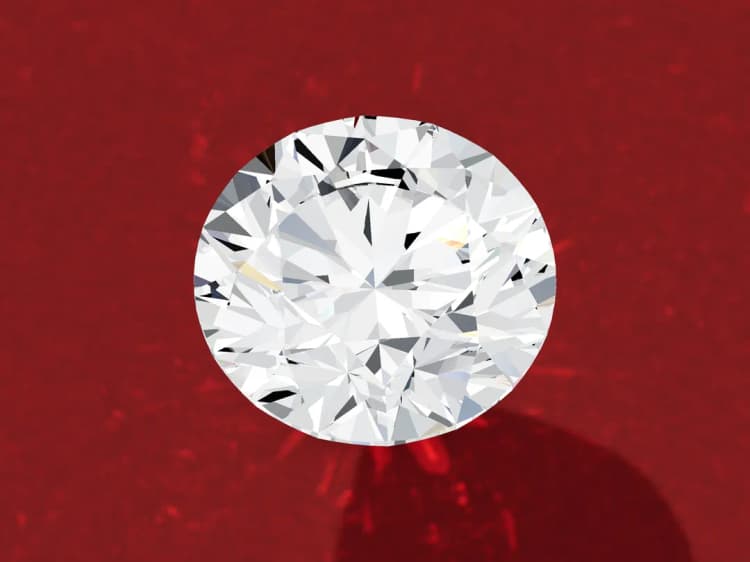
A well-cut diamond returns most of the light that enters it back through the top, which is what you see as brilliance (white flashes), fire (rainbow flashes), and scintillation (small sparkles as the stone moves). A poorly cut diamond lets a significant amount of that light leak out through the bottom or sides of the stone instead, which is what you see as a flat, dull, lifeless look on the finger.
Cut is the only one of the 4Cs that depends entirely on the human work of cutting the rough diamond. The other three (colour, clarity, and carat) are mostly determined by the rough diamond itself before the cutter starts work.
Why does diamond cut quality matter?
Because cut is what makes a diamond actually sparkle. The other 4Cs matter, but they do not control how much light returns to your eye:
- Colour controls how warm or cool the stone reads
- Clarity controls how clean the stone looks under magnification
- Carat controls how much stone there is
- Cut controls how alive the stone looks
Most engagement ring buyers fixate on colour and clarity because those grades feel more concrete (D is "better" than G, FL is "better" than VS2). But a high-colour, high-clarity stone with a poor cut grade will look duller than a lower-colour, lower-clarity stone with an excellent cut. The cut is the variable that does the visible work.
A practical way to think about it: if a diamond's cut grade drops from Excellent to Good, the stone returns roughly 30% less light. That difference is dramatic from a metre away and obvious in any normal lighting. A clarity grade drop from VVS to VS at the same carat weight is invisible to the naked eye.
What does a poorly cut diamond look like?
Flat, dull, lifeless, and often visibly grey or dark in the centre. A poorly cut diamond does not throw sparkle when you tilt it under light; instead, light passes straight through the stone and you can sometimes see through it. The stone reads as a piece of glass rather than as a diamond.
There are two specific ways a diamond can be cut poorly:
- Too shallow. The pavilion angle (the bottom half of the stone) is too flat, so light enters the top, hits the pavilion at the wrong angle, and exits straight out the bottom of the stone instead of bouncing back up. The stone looks watery and you can sometimes see through it. Shallow stones are also often cut deliberately wider to appear larger for their carat weight, which is a red flag.
- Too deep. The pavilion is too steep, so light hits the pavilion correctly but bounces back up at the wrong angle and exits out the sides of the stone, where the metal of the setting blocks it. The stone looks dark in the centre, often called a "fish-eye" effect, and the stone appears smaller than its carat weight should suggest.
In both cases the buyer paid for carat weight that is not contributing to how the stone looks. A poorly cut 1.5 carat diamond can look smaller and duller than a well-cut 1.0 carat diamond.
What is the cut grade scale?
GIA, IGI, and most diamond grading labs use a five-step scale for cut grade on round brilliant diamonds:
- Excellent (or Ideal): roughly the top 3% of cuts. Maximum brilliance, fire, and scintillation. Almost all incoming light returns to the eye.
- Very Good: very strong light return, slightly less than Excellent. Still produces a beautiful sparkling stone for most viewing.
- Good: noticeable reduction in brilliance. Acceptable but the difference is visible side by side.
- Fair: significant light leakage. The stone reads as dull in most lighting.
- Poor: major light loss. The stone looks dead, regardless of other grades.
For round brilliant diamonds, this grading is standardised across the major labs. For fancy shapes (oval, pear, cushion, emerald, marquise, asscher, princess), GIA does not issue a single overall cut grade because the criteria differ too much by shape. For fancy shapes you have to look at the individual proportion measurements (depth percentage, table percentage, length-to-width ratio) or work with a jeweller who can guide you.
Should I always buy an excellent cut diamond?
For round brilliants, yes. The price difference between Excellent and Very Good is small enough (usually 5 to 10%) that the visible sparkle gain is almost always worth it. Excellent cut is the standard recommendation, and we will not source anything below it for the stones in our round engagement rings.
For fancy shapes, the question is more nuanced because there is no overall cut grade. The right approach for fancy shapes:
- Ask the jeweller for the specific proportions of the stone (depth %, table %, length-to-width ratio)
- View the stone on a 360-degree video at high zoom before committing
- For ovals specifically, check for the bow-tie effect (see our bow tie in diamonds guide)
- For pointed shapes (pear, marquise), check the symmetry of the two halves and the proportions of the point
A "well-cut" fancy shape from a reputable maker performs as well as an Excellent-cut round. A poorly cut fancy shape can look dramatically worse than even a Good-cut round.
What are the right proportions for a well-cut round diamond?
For a round brilliant, the proportion ranges that typically produce an Excellent cut grade:
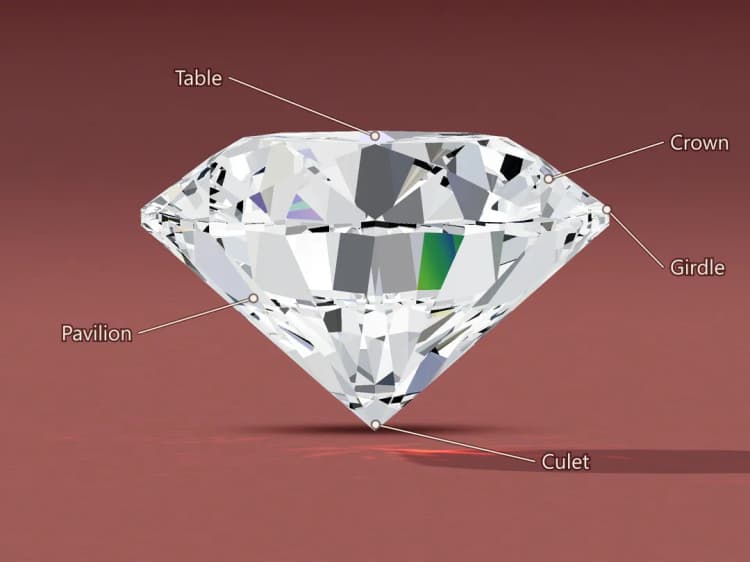
- Depth percentage: 59% to 62.6% (depth measured from the table to the culet, as a percentage of the stone's diameter)
- Table percentage: 53% to 60% (the diameter of the flat top facet, as a percentage of the stone's diameter)
- Crown angle: 33 to 35 degrees (the slope of the top half of the stone)
- Pavilion angle: 40.6 to 41 degrees (the slope of the bottom half)
- Girdle: thin to slightly thick (the band around the widest point of the stone)
- Culet: none or very small (the point or small facet at the very bottom)
- Symmetry and polish: Excellent or Very Good
These numbers do not need to be memorised. They are what produces the Excellent cut grade, and if a stone has been graded Excellent by GIA or IGI, the proportions are within these ranges by definition.
Is cut more important than clarity or colour?
Yes. Cut affects how the stone looks the moment you put it on the finger, while clarity and colour mostly matter under magnification or in specific lighting conditions.
A practical priority order for shopping within a fixed budget:
- Cut grade. Excellent for round, well-proportioned for fancy. Never compromise here.
- Colour. G or better for white-metal settings (white gold, platinum). H or I for warm-metal settings (yellow or rose gold).
- Clarity. VS2 for most stones, VS1 for step cuts (emerald, asscher) or stones above 2 carats.
- Carat. As much as your budget allows after the first three are nailed.
The classic shopping mistake is buying too much carat and not enough cut, ending up with a large stone that looks flat. The fix is to drop a quarter or half carat and use that money for an Excellent cut grade. The smaller-but-better-cut stone will look more impressive on the finger.
How do I check the cut quality of a diamond before buying?
Three practical checks:
- Read the grading certificate. GIA, IGI, and GCAL all grade cut quality. For round brilliants, look for Excellent or Ideal. Reject anything Good or below.
- Ask for a 360-degree video. A well-cut diamond moves with light and shows bright, lively flashes as it rotates. A poorly cut diamond looks the same from every angle, with light leaking visibly through the bottom or sides.
- View the stone in person if possible. Hold the diamond in front of a normal light source (not a jewellery store's overhead spotlights, which make every stone look better than it does in real life). Move the stone slowly. If it does not throw fire and brilliance, the cut is the reason.
If a jeweller cannot or will not provide a 360 video of the actual stone, do not buy from them. Photos alone are not enough to assess cut.
What cut quality should I look for in a lab-grown diamond?
The same standards as for mined diamonds: Excellent for rounds, well-proportioned for fancy shapes. The cut grading system is identical for lab-grown diamonds and mined diamonds, and the visual effect of cut quality is identical too.
One useful advantage with lab-grown diamonds: because the underlying stones are far cheaper than mined diamonds, you can afford to insist on Excellent cut without stretching the budget. Where a buyer of a 1 carat mined diamond might be tempted to drop to Very Good to save $1,000 to $2,000, the equivalent saving on a 1 carat lab-grown diamond is only $50 to $150. Stay at Excellent.
View our collection of lab-grown diamond engagement rings for excellent-cut stones at every carat.
Thanks for reading,
Jared and Brie
Designed with you, made to order
Our jewellers in Melbourne and Auckland make every ring to order for the person wearing it. If this article helped, the collection shows how these choices look on real rings, and you can ask us anything before you decide.
Or ask us a question first