
What is the difference between an asscher cut and an emerald cut?
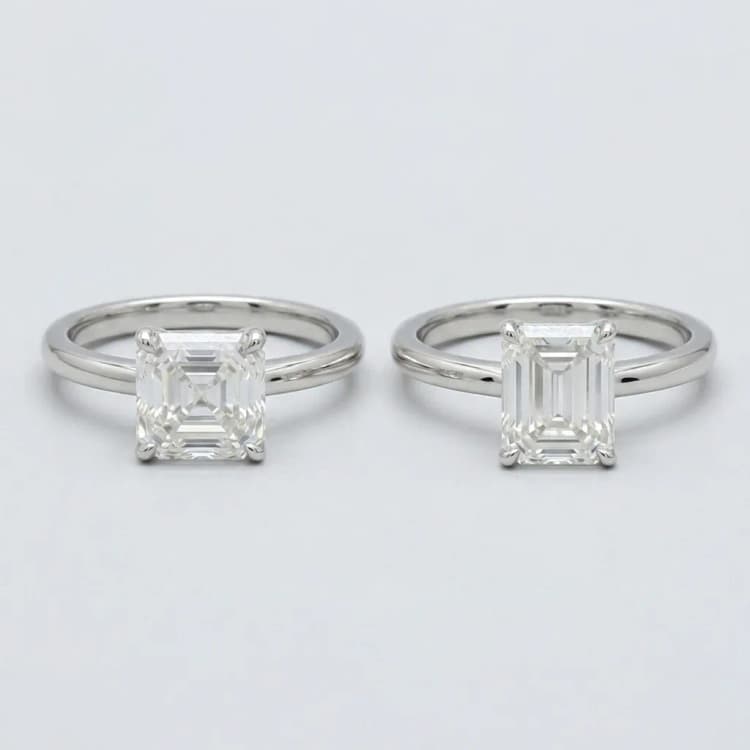
The emerald cut is a rectangle with neatly clipped corners. The asscher cut is a square with deeply cut corners that read almost octagonal from above. Both are step cuts, meaning the facets run in long parallel rows like the rungs of a ladder, instead of the small triangular facets you see on a round brilliant.
In plain numbers, the emerald cut has a length-to-width ratio between roughly 1.30 and 1.55. The asscher sits at 1.00 to 1.05, which is as close to a perfect square as a hand-cut diamond can reasonably get. That single ratio difference drives almost everything else: how the stone wears on the finger, how big it looks for its carat weight, and how the light behaves inside it.
Is an asscher cut the same as a square emerald cut?
Visually similar, technically different. A square emerald cut is exactly what it sounds like, an emerald cut shape with the length and width pulled to roughly equal. It uses the same step-cut facet pattern as a regular emerald cut, just on a squarer outline.
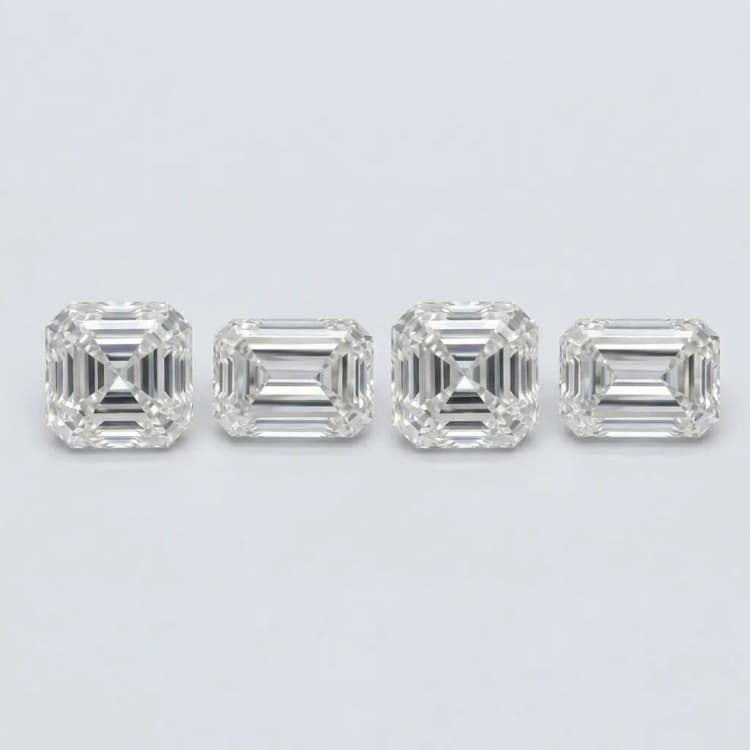
An asscher cut is its own design. The corners are cut deeper, the pavilion is steeper, and the facet pattern produces a tighter, more concentric reflection from above (the hall-of-mirrors effect). Look down into an asscher and you see what looks like a series of squares stacked towards the centre. Look down into a square emerald and you see the same broad parallel flashes as a standard emerald cut, on a squarer canvas.
Practically, both feel square in the hand. The asscher reads more vintage and more Art Deco because of the deeper corners and concentric pattern. The square emerald reads cleaner and more contemporary. If you want the deco look, asscher. If you want a modern square step cut, square emerald.
What does an asscher cut diamond look like?
Square outline with deeply cut corners, a high crown, and a step-cut facet pattern that creates a concentric square reflection towards the centre of the stone. The deep corners are the giveaway. They make the silhouette read as eight-sided rather than four-sided when you look at the ring straight on.
The original asscher cut diamond (cut by the Asscher family of Amsterdam in 1902) has 58 facets. The Royal Asscher version, patented in 2001, has 74 and shows a slightly more elaborate hall-of-mirrors pattern. Either way, the stone sits noticeably tall on the finger because the pavilion is deeper than a standard step cut, which is part of what creates the concentric light play.
Which looks bigger, asscher or emerald cut?
Emerald, easily, at the same carat weight. A 1 carat emerald cut measures roughly 7.0 x 5.0 mm to 7.7 x 5.5 mm depending on ratio. A 1 carat asscher measures around 5.5 x 5.5 mm. The emerald spreads the same weight across more visible surface, which makes the diamond read larger from above and elongates the finger at the same time.
Carat-for-carat, the emerald gives more visual size and the asscher gives more weight in a compact square. If looking larger for the money matters to you, the emerald wins. If you want presence without elongation, asscher does that.
Which sparkles more, asscher or emerald cut?
Neither sparkles the way a round brilliant does, because step cuts produce broad flashes of light rather than the small scattered flashes (called scintillation) that brilliant cuts are known for. Between the two, the asscher returns more visible flash because of its deeper pavilion and concentric facet pattern, which bounces light back through the centre of the stone more aggressively than the long parallel flashes of an emerald.
The emerald gives you long linear flashes that move across the stone as you tilt your hand. The asscher gives you a tighter, brighter centre that flickers as the stone moves. If you want any kind of step-cut and still want the most internal light play, asscher is the slightly livelier of the two. If you want quiet, mirror-like elegance, emerald.
What clarity grade do I need for an asscher or emerald cut?
VS1 or VS2 as a sensible floor for either, and always view the actual stone before you buy. Step cuts hide nothing, which is why the diamond clarity grade matters more here than it does in a busy brilliant cut. The broad parallel facets work like a window straight to the centre of the diamond, so inclusions that disappear in a round brilliant show up clearly here. The asscher is the slightly less forgiving of the two because the hall-of-mirrors pattern draws the eye directly to the centre, where any central inclusion sits.
A few practical notes:
- VS2 with edge-only inclusions (away from the centre) is usually fine
- SI1 can work on an emerald cut if the inclusions are at the corners or hidden under prongs
- SI1 on an asscher is risky because the concentric pattern points straight to the middle
- Avoid black or dark crystal inclusions in either, since they read as visible spots against the open facets
This is one of the few cases where moving to a lab-grown diamond pays off twice. Higher clarity grades are dramatically more affordable lab-grown than mined, and step cuts are exactly the shape where higher clarity earns its keep.
What colour grade do I need for an asscher or emerald cut?
G or better for platinum and white gold settings, H or I for yellow and rose gold. Body colour shows more in step cuts than in brilliant cuts because the open facets do not break light into scattered flashes that mask warmth. In a white-metal setting, warmth in the diamond reads as a yellow tint. In a warm-metal setting the metal absorbs the contrast, which is why you can drop a grade or two without it looking off.
If you are setting in white gold or platinum and the stone is over 1.5 carats, lean towards F or G. The larger the step cut, the more visible any colour will be.
How does each cut look on the finger?
The emerald cut elongates. Its rectangular outline runs along the length of the finger, which lengthens the hand visually and makes it a popular choice for shorter fingers or wider hands. It reads polished and quietly modern.
The asscher sits compact and centred. It does not lengthen the finger but it commands attention through symmetry. The square outline with cropped corners is one of the most recognisable Art Deco shapes in jewellery, which is why it works particularly well in vintage-style settings, milgrain detailing, and three-stone designs with trapezoid side stones.
East-west settings work for the emerald (rotating it 90 degrees so it lies across the finger). They do not really work for the asscher, since the symmetry means there is no east-west to rotate to.
What settings work for each?
Across our engagement rings, the most popular settings for an emerald cut are:
- Solitaire, with four prongs at the clipped corners. Lets the geometry of the stone do all the work.
- Three-stone with tapered baguettes as side stones. Repeats the step-cut language across the ring.
- East-west, which rotates the stone across the finger for a modern, less expected look.
- Halo, which adds the round-brilliant sparkle that the step cut deliberately does not provide.
For an asscher, the most popular settings are:
- Solitaire with four prongs. The square shape is bold enough to stand alone.
- Art Deco-inspired settings with milgrain edges, filigree, or geometric accents. The cut was peaking during Art Deco and the styles still suit it best.
- Three-stone with trapezoid side stones, which mirror the squared outline of the centre stone.
- Bezel, which suits the architectural feel of the asscher and protects the corners.
Asscher vs emerald cut for an active lifestyle
Both step cuts have cropped corners that protect against the chipping you would worry about on a sharp-cornered shape like a princess cut. They are both reasonable choices for daily wear, with a small honest caveat: the corners on either stone are the weakest point, and a hard knock at the wrong angle can chip them. Prongs at the corners are the standard protection.
The asscher with its deeper pavilion sits a touch taller off the finger, so it is marginally more likely to catch on clothing or door frames than a flatter emerald cut. A bezel setting fixes that for either stone.
So, asscher or emerald cut?
Pick the emerald if you want a stone that looks larger for its carat weight, elongates the finger, and reads quietly elegant. Pick the asscher if you want symmetry, more flash from the centre of the stone, and a clear vintage or Art Deco feel.
If a radiant cut is on your list too, it shares the emerald's outline with brilliant facets, and our emerald cut vs radiant cut guide compares the two.
The fastest way to decide is to try both. The numbers on paper do not show you how a stone moves on your hand, and most people who think they know which they prefer change their mind once they see them side by side.
View our collection of emerald cut engagement rings to see how the step-cut look wears, or the wider lab-grown diamond range to compare step cuts against the brilliant shapes. If the asscher wins, contact us and we'll source and set one as a custom order.
Thanks for reading,
Jared and Brie
Designed by us in Melbourne, made to order
Lily Dia is a small studio, so every ring is drawn, set and finished for the person wearing it. If this article helped, the collection shows how these choices look on real rings, and you can ask us anything before you decide.
View lab-grown diamond ringsOr ask us a question first