Does Moissanite Look Fake?

By Jared James · Last updated 25 May 2026
Quick answer
No, not if it's a D VVS1 stone, cut well, and set in solid gold. The moissanite that looks fake online is almost always a low-grade stone in a plated setting. Here's how to tell, what to avoid, and what to say if someone asks.
Does moissanite look fake?
No, not if it's a D VVS1 stone, cut well, and set in solid gold. At that spec a moissanite reads as a real, high-end gemstone to almost everyone who looks at it, and to most jewellers without a tester. The moissanite that looks fake in photos online (the kind you see in Reddit threads complaining about a $90 ring) is almost always a low-grade stone with a visible yellow or green tint, a careless cut, and a plated setting that wears through in a year. Quality solves the question by itself.
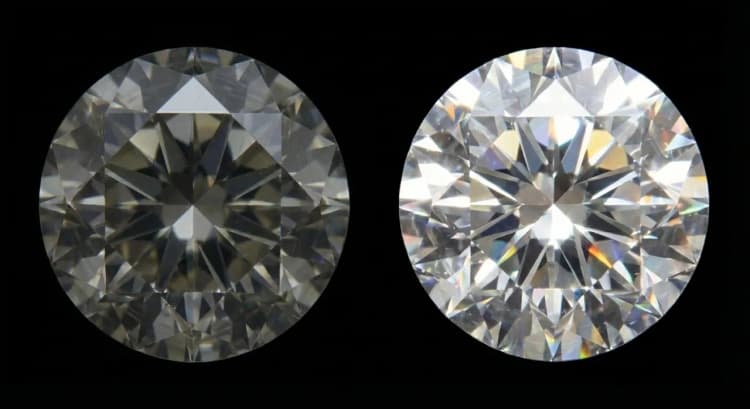
There's one real visual difference even with a great stone: moissanite throws more rainbow flash than diamond because its refractive index is higher (2.65 to 2.69 vs 2.42). Side by side in bright sunlight, you can see it. In normal indoor light, almost no one does.
Does moissanite look like a diamond?
To the naked eye, yes, especially at D VVS1 in a clean cut. The cooler, whiter brilliance you associate with diamond is mostly a function of cut quality and colour grade, and a well-cut moissanite gives you the same effect. What changes is the fire pattern. Moissanite produces more visible colour flashes (red, blue, green) when light hits it from the right angle. In subdued or office lighting most people don't pick that up. In direct sunlight or under a downlight, they sometimes do.
The other tell, if anyone's looking for it, is the double-refraction visible through the table of the stone at certain angles, but you need a loupe and you need to know what you're looking for. Most jewellers without a thermal-conductivity tester can't tell by eye either.

What makes moissanite look fake or cheap
Four things, in roughly the order that they ruin a ring:
Colour tint. Low-grade moissanite (G colour or below) often shows a yellow, grey, or green cast that's obvious in person even if the listing photos look fine. Anything graded D, E, or F should read as colourless to the eye. If you can see a tint when you tilt the stone, the grade is wrong or the seller is misrepresenting it.
A lazy cut. A poorly cut moissanite looks dull and glassy, like cubic zirconia under a layer of grease. The facet edges aren't sharp, the symmetry is off, and the light bounces around inside the stone instead of coming back out as sparkle. This is the most common reason a moissanite looks like a fake.
Plated settings. Gold-plated or rhodium-plated metal looks identical to solid gold in studio photos, but the plating wears through at the underside of the band and the back of the prongs within a year of daily wear. Once that happens, the ring reads as cheap regardless of how good the stone is. Solid 9k, 14k, or 18k gold doesn't have this problem.
Thin or clumsy prongs. Mass-produced settings use minimal metal in the prongs to save cost, which leaves them looking spindly next to the stone. Substantial, symmetrical, hand-finished prongs give the ring presence and stop the stone looking like it's stuck on top.

The moissanite "disco ball" effect
This is the fire problem. At larger carat weights (around 2ct and up) in direct sunlight or under harsh lighting, moissanite can throw enough rainbow flash to look distractingly colourful. Some people love it, some people read it as "not a diamond" and switch off.
If you want to dial it back, the cut does most of the work:
- Step cuts (emerald, asscher). Long parallel facets give a hall-of-mirrors effect with more white light and less colour fire. The least disco-ball-looking option in moissanite.
- Crushed-ice cuts (radiant, cushion). Small irregular facets scatter the fire into a finer, less concentrated sparkle. Reads closer to diamond at a glance.
- Round brilliant. The most sparkle of any cut, which means the most fire. At smaller sizes (under 1.5ct) it's not noticeable; at 2ct and up, it leans disco.
If you've already got a big round and the fire is more than you want, the lighting matters too. Most rooms are softer than the showroom you bought it in.
How to tell real moissanite from fake (or from CZ)
Three reliable ways:
Diamond/moissanite tester. A handheld thermal-conductivity tester reads moissanite the same as diamond (both conduct heat well). Cubic zirconia doesn't register. If the stone fails the test, it isn't moissanite. Most jewellers will test for free in store.
Weight. Moissanite is about 15% lighter than diamond at the same physical size. Cubic zirconia is around 75% heavier than diamond. A 6mm round CZ feels noticeably weightier on the lobe or finger than a 6mm moissanite.
Laser inscription. Charles and Colvard moissanite (and most reputable AU suppliers) laser-inscribe a tiny serial number on the girdle of the stone. You need a 10x loupe to see it, but it's the cleanest way to confirm the stone is what the seller says it is.
What to ignore: the "sparkle test" by eye. Internet guides will tell you that real moissanite throws rainbow flashes and fake doesn't, but a well-cut CZ in good lighting also throws colour, and a poorly lit moissanite doesn't. By eye is unreliable. The tester takes five seconds and is definitive.
Red flags when buying moissanite online
A short checklist of things that almost always mean it isn't what the listing says:
- A 2ct ring in "solid gold" for under $200. The gold alone costs more than that. The stone is cubic zirconia and the metal is plated brass.
- Listings that use "moissanite simulant", "imitation moissanite", or "man-made diamond" in the title or description. None of those are moissanite. Real moissanite is just called moissanite.
- No colour or clarity grade. A real seller of D VVS1 moissanite will tell you it's D VVS1. If the listing says "high quality" or "VVS" without the grade, assume it's lower than D and lower than VVS1.
- Stock photos. Reverse-image search the listing photo. If it shows up on twelve unrelated sites, you're not seeing the actual product.
- A seller with no AU address and no return policy. Cheap moissanite drop-shipped from overseas is the source of most "is this fake?" Reddit posts. Buy from an AU jeweller and the consumer law side is easier if something goes wrong.
What to say if someone asks if it's real
If you don't want to get into it, "it's moissanite" is a complete answer. If they want more, the short version is that moissanite is a real gemstone (silicon carbide), it's lab-grown rather than mined, and it's harder than ruby or sapphire. People who ask are usually curious, not checking up on you.
If it's a partner's ring and you want to volunteer the choice, framing it around the money is the simplest line: "We chose moissanite because we'd rather spend the rest on the house / the wedding / the honeymoon." That's a reason most people don't argue with.
You're wearing a lab-grown gemstone in a solid gold setting, which is a real piece of fine jewellery on its own terms. The "is it real?" question is mostly about cubic zirconia, and as long as your moissanite has a tester reading, a colour grade, and a solid setting, it's going to outlast the conversation.
If you want to see what high-grade moissanite looks like in person, our moissanite earrings and moissanite necklaces are all D VVS1 in solid gold. For more on the comparison, moissanite vs diamond stud earrings covers the differences in detail.
Thanks for reading,
Jared & Brie
Next step
See the stones set in real rings
Browse lab-grown diamond and moissanite engagement rings to see how they compare once they are set.
View lab-grown ringsNeed a second opinion
Talk to the studio
If you are weighing up a ring or comparing options, send the details through and we can help you think it through.
Contact the studio