How to Test Gold at Home

By Jared James · Last updated 25 May 2026
Quick answer
The fastest at-home gold tests are the hallmark check and the magnet test, which together rule out most fakes. An acid testing kit or electronic tester gives you a precise karat reading. Vinegar, bleach, and skin-discolouration tests don't reliably tell you anything.
How do you test gold at home?
Three steps cover most of what you can learn at home: check the hallmark inside the band, run a strong neodymium magnet across the piece, and (if you need a karat reading) use an acid testing kit or an electronic gold tester. Hallmark plus magnet rules out most fakes in under a minute. Acid or electronic testing gives you the exact karat (9k, 14k, 18k, 22k, 24k) if the hallmark is missing or you don't trust it.
The popular vinegar, bleach, water, and "does it turn my skin green" tests don't reliably distinguish real gold from fakes, and a few of them can damage the piece. Skip those.
What do the hallmarks on gold mean?
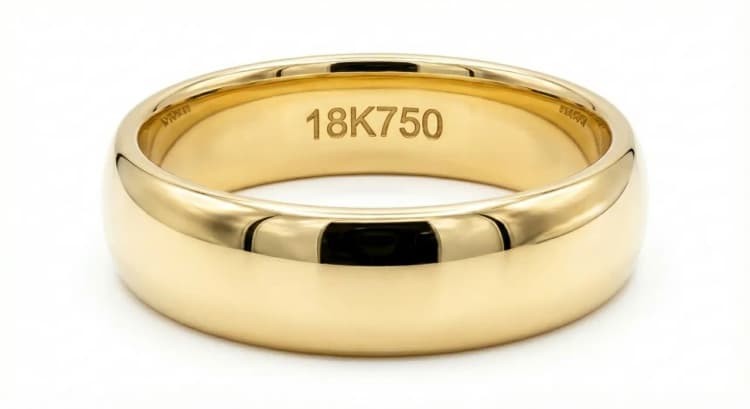
Gold jewellery sold in Australia is almost always stamped with a karat or fineness mark inside the band, on a clasp, or on an earring post. The two systems mean the same thing:
- 375 = 9k (37.5% pure gold). Historically the most common karat in Australian-made jewellery.
- 585 = 14k (58.5% pure gold). More common in US imports than in Australian-made pieces.
- 750 = 18k (75% pure gold). The premium standard for fine jewellery in Australia.
- 916 = 22k (91.6% pure gold). Mostly Indian and Middle Eastern wedding jewellery.
- 999 or 9999 = 24k (99.9% pure gold). Bullion-grade; too soft for everyday wear.
Letter marks tell you the piece is plated rather than solid gold:
- GF, GE, RGP (gold filled, gold electroplate, rolled gold plate): a layer of gold bonded over a base metal. Looks gold, isn't solid gold.
- HGE, HGP (heavy gold electroplate, heavy gold plate): same idea with a thicker plating layer.
- GP, EP (gold plated, electroplated): the thinnest plating, wears off fastest.
- Vermeil: gold plating over sterling silver. The base is precious but the gold is still surface-only.
You'll also sometimes see a maker's mark (initials or a logo) and a country mark next to the karat. Hallmarks can be faked, so treat them as a starting point and confirm with one of the other tests. A missing hallmark on something claiming to be solid gold is suspicious by itself.
The magnet test for gold
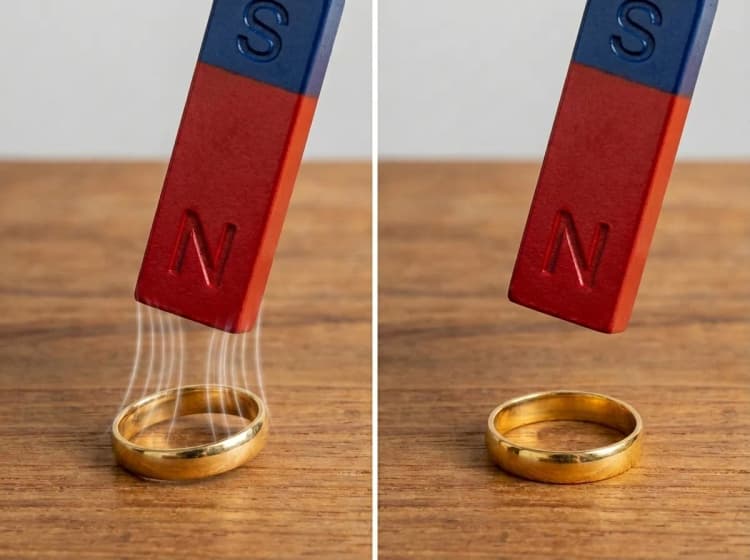
Real gold isn't magnetic. Bring a strong neodymium magnet (not a fridge magnet, which is too weak) close to the piece. If it attracts, the piece is either not solid gold or has a significant base-metal core under the plating. If there's no attraction, the piece passes this first filter.
The catch is that some gold-plated items are plated over non-magnetic base metals (brass, copper, zinc alloys), and those will pass the magnet test while not being solid gold. The magnet is a quick first screen. It doesn't give a final answer on its own.
The float test
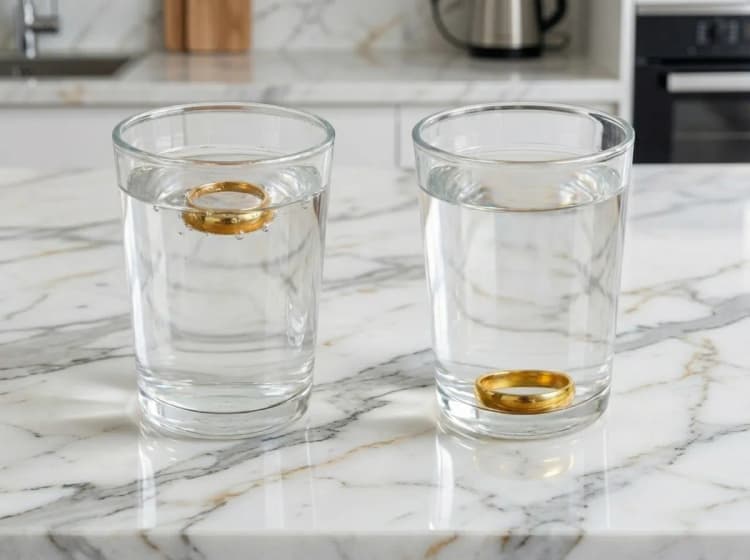
Real gold is dense, around 19.3 g/cm³ for pure 24k and 13 to 16 g/cm³ for 14k to 18k alloys. Drop the piece into a glass of water and it should sink straight to the bottom. A piece that floats or hovers is definitely not solid gold.
The limit is that most jewellery base metals (brass, copper, silver, lead-based fakes) also sink, so a sinking result confirms "denser than water" without confirming "gold". Tungsten in particular has almost the same density as gold and is the metal of choice for fake gold bars. A float test on a finished piece of jewellery rules out plastic and hollow fakes and not much else.
The ceramic plate test
A piece of unglazed ceramic (the underside of a kitchen tile works) shows a different streak colour for gold than for most fakes. Drag the piece firmly across the unglazed surface and look at the mark:
- Yellow-gold streak: likely real gold.
- Black, grey, or no streak: likely plated or fake.
This works because gold is soft enough to leave a metallic deposit on the rough ceramic, and most fake-gold base metals leave a different colour. The downside is that it's a scratch test, so it leaves a small worn mark on the piece. Use it on an inconspicuous spot, or skip it on finished pieces you care about.
The vinegar test: does it work?
Not reliably. The vinegar test (drop a few drops of white vinegar on the piece, wait, see if the colour changes) gets shared as proof of authenticity, but household vinegar is too weak to react with most metals, real gold or otherwise. A piece that doesn't change colour passes the test even if it's brass or copper under a thin plating, because vinegar isn't strong enough to break through plating in a minute.
The test has one narrow use: if vinegar visibly tarnishes the surface, the piece is definitely not solid gold. A "no reaction" result tells you almost nothing.
The acid testing kit
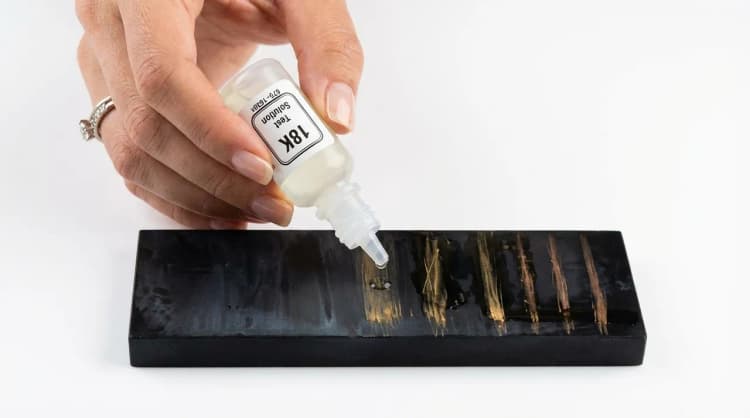
The most reliable at-home method for confirming both authenticity and karat. A gold acid testing kit costs $30 to $80 in Australia and includes a black testing stone, separate acids for each karat (10k, 14k, 18k, 22k), and sometimes a set of testing needles with known gold samples for comparison.
How it works:
- Drag the piece firmly across the testing stone in an inconspicuous spot. You should see a thin gold streak left behind on the stone.
- Drop a small amount of the karat acid you suspect (start with the highest karat you think it might be) onto the streak.
- Read the result. If the streak dissolves or changes colour significantly, the piece is lower karat than the acid. If the streak holds, the piece is at least that karat.
- Step down through karats to narrow the exact value. Surviving 14k acid but dissolving under 18k acid means you have 14k gold.
Safety notes:
- Wear nitrile gloves and eye protection. The acids include nitric and hydrochloric acid; they will burn skin.
- Work in a well-ventilated space; the fumes are unpleasant.
- Keep baking soda or a bicarbonate solution nearby to neutralise spills.
- Apply acid to the streak on the stone, never directly to the piece.
- For thick-plated items, file a small notch in a hidden spot to expose the metal underneath; otherwise you're testing the plating, not the gold underneath.
The acid test leaves a small streak on the stone (not on the piece) and requires either filing or dragging the piece on the stone, so it isn't fully no-trace.
Using an electronic gold tester
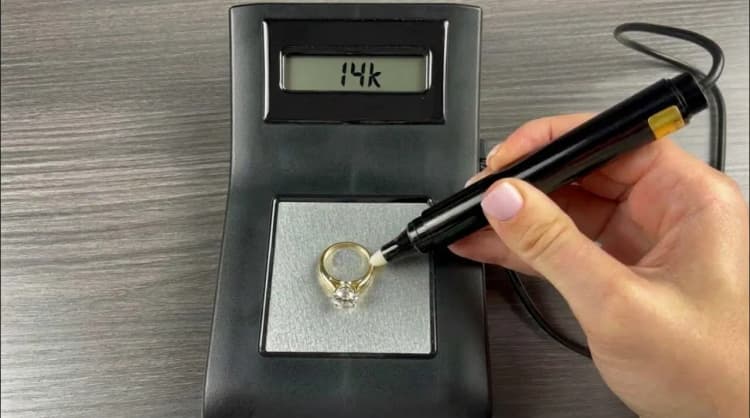
For frequent testing, an electronic gold tester measures surface electrical conductivity to estimate karat. Decent units cost $80 to $400 in Australia and give a karat reading in a few seconds by pressing a probe against the gold.
Advantages over acid:
- No acids and no scratching.
- Reads in 2 to 5 seconds.
- Reusable, with no consumables to replenish.
Limitations:
- Surface-only reading, so any plating fools the test. File a notch on suspect items to expose the underlying metal.
- Needs periodic calibration with a known gold sample (most kits include an 18k calibration plate).
- Probe tips wear and need replacement every few months under regular use.
Electronic testers make sense if you regularly buy or sell second-hand gold. For a one-off check on an inherited piece, the acid kit is more cost-effective.
Does real gold turn your skin green?
Sometimes, yes, even when it's real. Skin discolouration (green on the finger, black under a chain) comes from other metals in the alloy (usually copper or nickel) reacting with sweat, soap, and skin chemistry. 9k and 14k golds contain more copper than 18k, so they're more likely to leave a mark on some skin types. Sterling silver also turns skin black under similar conditions.
A green-finger result rules out 24k (which is too pure to react) but doesn't tell you whether the piece is gold or a copper alloy with no gold in it. Use the magnet, ceramic, or acid tests to find out for sure.
Going the other way doesn't work either. A piece that leaves no green mark could still be a non-reactive base metal under thick plating, or a fake alloy designed to avoid the reaction. Skin reaction alone is too dependent on body chemistry to use as a test.
When to take it to a jeweller
If the piece has sentimental or financial value, a jeweller is faster and more accurate than any home test. Most Australian jewellers will test gold for free for walk-ins, and a written appraisal for insurance costs $50 to $150 depending on the piece.
We do free gold testing at our Melbourne workshop on any piece you bring in. Contact us if you'd like something checked, or if you're considering trading in an old piece for something new.
If you're upgrading into a new piece, our engagement ring collection covers 14k and 18k gold settings in lab-grown diamond and moissanite.
Thanks for reading,
Jared & Brie
Next step
See the stones set in real rings
Browse lab-grown diamond and moissanite engagement rings to see how they compare once they are set.
View lab-grown ringsNeed a second opinion
Talk to the studio
If you are weighing up a ring or comparing options, send the details through and we can help you think it through.
Contact the studio