What Are Lab-Grown Diamonds?

By Jared James · Last updated 21 May 2026
Quick answer
A lab-grown diamond is a real diamond, grown from carbon in a controlled chamber rather than mined from the earth. It has the same hardness and the same diamond sparkle as a natural diamond, and what really changes with origin is the price, the resale expectations and what the stone means to you.
What counts as a lab-grown diamond
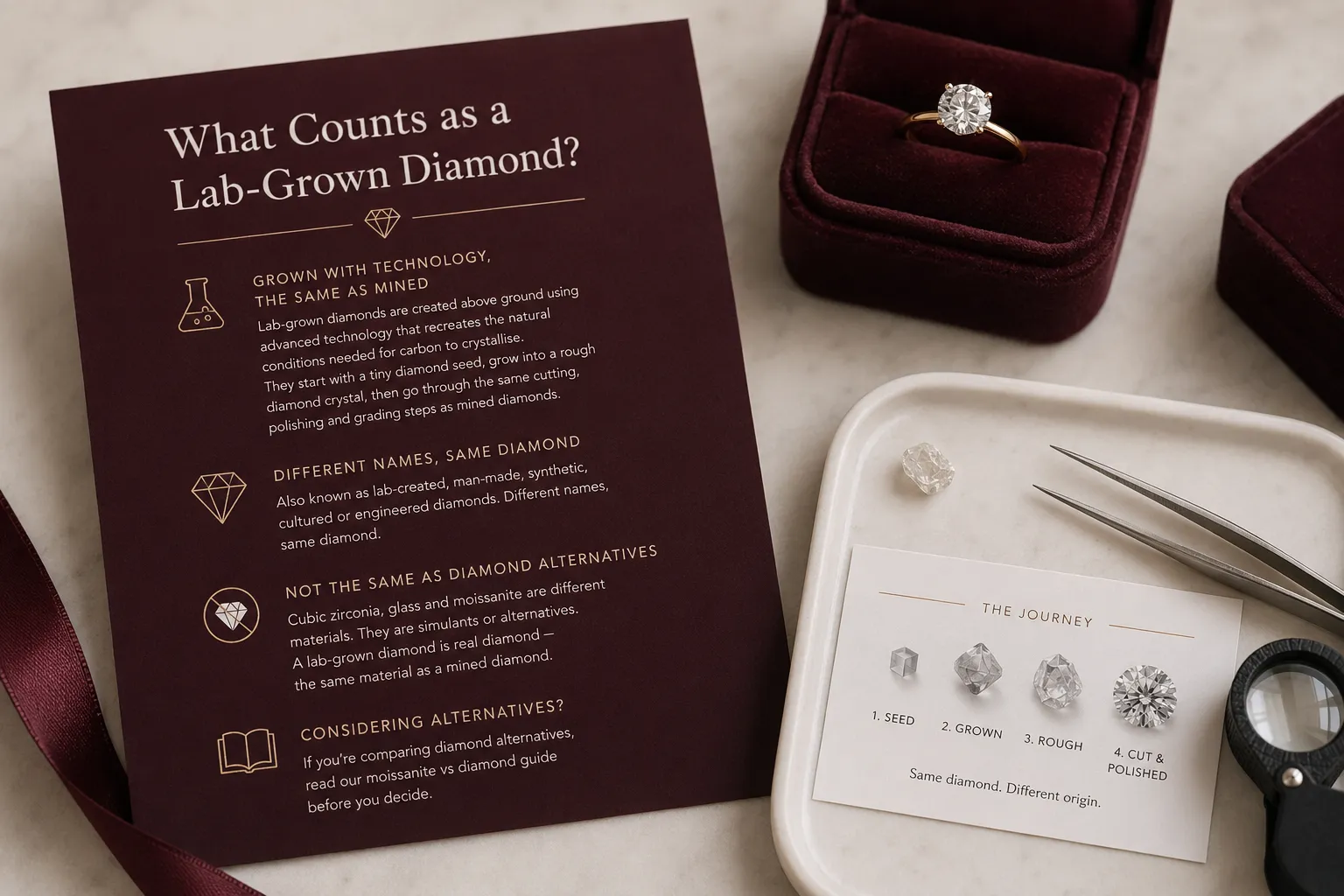
Lab-grown diamonds are diamonds made above ground, using technology that recreates the conditions carbon needs to crystallise. They start life as a tiny diamond seed, grow into a rough diamond crystal, and then go through the same cutting, polishing and grading steps as a mined diamond.
You will also see them called lab-created, man-made, synthetic, cultured or engineered diamonds, and all of those names point to the same thing, a diamond grown in a lab rather than mined. So whichever label a seller uses, you are looking at the same product.
Cubic zirconia, glass and moissanite are something else. They are diamond simulants, or diamond alternatives, made from different materials, whereas a lab-grown diamond is the same material as a mined diamond, so it behaves like a diamond once it is in a ring.
If you are weighing up diamond alternatives too, it is worth reading the moissanite vs diamond guide before you decide, because the two stones can both be lovely to look at while differing in material, sparkle and price.
Are lab diamonds real?
Yes, lab-grown diamonds are real diamonds. They are pure carbon arranged in a diamond crystal structure, and that is what gives them the same hardness, brilliance and fire as a mined diamond of the same quality.
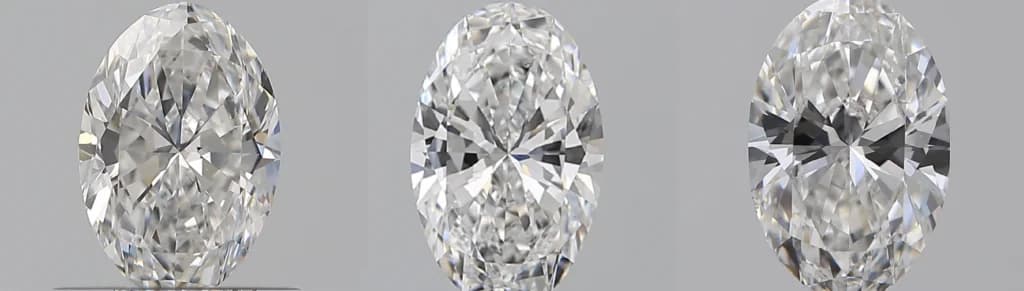
You cannot pick a lab-grown diamond by eye, and even a trained jeweller needs specialist equipment to confirm where it came from, because sparkle comes down to how well the stone is cut rather than how it was grown. The origin is recorded on the grading report instead, which is why certification matters when you are comparing stones.
If you want the short answer in a little more detail, head to are lab-grown diamonds real?
How lab-grown diamonds are made: HPHT vs CVD
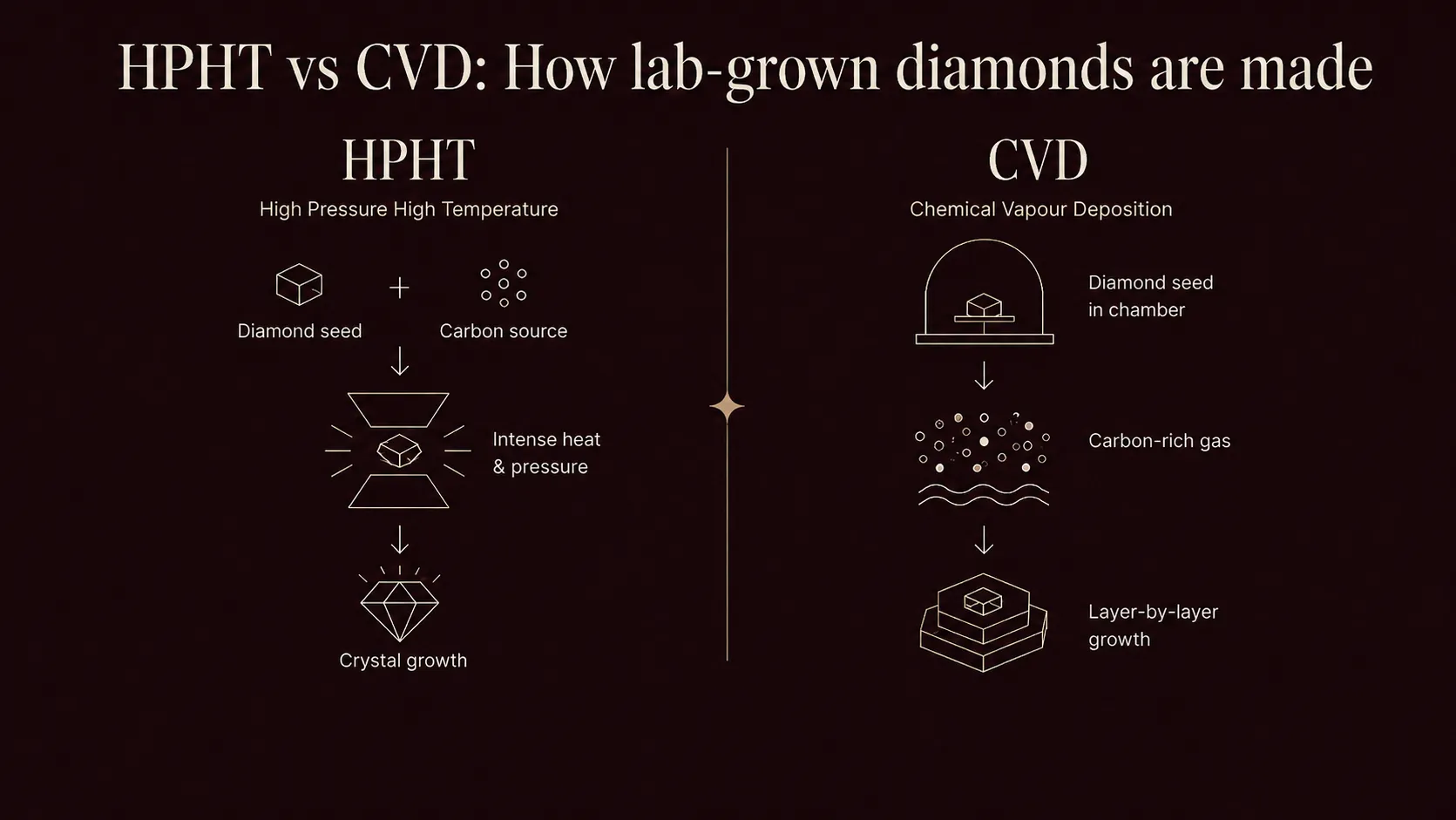
Lab-grown diamonds are made in two main ways, HPHT and CVD. Both start with a diamond seed and a carbon source, and both produce rough crystals that can be cut into engagement ring stones. The method is sometimes listed on the grading report, but your buying decision still comes back to the cut, colour, clarity, carat and how the stone actually looks.
HPHT, High Pressure High Temperature
HPHT presses a diamond seed into a carbon source under intense heat and pressure, and carbon crystallises around the seed. It works on much the same principle as the way diamonds form deep in the earth, just inside controlled equipment instead.
CVD, Chemical Vapour Deposition
CVD places a diamond seed in a chamber filled with carbon-rich gas. The gas breaks down, and carbon settles onto the seed layer by layer, slowly growing a diamond crystal over time.
How lab-grown diamonds are graded
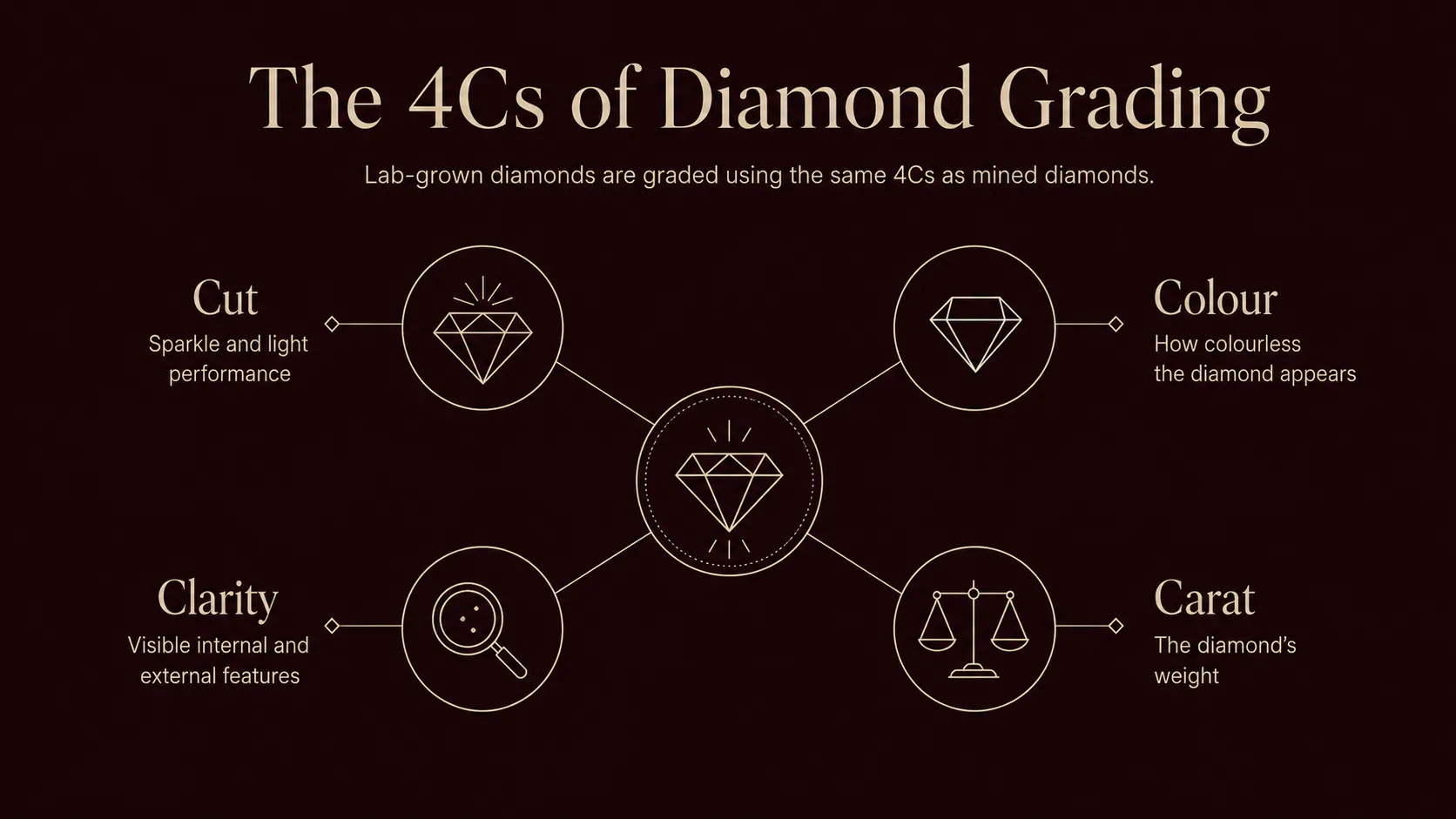
Lab-grown diamonds are graded with the same 4Cs used for mined diamonds, the cut, colour, clarity and carat weight, and the report states that the diamond is laboratory-grown, so you can weigh up quality and origin separately. That is how IGI and most laboratories handle them. GIA is the exception: from October 2025 its lab-grown reports use a simpler Premium or Standard rating in place of the 4Cs.
Cut matters most for sparkle. Colour and clarity matter too, but they are best read alongside the setting metal, the stone shape and the size, because they all play off each other. A well-cut G colour VS2 diamond can make a better engagement ring than a larger stone with weak light return.
Start with the 4Cs of diamonds, then compare the diamond colour, diamond clarity and diamond certification guides once you have a particular stone in mind.
Watch: 8 checks before you buy
A quick video walkthrough of the eight checks to make on a lab-grown diamond certificate before you buy.
How much lab-grown diamonds cost
A lab-grown diamond usually costs less than a mined diamond of the same cut, colour, clarity and carat weight, and the difference comes down to supply. A lab can grow a diamond in a matter of weeks and there is real competition between growers, so the price reflects production rather than natural scarcity.
The same four factors that grade a diamond also drive its price. Carat weight moves it the most, and the gap between lab-grown and mined tends to widen as the stone gets larger, so a bigger centre stone is where your budget stretches furthest. Shape plays a part too, because a round diamond loses more of the rough crystal in the cutting, so it usually costs more than a fancy shape of the same weight.
Prices move with the market, so for current figures it is best to look at live stock. You can see what lab-grown diamonds currently cost, and if you are weighing that spend against resale and rarity, are lab-grown diamonds worth it? works through the trade-off.
Lab-grown vs natural diamonds
Lab-grown and natural diamonds are the same material, so the comparison is never really about quality. It comes down to origin, availability, price and resale expectations.
If you love the idea of a stone that formed underground over a very long time, a natural diamond may carry more meaning for you. If you want the diamond look and feel while putting more of the budget into size, cut or the setting, then lab-grown tends to make more sense.
| Factor | Lab-grown diamond | Natural diamond |
|---|---|---|
| Material | Pure carbon in a diamond crystal structure. | Pure carbon in a diamond crystal structure. |
| Hardness | 10 on the Mohs scale. | 10 on the Mohs scale. |
| Appearance | The same diamond brilliance and fire when cut to the same standard. | The same diamond brilliance and fire when cut to the same standard. |
| Origin | Grown from a diamond seed using HPHT or CVD technology. | Formed underground and brought to the surface through mining. |
| Grading | Graded on the 4Cs by IGI; GIA switched to a Premium or Standard rating in 2025. | Assessed by the 4Cs, with the report noting natural origin. |
| Price | Usually lower than a comparable natural diamond. | Usually higher at the same size and grade. |
| Resale | A smaller resale market, partly because new supply can scale. | A more established resale market, though retail price is rarely recovered. |
For a deeper comparison, read lab-grown vs natural diamonds.
Are lab-grown diamonds more ethical?
Ethics and the environment are among the most common reasons people choose lab-grown. Growing a diamond above ground avoids the land disturbance and the labour concerns that can come with mining, and the supply chain is shorter, which makes it easier to trace a stone back to its source.
It is worth a closer look before you treat it as settled, though. A lab still uses energy to grow and cut a diamond, and how clean that energy is varies from one producer to the next, while a mined diamond can also be sourced responsibly. If origin and footprint sit at the centre of your decision, the ethical diamonds guide compares the two in more detail.
Lab-grown diamond engagement rings
Lab-grown diamonds work well for engagement rings because they are hard enough for daily wear, they grade like natural diamonds, and they give you more room to move inside a set budget. A lot of buyers use that room to put cut quality first, or to choose a larger centre stone or a more considered setting.
They suit you less if natural rarity or later resale is what you care about most, and that is an origin and market question rather than anything to do with quality. Choose the stone for how you plan to wear it, how you feel about its origin and what the budget needs to cover.
- Choose lab-grown if you want a real diamond and more size for the spend.
- Choose lab-grown if you plan to keep the ring and value the design more than resale.
- Choose natural if rarity and the natural formation story matter more.
Ready to compare
See lab-grown diamonds in ring settings
Browse lab-grown diamond engagement rings and compare how shape, size, colour and clarity read once the stone is set.
View lab-grown ringsHow to care for a lab-grown diamond
Caring for a lab-grown diamond is no different to caring for a mined one. Clean it with warm water, a mild soap and a soft brush, then dry it with a lint-free cloth. The stone itself is hard-wearing, but the setting around it still needs attention, especially the claws, any fine bands and pave-set details.
Store diamond jewellery on its own so it does not scratch softer stones or metals, and have the setting checked if the ring starts to catch, rattle or feel loose. The jewellery care guide goes into more detail.
Frequently asked questions
- Are lab-grown diamonds real diamonds?
- Yes. Lab-grown diamonds are real diamonds. They are pure carbon in a diamond crystal structure, with the same hardness and the same diamond sparkle as mined diamonds of the same cut quality.
- How are lab-grown diamonds made?
- They are made with HPHT or CVD technology. Both methods start with a diamond seed and a carbon source, then grow a rough diamond crystal that is cut, polished and graded.
- Are lab-grown diamonds cheaper than natural diamonds?
- Yes. At the same cut, colour, clarity and carat weight, a lab-grown diamond usually costs less than a mined one, because the supply is not limited the way mined supply is. The saving tends to grow as the carat weight goes up.
- Are lab-grown diamonds graded like natural diamonds?
- Mostly. Laboratories such as IGI grade lab-grown diamonds by cut, colour, clarity and carat weight, the same scales used for mined diamonds, and the report identifies the stone as laboratory-grown. GIA changed its approach in October 2025 and now rates lab-grown diamonds as Premium or Standard rather than using the 4Cs.
- Are lab-grown diamonds more ethical than mined diamonds?
- They can be. Growing a diamond avoids the land disturbance and the labour concerns that can come with mining, and the supply chain is shorter. A lab still uses energy though, and mined diamonds can also be sourced responsibly, so it is worth reading the detail before you decide.
- Is moissanite a lab-grown diamond?
- No. Moissanite is a different material, silicon carbide rather than carbon, so it is a diamond alternative rather than a diamond. A lab-grown diamond is the same material as a mined diamond, and the two stones sparkle in noticeably different ways.
- Can you tell a lab-grown diamond from a natural diamond by looking?
- No. A lab-grown diamond and a natural diamond of the same cut, colour, clarity and carat weight look the same to the eye. Specialist laboratory equipment can identify the growth origin.
- Do lab-grown diamonds get cloudy over time?
- No. Lab-grown diamonds do not become cloudy because of their origin. Like any diamond, they can look dull when soap, lotion or everyday wear leaves residue on the stone, so regular cleaning helps keep the sparkle clear.
- Are lab-grown diamonds good for engagement rings?
- Yes, if you want a real diamond and prefer to put more of the budget into size, cut quality or the setting. They may suit you less if natural rarity or later resale value matters most.
Still comparing
Ask us to compare specific stones
Send the diamond reports or the ring brief you are working with, and we will help you compare the trade-offs in plain language.
Contact the studio