
What is the girdle of a gemstone?
Last updated 17 October 2026
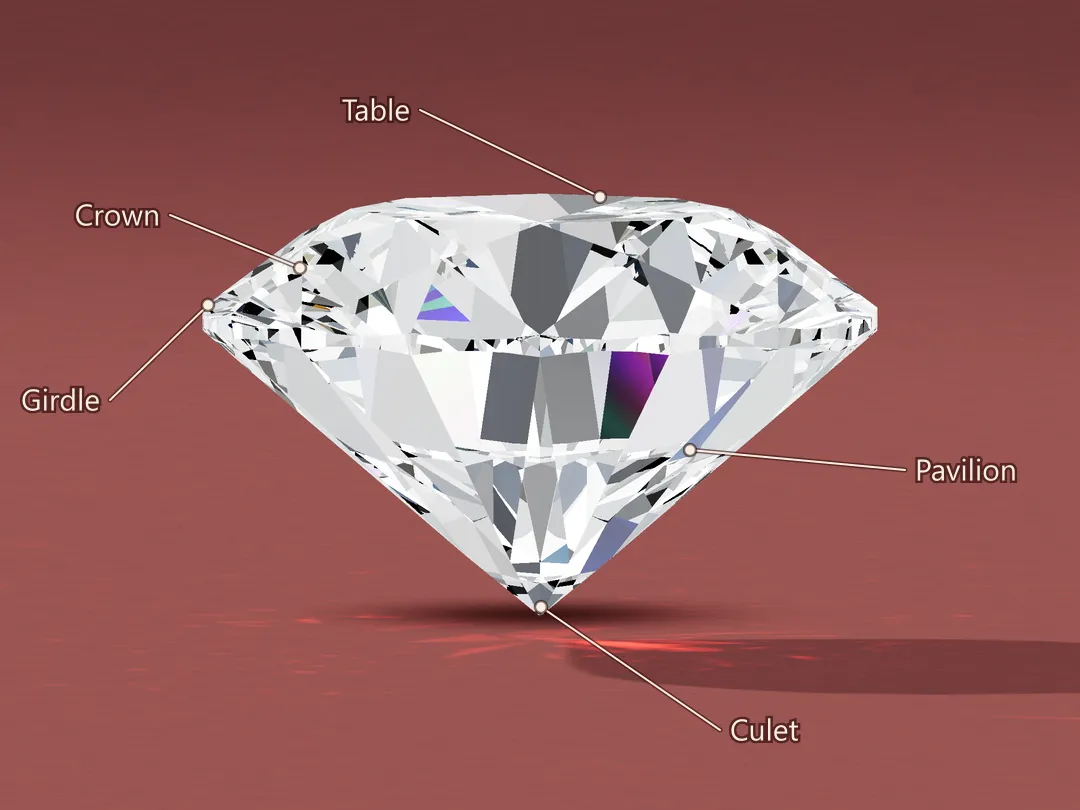
The girdle is the edge between a cut gemstone’s crown and pavilion. On a diamond it may be faceted, polished or bruted. Thickness matters for durability and weight distribution: a very thin area may be vulnerable to chipping, while an excessively thick girdle can retain weight without increasing the face-up dimensions.
The girdle belongs to the stone
The girdle runs around the boundary between crown and pavilion. It is separate from the ring’s metalwork. A prong or bezel meets the stone around this area, but the seat needs to fit the surrounding contour as well.
Read the full thickness description
Girdle thickness can vary around a diamond. A report may describe a range from thinner to thicker areas rather than one uniform band. A simplified side view identifies the location; it cannot show every variation or replace inspection of the individual stone.
Frequently asked questions
- Why does girdle thickness matter on a diamond?
- Very thin areas can be vulnerable to chipping, especially where the stone is exposed to impact. An excessively thick girdle can retain weight without increasing face-up dimensions. The significance depends on the stone’s shape, the location of those areas and the setting.
- What does it mean when a diamond has a faceted girdle?
- A faceted girdle has small flat facets cut along the band, giving it a polished, sparkly edge. A bruted girdle has a rougher frosted look. Both are normal; faceted girdles are more common in modern cuts.
- How does a setting contact the girdle?
- The setter fits the stone into a bearing or seat around its edge. Depending on the design, metal can contact adjacent crown and pavilion surfaces as well as the girdle. The fit should suit the stone’s contour rather than simply squeeze its edge.