
How big is a 1 carat diamond in mm?
A well-cut 1 carat round brilliant measures about 6.5mm across, which is close to the width of a standard pencil's hexagonal barrel. The same weight cut as an oval stretches to roughly 8.3mm long and 5.6mm wide, which is why elongated shapes are the usual pick for buyers who want the most visible size from the weight. One carat sits right on the worldwide average for engagement ring centre stones, so it reads as classic rather than small.
The face-up measurements for a well-cut 1 carat diamond by shape, using the same ratios as our 2 carat size guide:
| Shape | 1 carat size (mm) |
|---|---|
| Round brilliant | 6.4mm across |
| Oval (1.40 ratio) | 8.3mm x 5.6mm |
| Cushion (1.00 ratio) | 6.0mm x 6.0mm |
| Princess | 5.6mm x 5.6mm |
| Emerald cut (1.40 ratio) | 7.1mm x 5.2mm |
| Asscher (1.00 ratio) | 5.6mm x 5.6mm |
| Pear (1.50 ratio) | 8.7mm x 5.6mm |
| Marquise (2.00 ratio) | 10.3mm x 5.2mm |
| Radiant (1.10 ratio) | 6.3mm x 5.2mm |
Every value is approximate and assumes the listed length-to-width ratio and a well-proportioned cut. A deep-cut stone hides weight underneath and faces up smaller than the table says, which is one of the quiet ways a cheap stone disappoints. If you want to see the real size before you buy anything, draw a 6.4mm circle with a ruler; screens scale images unpredictably, so paper beats any photo.
Is 1 carat a size or a weight?
A weight. One carat is 200 milligrams, a fifth of a gram, and the carat weight tells you nothing on its own about how large a stone looks from above. Three things separate weight from the size you actually see:
- Face-up dimensions. The length and width in mm, which is what the table above shows. Two 1ct stones of the same shape can differ by several tenths of a millimetre depending on how they were cut.
- Visible area. The mm footprint the stone occupies on the finger. A 1ct marquise covers noticeably more finger than a 1ct princess because the weight is spread long and shallow rather than packed into a deep square.
- Spread of the cut. A stone cut deep for weight retention faces up small; a stone cut well faces up true. This is why we recommend judging stones by their measurements and cut quality, never by carat alone.
What does a 1 carat diamond look like on the hand?
Balanced. On most hands a 1 carat stone reads as clearly present without dominating the finger, which is exactly why it has been the classic engagement ring weight for decades.
On slimmer fingers (Australian sizes around J to L), a 1 carat round covers most of the visible width between the knuckle creases, and elongated shapes like the oval and the marquise run along the finger's line, so the stone looks larger than the same weight in a square outline. If you have long, slim fingers, 1 carat is comfortably in proportion.
On average to wider fingers (around N and up), the same stone reads more delicate, and buyers who want the stone to hold visual weight on the hand often either step up toward 1.5 carats or choose a spread-maximising shape. An oval, pear or radiant at 1 carat gives back most of the presence a round loses on a wider finger.
How does 1 carat compare with 2 carats?
Smaller than you would guess from the numbers. Doubling the weight does not double the size you see: a 2 carat round is about 8.1mm across against 6.4mm, which is roughly 27% wider and about 60% more face-up area, not twice as much. The diagram below shows both weights at one shared scale.
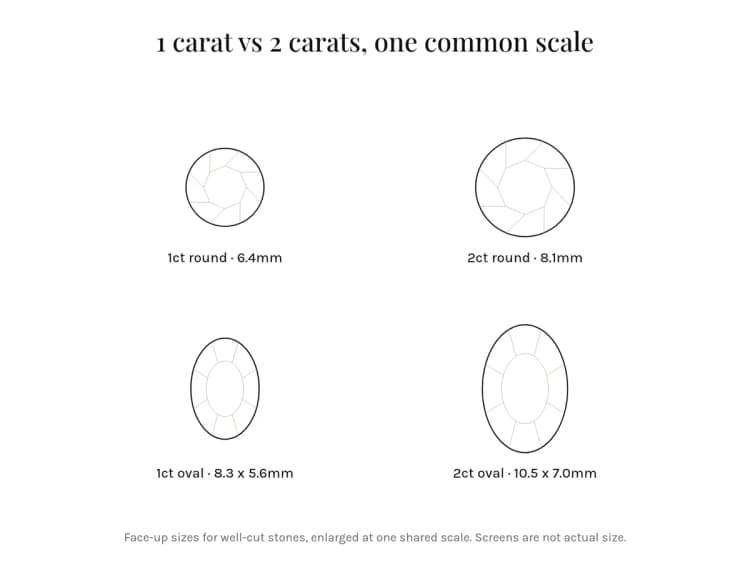
That gap is very visible on the hand, and it is also where the price curve gets steep, because larger rough is rarer and the price per carat rises with the weight. The full mm table for every shape at 1, 1.5, 2, 2.5 and 3 carats lives on our diamond carat size chart.
What setting suits a 1 carat diamond?
Almost anything, which is part of the appeal. A 1 carat stone is light enough that a four-prong setting holds it securely, and it does not need the reinforced shanks and six-prong heads we recommend once stones pass 1.5 carats.
A few pairings that consistently work across the engagement rings we make:
- Band width: 1.6mm to 2mm keeps a 1ct centre looking generous. A wide 2.5mm band next to a 6.4mm stone visually shrinks it.
- Solitaire: the default for a reason; a plain band puts the whole size budget into the stone.
- Hidden halo or pave: adds sparkle at the base without pretending the centre is bigger than it is.
- Halo: the honest size cheat. A thin halo can push the face-up footprint of a 1ct round toward what a 1.5ct reads as.
How much does a 1 carat diamond cost in Australia?
For lab-grown, less than most buyers expect. On our live stone feed on 12 July 2026, a 1ct oval lab-grown diamond in D colour and VVS1 clarity was $1,589 as a loose stone, and $3,149 as a complete ring in an 18k gold solitaire setting. Mined stones of the same grade typically run five to eight times the loose price. Prices move with the stone feed, so treat those numbers as a dated example rather than a quote.
The full breakdown of stone, setting and complete-ring pricing at this weight, with named specifications and checked dates, is in our 1 carat lab diamond price guide, and the same exercise runs one and two carats up in the 2 carat and 3 carat guides.
So how big is a 1 carat diamond?
About 6.5mm across as a round, up to 10.3mm long as a marquise, and right on the engagement ring average worldwide. It is large enough to read as a classic centre stone on any hand, and on slim fingers it looks genuinely substantial. If you are choosing between weights, judge the mm measurements and the cut before the carat number, and look at both sizes on your own hand before deciding.
Browse our lab-grown diamond engagement rings to see 1 carat designs in every shape, or talk to us about building around a specific stone.
Thanks for reading,
Jared and Brie
Designed by us in Melbourne, made to order
Lily Dia is a small studio, so every ring is drawn, set and finished for the person wearing it. If this article helped, the collection shows how these choices look on real rings, and you can ask us anything before you decide.
View lab-grown diamond ringsOr ask us a question first