Diamond Carat Size Chart: 1ct to 3ct in mm
Last updated 17 October 2026
Quick answer
Carat is weight, not a fixed size in millimetres. Compare the round example below, learn which measurements matter for each shape, and use a stone’s own dimensions for an approximate on-hand preview.
Carat size chart in mm
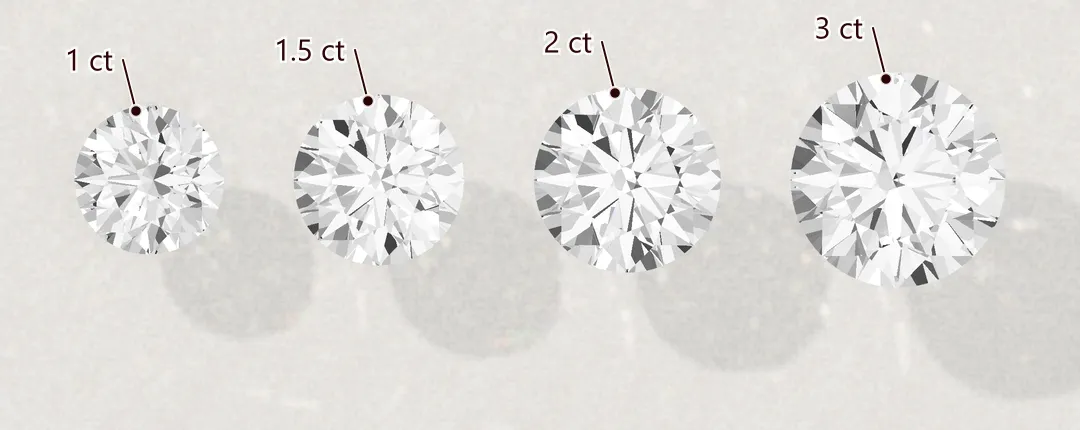
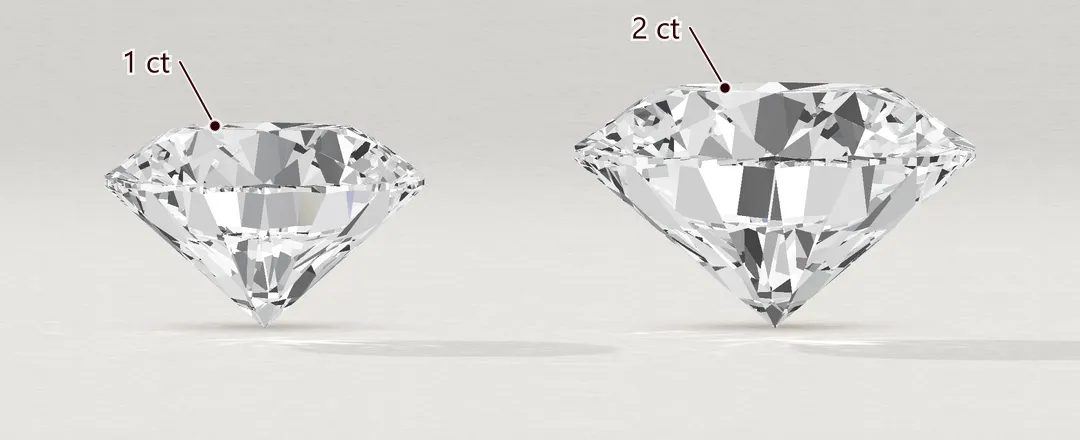
Carat measures weight, so it cannot be converted into one fixed diameter or length. The table below is a same-proportions round example. It shows how dimensions change when one shape is enlarged evenly; it is not a set of typical sizes or cut-quality targets.
GIA’s public sample report lists a 0.99 carat round brilliant with measurements of 6.40 to 6.43 × 3.94 mm. The first two numbers are the minimum and maximum diameters; the last is the depth. Our model uses the mean of the two diameters, (6.40 + 6.43) ÷ 2 = 6.415 mm, as its starting diameter. This mean is calculated from the report’s rounded measurements. It assumes unchanged density and geometrically similar stones, scaling every linear dimension, including depth, by the cube root of the weight ratio.
Every weight shown in this chart, including 1 carat, is a hypothetical scaled example. These are calculated dimensions, not additional diamonds measured by GIA. Diameters are rounded to 0.1 mm. A real stone can have different proportions, so check its own grading report.
| 1 ct | 1.5 ct | 2 ct | 2.5 ct | 3 ct |
|---|---|---|---|---|
| 6.4 mm | 7.4 mm | 8.1 mm | 8.7 mm | 9.3 mm |
What to compare for each shape
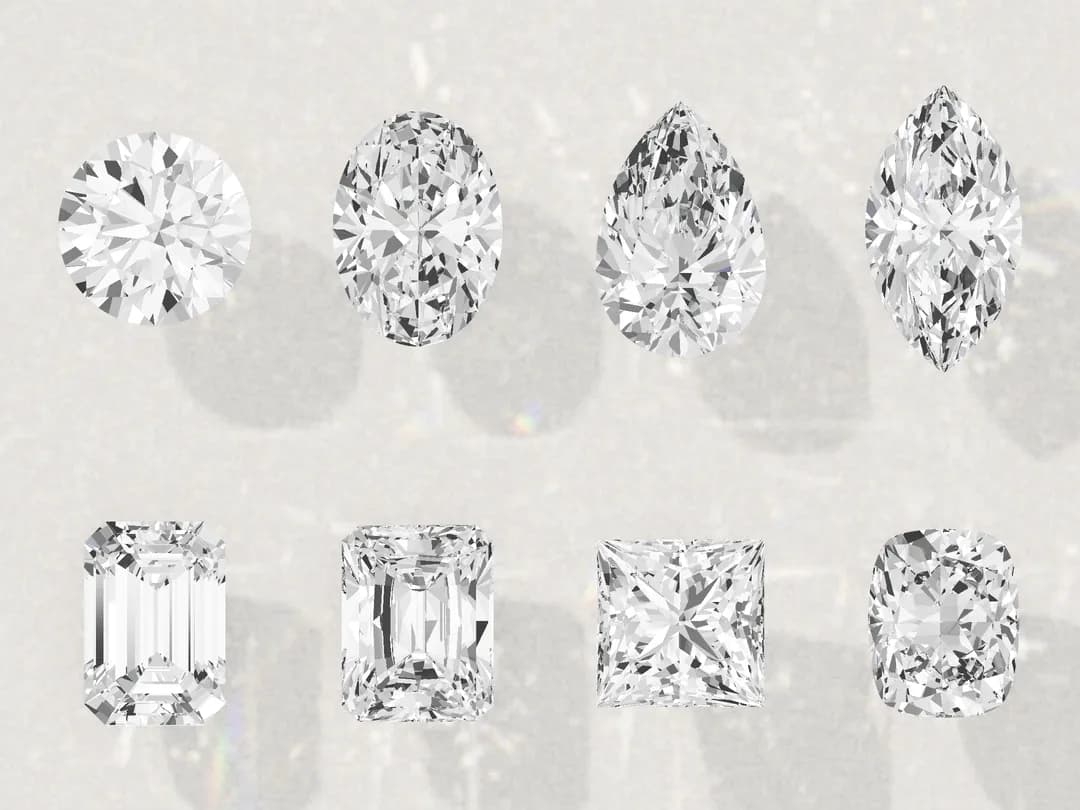
For fancy shapes, a report gives length, width and depth. Length divided by width gives the length-to-width ratio. Those numbers describe the dimensions; they do not by themselves establish a cut grade or the exact outline area.
| Shape | Measurements to compare | Reading the outline |
|---|---|---|
| Round brilliant | Minimum and maximum diameter, plus depth. | Use both diameter readings; an average is a useful summary, not a claim of a perfect circle. |
| Oval | Length, width and depth. | Compare the long and short directions separately. |
| Cushion | Length, width and depth. | Check whether the individual outline is near-square or elongated; do not assume equal sides. |
| Princess | Length, width and depth. | Record both face-up dimensions even when the outline looks square. |
| Emerald cut | Length, width and depth. | The clipped corners mean length multiplied by width is not the exact face-up area. |
| Asscher | Length, width and depth. | Check both dimensions rather than treating the shape name as a measurement. |
| Pear | Length, width and depth. | Include the point in the full length and compare the widest part across the outline. |
| Marquise | Length, width and depth. | Compare the full tip-to-tip length and the widest part across the outline. |
| Radiant | Length, width and depth. | Compare the individual dimensions; the name does not specify a length-to-width ratio. |
For example, dimensions of 10.5 × 7.0 mm give a ratio of 1.50. This arithmetic example does not assign a carat weight or a cut grade to those measurements. Two outlines can have the same length and width but different shoulders, corners or fullness.
Compare diamond size on your hand
Ring size is useful for fit, but it does not tell you the visible width of your finger from above. Dividing a diamond’s width by a ring’s inside diameter gives a ring-diameter ratio, not measured finger coverage.
For an on-hand preview, start with the individual diamond’s millimetre measurements. Place a roughly measured paper outline where the ring will sit and compare its length and width on your own hand. A flat outline shows only an approximate footprint; it cannot show setting height, the band or how the finished ring will feel.
Use our ring size chart for approximate size references, and confirm fit with suitable finger gauges. A ring-size conversion alone cannot predict how large a diamond will look.
Is 2 or 3 carats too big for my finger?
Neither weight alone decides whether a ring feels too large. Compare the actual diamond dimensions with the setting’s width and height, then try a similarly sized ring on the intended finger.
Check how it feels when you bend your fingers or put your hand in a pocket. A paper outline is a starting point for comparing a footprint; a fitted sample ring is more useful for judging height, comfort and everyday wear.
Round sizes at one scale
Check the size on paper
Use the measurements from the individual stone’s report rather than assuming that all diamonds at that weight share one size. Mark the dimensions with a millimetre ruler. A circle can approximate a round outline; for a fancy shape, a length-by-width rectangle marks its outer limits but does not reproduce the full silhouette. Hand drawing and cutting add error, so use this as a rough preview.
A screen image or screenshot is not reliably actual size. For any purpose-made printable, use 100% or Actual Size rather than Fit, then check that file’s own scale marks with a physical ruler on every printed page before using it.
Our ring size chart includes a printable ring sizer with its own scale checks. Checking that PDF does not calibrate this webpage, an image or another file. This page’s round comparison is a relative-size illustration, not a printable diamond-sizing template.
Why carat is not a size
One metric carat is 200 milligrams. The face-up outline is two-dimensional, while the diamond has volume and depth. Weight and visible size are related, but they are not interchangeable.
If density and the complete shape stay the same, doubling the weight increases every linear dimension by about 26% and the face-up area by about 59%. This is a geometric comparison: every dimension, including depth, is enlarged by the same factor. It does not predict the difference between two independently cut diamonds.
Shape, depth and other proportions can change the measurements at a given weight. A longer outline is not automatically wider or greater in face-up area, and dimensions alone do not establish how well a diamond is cut. Compare the report’s measurements alongside its other grading information.
Size guides by weight
- #01
How big is a 1 carat diamond?
The 1ct size in mm for every shape, on the hand and next to 2 carats at one scale.
- #02
How big is a 2 carat diamond?
The 2ct size in mm for every shape, measured on our own stones, and 2ct beside 1ct and 3ct.
- #03
Is a 3 carat diamond big?
The 3ct size in mm for every shape and how a stone that size wears day to day.
- #04
What diamond carat weight really means
Why carat is weight rather than size, and how cut changes what you see.
What each weight costs
Frequently asked questions
- Is carat a size or a weight?
- A weight. One metric carat is 200 milligrams. Millimetres describe the diamond’s dimensions. Compare the individual stone’s reported measurements as well as its carat weight.
- How many mm is a 1 carat diamond?
- There is no single measurement for every 1 carat diamond. The same-proportions round model on this page gives about 6.4 mm at 1 carat. That is a calculated illustration, not a standard size; another shape or different proportions can give different measurements.
- How many mm is a 2 carat diamond?
- The same-proportions round model on this page gives about 8.1 mm at 2 carats. This is an illustrative calculation, not a measurement that every 2 carat diamond should meet. Compare the actual diameter, or length and width, on the individual report.
- How many mm is a 3 carat diamond?
- The same-proportions round model on this page gives about 9.3 mm at 3 carats. It is a calculated example rather than a universal size. The dimensions of an individual 3 carat diamond depend on its shape and proportions.
- Why does doubling the carat not double the size?
- For diamonds with the same density and geometrically similar shapes, doubling the weight multiplies every linear dimension by the cube root of two: about 26% more width, length and depth. The face-up area increases by about 59%. Different proportions can change those comparisons.
- Are the sizes in this chart exact?
- No. The round chart contains modelled examples, rounded to 0.1 mm, using a public GIA sample report as its starting point. It is not a table of measured diamonds at each weight or typical dimensions for every cut. Use the individual stone’s report for its measurements, and check any physical-size printout with a ruler.
Sources and further reading
- GIA: Carat Weight
- NIST: Precious Metals Conversion Information
- GIA: How to Read a Diamond Grading Report
- GIA public sample report 2231120907
- GIA: Anatomy of a Round Brilliant
- GIA: Understanding Carat Weight
- GIA: Pear Shaped Diamond Guide
- GIA: Observations of Oval-, Pear-, and Marquise-Shaped Diamonds
- GIA: Accurate Determination of Finger and Ring Sizes
- Adobe: Adjust page size for printing
- W3C: CSS Values and Units, absolute lengths