What is proportion in diamond cutting?

By Jared James · Last updated 21 May 2026
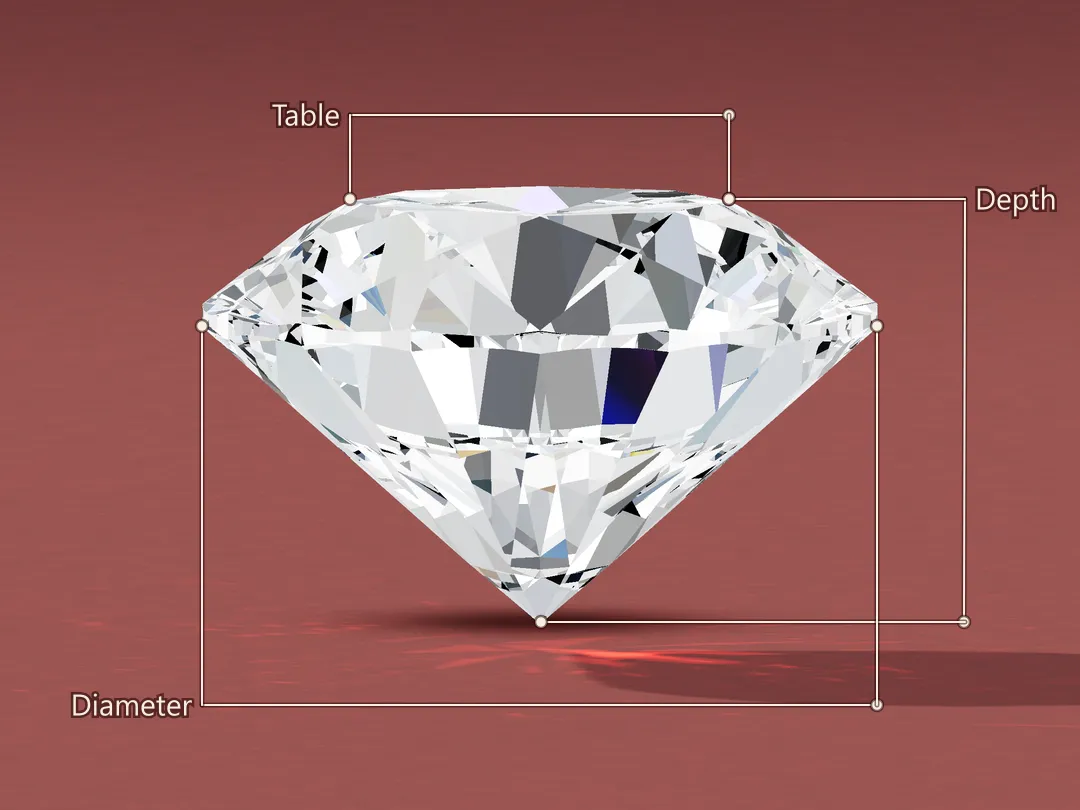
Proportion in diamond cutting refers to the precise relationship between a stone's dimensions, including its table size, crown height, pavilion depth and girdle thickness, which together determine how light behaves inside the stone. When these angles and percentages fall within ideal ranges, light entering the diamond reflects between the pavilion facets and exits through the top, creating maximum brilliance and fire. If the stone is cut too deep or too shallow, light leaks out the sides or bottom and the diamond looks dull or dark in the centre. Proportion is the most important factor in cut quality.
Frequently asked questions
- What are good proportions for a round brilliant cut diamond?
- For a round brilliant, gemologists look for a table percentage of roughly 54 to 60 percent, a total depth of 59 to 63 percent, and a pavilion angle of around 40.6 to 41 degrees. These measurements together produce excellent light return. GIA summarises this in its cut grade.
- How is proportion different from symmetry?
- Proportion refers to the overall dimensions and angles of the cut, while symmetry describes how precisely the facets are aligned and matched to each other. A stone can have ideal proportions but slightly off symmetry, and both affect the final appearance and grade.
- Does proportion matter for coloured gemstones?
- Yes, though the rules are less strict than for diamonds. For coloured stones, proportion affects both brilliance and colour saturation, since a deeper cut can intensify colour while a shallower cut may make the stone look pale. Cutters balance these factors for each individual gem.
Talk through proportion with us
Tell us what you have in mind, even if it is only a budget and a piece of jewellery type, and we will help you weigh up the options. We reply to every enquiry, usually within one business day.
Contact the studio