
What is depth percentage in a diamond?
Last updated 17 October 2026
For a round brilliant diamond, depth percentage is total depth divided by average girdle diameter, multiplied by 100. If a stone is 4.00 mm deep and averages 6.50 mm across, its depth is about 61.5%. This number describes a proportion; it does not by itself establish an ideal cut or good light performance.
Work through a round-diamond example
If the minimum and maximum girdle diameters are 6.45 mm and 6.55 mm, their average is 6.50 mm. Divide a 4.00 mm total depth by 6.50 mm, then multiply by 100: the result is about 61.5%. The figures are hypothetical and establish no cut grade.
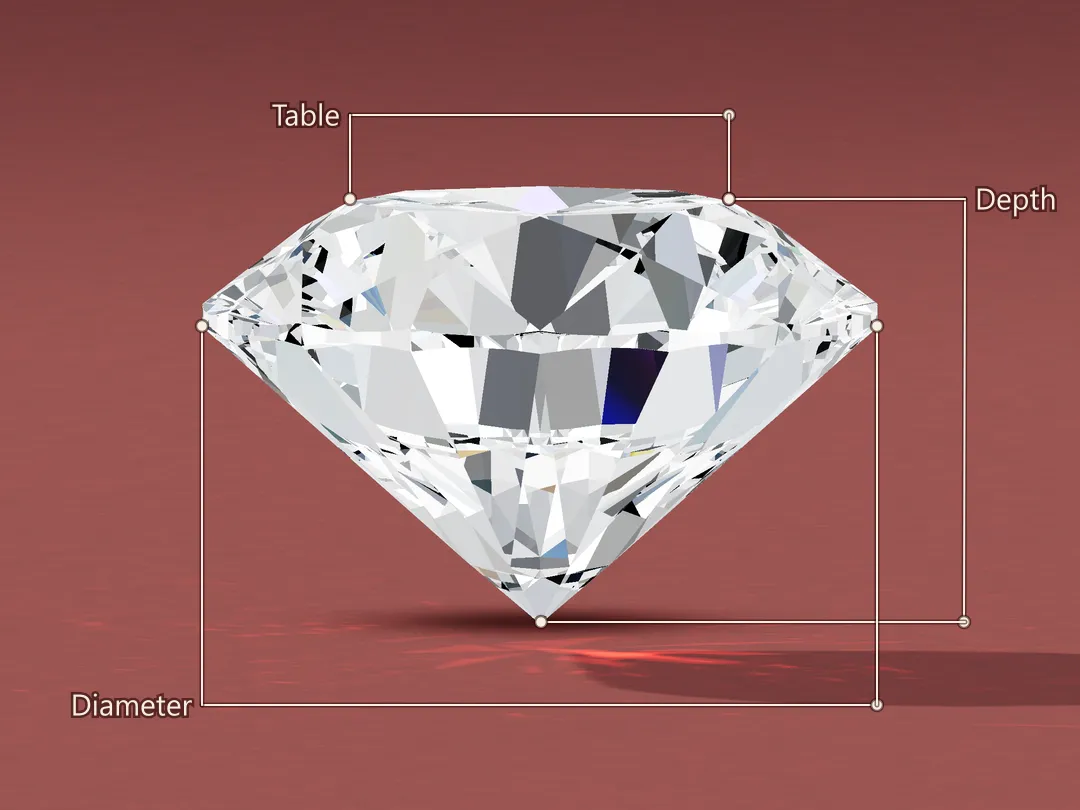
Keep the measurement convention with the number
A report’s displayed measurements are rounded. Recalculating from those displayed values may differ slightly from the reported percentage. For other shapes, check the laboratory’s measurement convention rather than treating average round diameter as a universal denominator.
Frequently asked questions
- What is the ideal depth percentage for a round brilliant diamond?
- No depth percentage alone establishes an ideal cut. It must be considered with crown, pavilion, table and other features. Even two diamonds with the same total depth percentage can have different proportions and appearances.
- Can I use the same depth rule for every shape?
- No. Fancy-shape measurements and facet arrangements differ. Use the report’s stated convention and assess the whole stone. A round-brilliant shortcut should not be treated as an oval, pear or emerald-cut grading rule.
- Where do I find a diamond's depth percentage?
- Look in the measurements or proportion information on the relevant laboratory report. The available fields differ by report service and shape, so not every report includes the same diagram or angles.