

What does carat mean for gold?
For gold, carat measures purity by weight in 24 parts. An 18ct alloy contains 75% gold, and a 9ct alloy contains 37.5%. The remaining metals influence colour and working properties. A higher carat means a higher proportion of gold in the alloy.
Diamond carat measures weight: 1 carat is exactly 0.2 grams. A gold purity label does not tell you the weight of a ring, and a diamond’s carat weight does not tell you the purity of its setting.
Carat vs karat: what is the difference?
For gold, carat and karat name the same purity measure. Karat is the usual American spelling, while carat is used in Australia and Britain. The abbreviations 18k and 18ct both describe 18 parts gold in 24. A spelling or stamp alone does not establish where a piece was made.
Gemstone weight is written carat. In a description such as “a 1 carat diamond in 18ct gold”, the first number gives the stone’s weight and the second gives the metal’s purity. The carat glossary definition explains gemstone weight.
Gold carat purity table: 9ct to 24ct
Carat uses 24 parts, while fineness uses 1,000. These common examples show how the labels relate, including the difference between calculating 14/24 and reading a 585 mark.
| Carat or standard | Gold content by weight | Example mark |
|---|---|---|
| 9ct | 37.5% | 375 |
| 10k | About 41.7% | 417 |
| 14k, calculated as 14/24 | About 58.3% | 14k |
| 585, a common 14k standard | 58.5% | 585 |
| 18ct | 75% | 750 |
| 22ct | About 91.7% | 916 |
| 24ct, fine-gold examples | 99.9% or 99.99% | 999 or 999.9 |
The 22ct calculation is about 91.7% gold; 916 is the customary mark for that standard. For fine gold, 999 means 99.9% and 999.9 means 99.99%. Check the stated fineness rather than assuming every 24ct description uses the same figure.
A number such as 750 identifies a stated gold fineness of 75%, but an isolated stamp is not the same as a complete assay-office hallmark. A mark or colour alone cannot authenticate an unfamiliar piece. If its composition matters, ask a qualified jeweller or assay service which assessment is appropriate.
Read any letters alongside the number. GP indicates gold plating; GF indicates gold filled, with a gold-alloy layer mechanically bonded over another metal. Gold filled and electroplated describe different construction methods. Neither description means that the whole piece has the stated gold purity throughout. Our home gold-testing guide explains common checks and their limits.
Is higher carat gold better?
Higher carat gives a greater gold proportion, while colour and wear depend on the complete alloy and how the piece is made. Pure gold is relatively soft, but 24ct jewellery exists, including hard-gold products made using specialised processes. Its suitability for a particular design needs the maker’s specifications.
14k and 18ct can both be used for everyday rings. Supplier data show overlapping hardness values, so 14k is not always harder and its label does not promise longer-lasting polish. Compare the actual alloy, finish and construction in 14k vs 18k gold, or explore carat and colour together in types of gold.
9ct contains 37.5% gold, and its remaining metals can produce different colours and working properties. It is not automatically the hardest or palest option. The 9ct label gives the gold proportion; the alloy and finished design need their own assessment.
What does carat mean on a gold ring with a diamond?
Both meanings at once, and this is where the confusion peaks. A listing that reads "1 carat diamond ring in 18ct gold" is using the word twice for two different measurements: the diamond weighs 1 carat (0.2 grams), and the band is 18 parts per 24 pure gold. The stone number is a weight. The metal number is a purity.
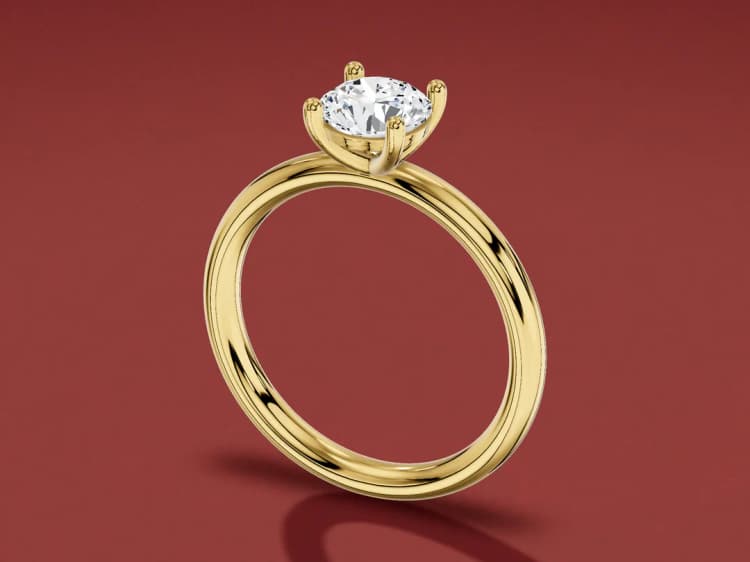
“1 carat gold ring” needs more detail: it could refer to a one-carat gemstone set in gold, while a literal 1-karat purity calculation would be 1/24, about 4.2% gold. Ask which measurement is meant and read the stone weight and metal specification separately. How much does a carat weigh? explains the gemstone measurement.
Does carat change the price of gold?
Gold content is one factor in a jewellery price. For the same weight of alloy, 18ct contains twice as much gold as 9ct: 10 grams of 18ct alloy contains 7.5 grams of gold, while 10 grams of 9ct alloy contains 3.75 grams.
That calculation describes the gold in the alloy. To understand the full price difference between finished rings, compare current quotes for the same design, stone and dimensions, with the metal specification stated.
The short version
Gold carat describes purity in 24 parts. 18ct is 75% gold and 9ct is 37.5%; 14/24 is about 58.3%, while the common 585 standard means 58.5%. Karat is the American spelling for gold purity. Diamond carat measures weight, with 1 carat equal to 0.2 grams. Read the metal specification and stone weight separately.
Browse our engagement rings and lab-grown diamond engagement rings to compare designs and their listed metal options. Check the current specification for the design you are considering.
Sources
- Perth Mint: gold carat and purity
- World Gold Council: gold purity and fineness
- UK Assay Offices: hallmarking guidance
- Stuller: alloy composition and hardness
- Santa Fe Symposium: gold-alloy metallurgy
- World Gold Council: 24k hard-gold jewellery
- GIA: gold-plated gold and testing limits
- FTC Jewellery Guides: gold-content descriptions
- GIA: diamond carat weight
Designed by us in Melbourne, made to order
Lily Dia is a small studio, so every ring is drawn, set and finished for the person wearing it. If this article helped, the collection shows how these choices look on real rings, and you can ask us anything before you decide.
View lab-grown diamond ringsOr ask us a question first