

What is a curved wedding band?
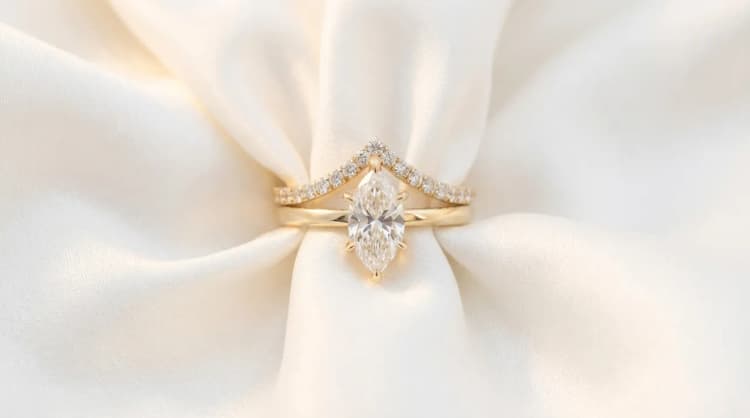
A curved wedding band has a shaped edge that follows the outline of an engagement ring. It is made to sit around a low basket, halo, bezel or group of side stones that would stop a straight band from moving close to the engagement ring. You may also see it called a contour band, shadow band, fitted band or tracer band.
The names overlap, but the fit matters more than the label. A shallow curve can clear a solitaire basket. A deeper V or U shape may be needed for a halo or a long centre stone. A notched band uses a small cut-out instead of a visible sweep, while an open band leaves a deliberate gap between two ends.
Which wedding band fits each engagement ring style?
Start with the engagement ring from the side. The lowest part of its setting decides whether a straight band can pass underneath it.
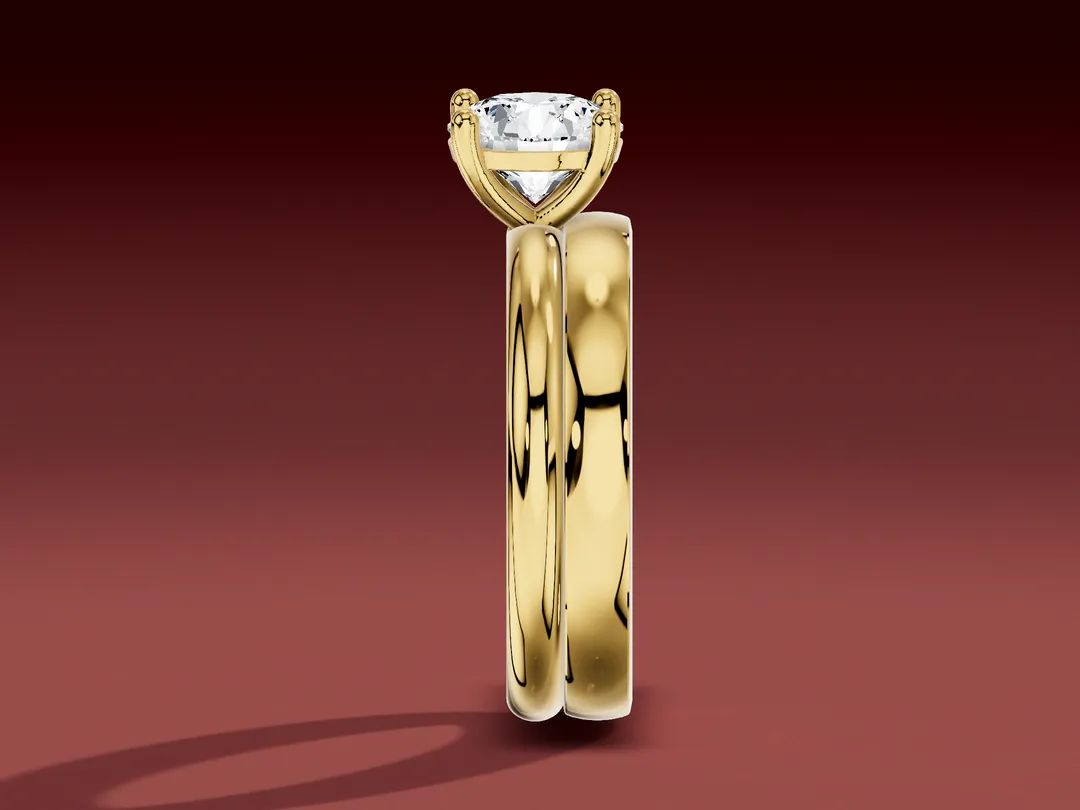
High-set solitaire. A straight wedding band often sits flush because its top edge can slide under the basket. If the basket drops below the band line, a shallow contour or small notch is usually enough.
Low-set solitaire or bezel. These settings put more metal close to the finger. A fitted curve normally works better than trying to force a straight band against the basket.
Halo or hidden halo. A halo can project past the engagement ring band, and a hidden halo can still sit low enough to block a straight wedding band. Match the curve to the widest part of the setting rather than the centre stone alone.
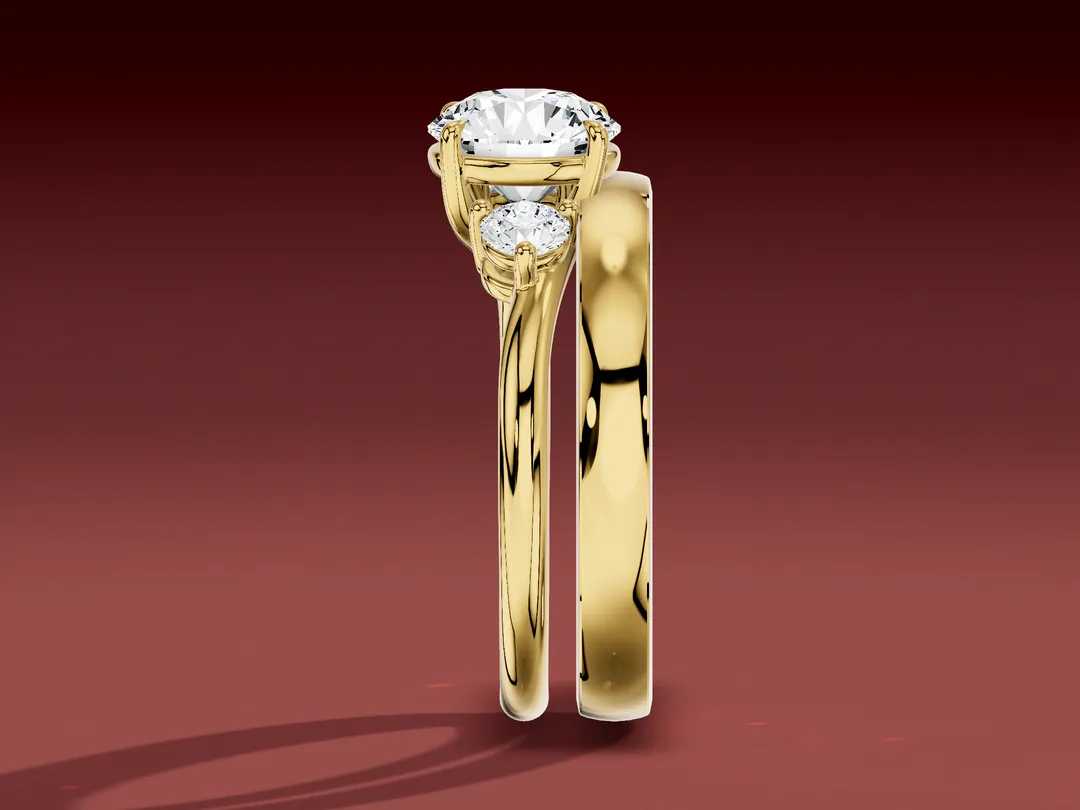
Three-stone ring. Side stones often create a wider obstruction than a solitaire basket. A broader, gentler curve usually looks more balanced than a narrow V. See the three-stone guide for the main setting profiles.
Marquise, pear or oval centre. The point or long axis can make a symmetrical curve look too deep. A custom contour can follow the actual basket while keeping the visible part of the wedding band calm.
Can you have a curved wedding band made for a ring you already own?
Yes. A custom curved band is modelled against the engagement ring you already have, so the curve follows its actual basket, halo or side stones rather than a generic shape for the stone. It works whether the engagement ring came from the same jeweller or from somewhere else.
This is how a fitted band is usually made:
- Share the engagement ring. Send clear photographs from above and from the side, with the ring size and the width and height of the band. If the jeweller made the engagement ring, they may already have its CAD file.
- Model the band in CAD. The wedding band is drawn against the engagement ring's profile, so the clearance around the basket or halo can be checked before anything is made.
- Approve the design. Check the render from above and from the side, and choose the metal, width and any stones.
- Make the band by hand. The band is cast, shaped, set and polished, then checked against the engagement ring's measurements.
Match the metal to the engagement ring where you can. Two rings worn side by side rub against each other, so the same metal keeps the colour consistent and the wear even. For a ring you already own, we make custom wedding bands to fit it, in 14k or 18k gold or platinum, in 4 to 6 weeks from design approval.
Contour band vs shadow band vs tracer band
Contour band is the broadest description. It simply means the band follows a shape. Shadow band often describes a close-fitting curved band that visually traces the engagement ring, and tracer band is commonly used for a band made to the exact profile of a particular ring.
In practice, jewellers use the terms interchangeably. Ask to see the ring pair from above and from the side, and confirm whether the band is made for your exact setting or for a general shape.
Should a curved wedding band sit completely flush?
It can, but it does not have to. A small, even space can look intentional and may protect raised details from rubbing. The problem is an uneven gap, pinching, or two metal edges grinding against each other.
If the band rocks, catches or pushes the engagement ring sideways, the curve is wrong. If both rings sit comfortably and the space is even, the choice is visual. The separate sit-flush guide covers spacers, soldering and setting changes when the issue is mechanical rather than a band-selection question.
Can you wear a curved wedding band on its own?
Yes, although a deep contour looks more obviously shaped when the engagement ring is absent. A shallow curve or open band can read as a deliberate standalone design. If you expect to wear the wedding band alone often, try it that way before ordering.
A custom tracer gives the closest fit but is also the most specific to one engagement ring. If the engagement ring is later reset, the original wedding band may no longer match.
How to choose the curve before ordering
Try the bands on the correct finger with the engagement ring. Check the pair while your hand is open and while making a loose fist, because rings shift on a moving hand.
Look for:
- enough clearance around the basket, halo or side stones
- an even space on both sides
- no sharp contact point where the rings can rub
- a curve that still looks intentional if worn alone
- similar height and visual weight across both bands
For an online or custom order, provide side and top photographs plus the engagement ring's measurements or CAD. A generic curve based only on stone shape cannot account for basket depth, band height or side-stone spread.
Browse engagement ring settings first if you are choosing both rings together. Designing the stack as a pair gives you more control over the gap than trying to solve it after the engagement ring is finished.
Designed by us in Melbourne, made to order
Lily Dia is a small studio, so every ring is drawn, set and finished for the person wearing it. If this article helped, the collection shows how these choices look on real rings, and you can ask us anything before you decide.
Design your wedding bandOr ask us a question first