
What is the difference between an emerald cut and a radiant cut?
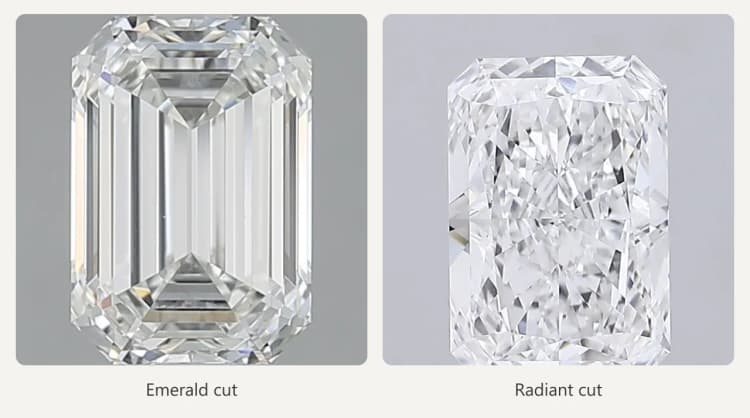
The facets are the difference. Both stones share the same outline, a rectangle with clipped corners, but an emerald cut is a step cut, with long parallel facets running down the stone like the rungs of a ladder, while a radiant cut is faceted like a brilliant, with dozens of small triangular and kite-shaped facets packed across its face. Across a room the two look much the same, and up close they handle light differently.
The radiant was designed in 1977 to give the emerald outline the brightness of a round brilliant, and that is still the choice you are making between them: open, calm step facets, or sparkle in the same shape.
Which sparkles more, emerald or radiant cut?
The radiant, by a long way. Its brilliant facets break light into lots of small, fast flashes, the same scintillation you see in an oval or a round, while an emerald cut's long step facets return light in broad planes that slide across the stone as your hand moves. Some people call that the hall of mirrors effect, and it is the whole character of the cut, clean and a little architectural.
Radiants vary more than emerald cuts do. Some show a crisp, even sparkle, others show a softer crushed ice texture where the facets blur into glitter, and a poorly cut radiant can look dark or flat through the middle. None of that shows up on a grading report, so look at a video of the exact stone before you choose, and every stone in our builder has a 360 video.
Which looks bigger, emerald or radiant cut?
At the same carat weight, the radiant measures slightly larger in the diamonds we source. We compared the median measurements of every lab-grown emerald and radiant in our builder on 28 September 2026, taking 1.00 to 1.09 carats as 1 carat, and so on:
| Carat | Emerald cut | Radiant cut |
|---|---|---|
| 1 carat | 6.9 x 4.8 mm | 7.1 x 5.1 mm |
| 2 carat | 8.6 x 6.0 mm | 8.8 x 6.4 mm |
| 3 carat | 9.9 x 6.8 mm | 10.3 x 7.0 mm |
The gap is a few tenths of a millimetre, which you will struggle to see on the hand, and the radiant's sparkle tends to make it read a little bigger again. If face-up size for your budget matters most, the radiant has a small edge, although it is small enough that the look you prefer should decide it.
Is a radiant cut more expensive than an emerald cut?
As a loose stone, a little. Among the same lab-grown diamonds, the median radiant cost 6% more than the median emerald at 1 carat, 8% more at 2 carats and 15% more at 3 carats. In our fixed-price complete rings the difference mostly disappears, because each ring is priced from the particular stone we select for it, and at 2 carats the radiant rings start lower.
| Carat | Emerald stone, median | Radiant stone, median | Emerald ring, from | Radiant ring, from |
|---|---|---|---|---|
| 1 carat | $1,253 | $1,328 | $2,950 | $3,000 |
| 2 carat | $2,492 | $2,679 | $4,600 | $4,250 |
| 3 carat | $3,636 | $4,192 | $6,900 | $7,050 |
The stone prices cover every lab-grown emerald and radiant in our builder, all D to F colour, VS1 clarity or better and graded by IGI, in Australian dollars on 28 September 2026. The ring prices are the starting prices of our 1 carat, 2 carat and 3 carat collections in 18k gold, each with an E to F, VVS1 centre diamond graded by IGI.
What clarity and colour do you need for each?
An emerald cut asks for more. Its open facets work like a window into the stone, so an inclusion under the table or a hint of warmth in the body shows up far more than it would in a brilliant cut, and VS1 or VS2 clarity with G colour or better is a sensible floor in white gold or platinum. A radiant's busier facet pattern hides small inclusions and a little colour, so VS2 and H is a comfortable place to start.
With us, both are covered already. Every lab-grown diamond we source in either shape is D to F colour and VS1 or better, graded by IGI, and the emerald cut is the shape that makes the most of those grades, because it shows so much of the inside of the stone. Our diamond clarity guide explains the grades if you are comparing stones elsewhere.
Is an elongated radiant the same as an emerald cut?
In outline it can be very close. Radiants come square, around a 1.00 to 1.05 length-to-width ratio, or elongated, and almost all the radiants we source are elongated, with most sitting between 1.34 and 1.50, against 1.39 to 1.53 for our emerald cuts. Side by side at the same weight the outlines are nearly identical, so the choice comes down to the facets and how you want the stone to catch the light.
How does each look on the finger?
At these ratios both lengthen the finger, and they read differently once you wear them. An emerald cut looks polished and quiet, with the long lines of its facets running along the finger, and it suits minimalist and Art Deco rings where the geometry is the point. A radiant looks brighter and more modern, geometric in shape but lively in the light, and in feel it sits between an emerald cut and a princess cut.
Which is more durable?
Both are good for daily wear. The clipped corners that define both shapes protect them from the chipping you would worry about on a sharp-cornered princess cut, although the corners are still the weakest point on either stone, which is why most settings put a prong over each one. A bezel setting wraps the whole edge in metal if you want more protection, and we make one in each shape.
What about moissanite?
The facets matter even more. Moissanite has about 2.4 times the rainbow fire of a diamond, and an emerald cut's long, open facets show that fire as broad flashes of colour. A crushed ice radiant breaks the same fire into small flashes, which is why it is one of the cuts that looks closest to a diamond, and our guide to the best cut for moissanite goes through the other shapes. We offer both shapes in moissanite as well as lab-grown diamond.
Which settings suit each?
Most of our designs come in both shapes, so you can compare them like for like.
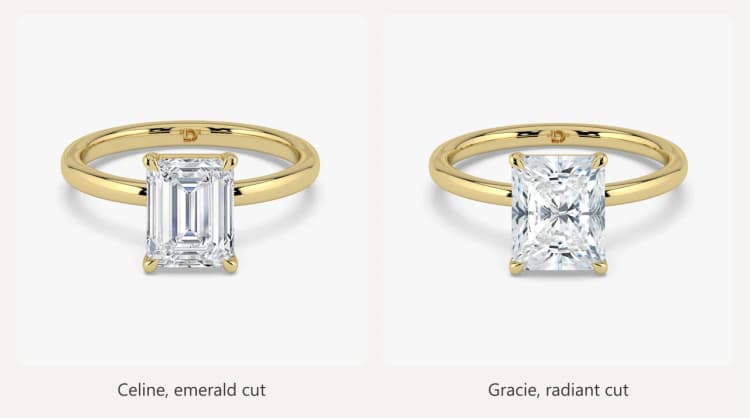
- Solitaire: Celine and Gracie, the simplest way to see the difference in the stone itself.
- East-west: Edyn and Billie, which turn the stone across the finger.
- Bezel: Karlie and Zendaya, with a smooth rim of metal around the stone.
- Hidden halo: Ivy and Zarah, with small diamonds tucked beneath the centre stone.
- Pavé band: Poppy and Bonnie, with small diamonds set three quarters of the way around the band.
- Three stone: Juniper and Cara in emerald, and Viola in radiant.
So, emerald or radiant cut?
Choose the emerald cut if you want clean lines and broad, slow flashes of light, and you would rather the stone read calm than bright. Choose the radiant if you want the same outline with the sparkle of an oval or a round and a touch more size for the weight, knowing the loose stone costs slightly more.
The quickest way to decide is to see both in the same setting. View our emerald cut engagement rings and radiant engagement rings, or design your own ring and compare stones in both shapes. If you are still torn, contact us and we'll help you compare real stones side by side.
Thanks for reading,
Jared and Brie
Designed by us in Melbourne, made to order
Lily Dia is a small studio, so every ring is drawn, set and finished for the person wearing it. If this article helped, the collection shows how these choices look on real rings, and you can ask us anything before you decide.
View lab-grown diamond ringsOr ask us a question first